
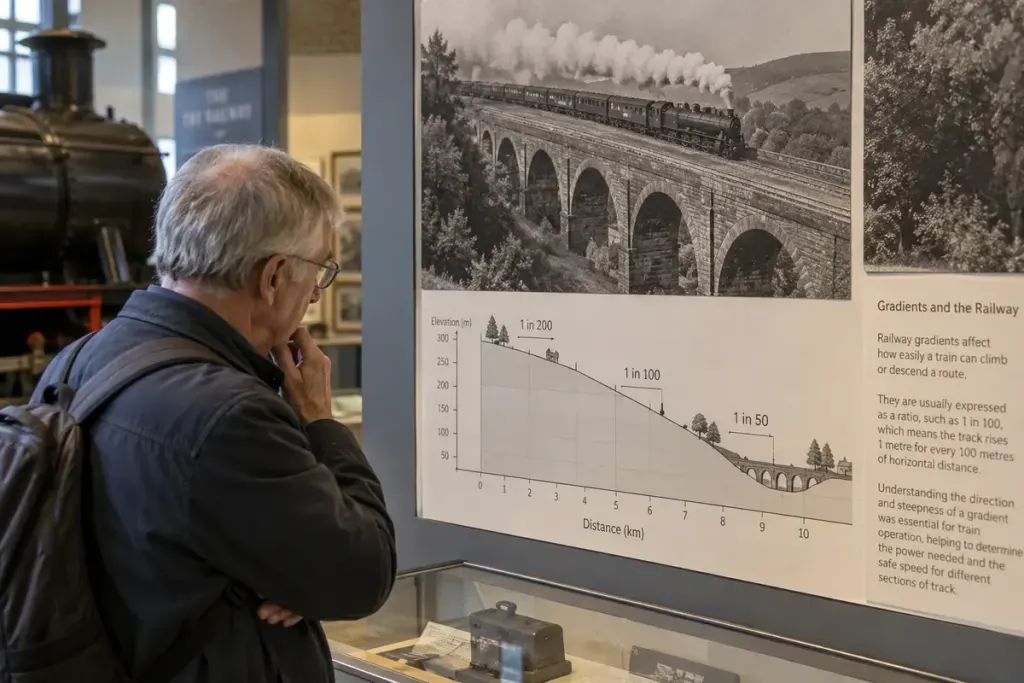
A railway profile can make a mountain crossing look like a wall. That impression may come partly from the drawing’s vertical scale. Before using a profile to explain the demands of a Montana route, read its labels as carefully as its peaks.
Begin with the endpoints and direction. A gradient that climbs when read from left to right descends in the opposite direction. An account of a westbound train cannot be compared casually with a profile described eastbound without checking which way the line is being read.
Translate the notation
A gradient of one percent means a vertical change of one unit for every hundred horizontal units. In a simplified example, a rise of ten feet over a horizontal distance of one thousand feet is one percent. This is an explanation of the calculation, not a measurement of a particular railway.
Some documents use ratios or other conventions. Identify the units and the meaning of any plus or minus signs before converting them. Also distinguish the steepest short section from the average climb between two towns; averaging can hide the part that mattered operationally.
Check how the drawing was made
Compare the horizontal and vertical scales. If elevation is exaggerated, the line’s apparent angle on the page is not the slope a train encountered. Note the survey date, route revision and whether the document describes an intended alignment or the line actually built.
A profile alone cannot tell you the exact locomotive requirement, speed or load. Curves, train weight, equipment, operating rules and conditions also matter. Use timetables, engineering records and contemporary operating accounts to investigate those questions rather than deriving them from a dramatic-looking slope.
In your research notes, preserve the document title, repository reference, date, direction and scale. Then write a limited finding: “The profile records a rising section in this direction.” That statement is stronger than a colourful claim about an engine’s struggle that the source does not establish.