
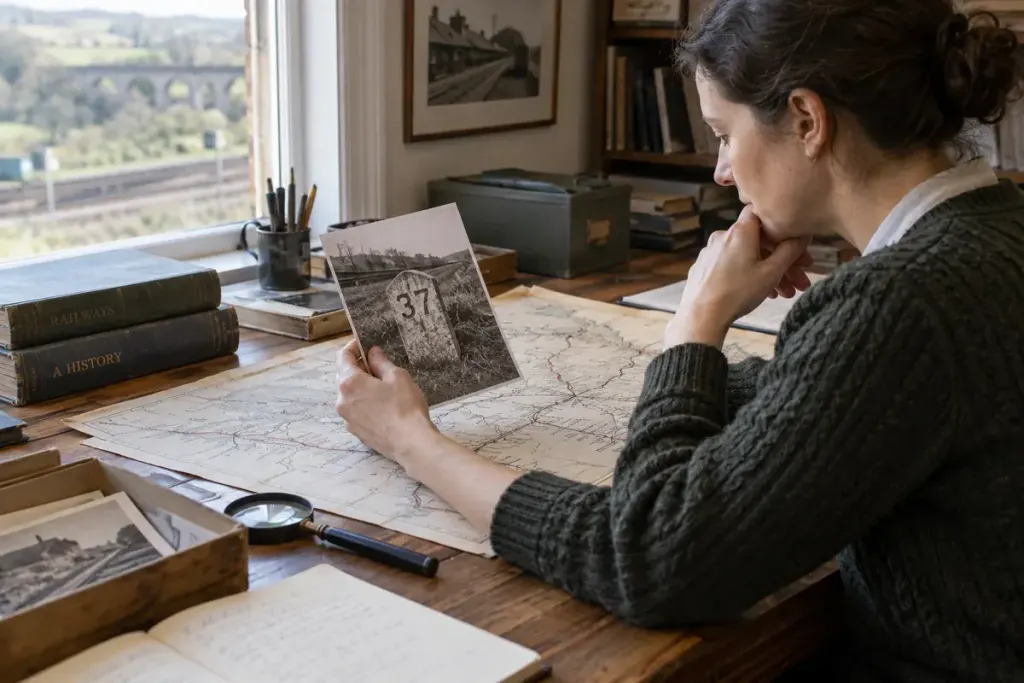
A photograph labelled “milepost 42” sounds precise, but the number is incomplete without its reference system. Forty-two miles from where, along which route, and at what date? A town’s present-day distance from the location may have little to do with the railway’s recorded mileage.
Begin with the source that uses the number. Record the railway or division, the line name, and the date. A timetable, track chart, or engineering document may identify the mileage origin and show how locations were numbered along that particular route.
Keep route distance separate from map distance
A railway follows its alignment, including curves and detours. A straight line measured between two points on a modern map is a different quantity. Do not use that straight-line measurement to dismiss a historical mileage entry as an error.
Changes to a route can complicate interpretation. A realignment, branch connection, or revised operating arrangement may affect the relationship between recorded mileage and the physical line. Establish what the relevant document says rather than assuming every later marker continues an earlier system unchanged.
Build a location from several references
Compare the milepost with nearby named stations, bridges, junctions, or other features recorded in the same period. A sequence of matching references is stronger than one number that happens to fit an approximate distance.
For a research note, use separate fields for quoted location, source date, proposed modern location, and uncertainty. Preserve the original wording even after you identify the place. Future evidence may change the interpretation without changing what the historical record actually said.
Use archive material, authorised museum displays, and safe public viewpoints. Do not enter railway property to search for a marker. The number becomes useful historical evidence when it is tied to a documented route and origin, rather than treated as a self-explanatory coordinate.