
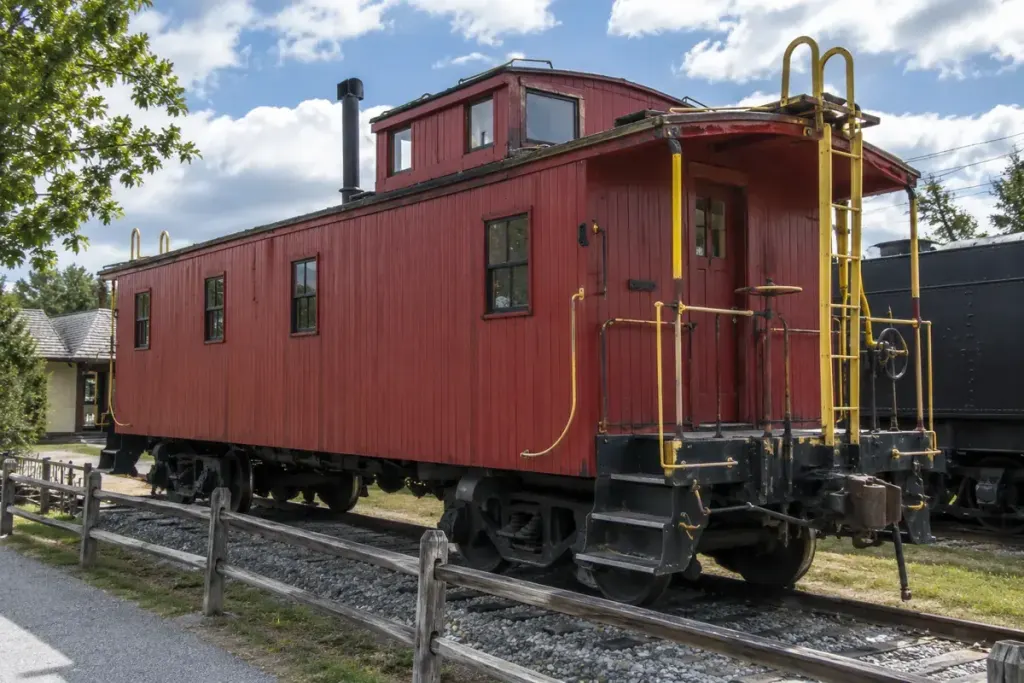
A small carriage at the back of a freight train can attract more attention than several wagons in front of it. The caboose is easy to recognise as a railway symbol, but its interior invites a more interesting question: what work had to happen here?
Begin with the particular vehicle in front of you. A restored museum example represents a railway, a period and a history of alterations, not every caboose that ever ran.
Read the label before naming the feature
Record the railway, vehicle number, builder or construction date when provided, and the period represented by the display. Ask whether the fittings are original, restored or installed to illustrate a later working arrangement.
At Steamtown, the National Park Service’s Life in a Caboose programme uses a Rutland Railroad caboose to explore how the vehicle was used and what life inside it involved. That is a useful model for a museum visit: connect the object to the people using it.
Turn the interior into questions
Look at seats, windows, storage, writing surfaces and any heating or cooking equipment that is actually present. Ask which duties each feature supported. Do not assume that an item you recognise had exactly the same purpose as its domestic equivalent.
If the vehicle has an elevated lookout or projecting side windows, ask how that arrangement helped the crew observe the train. A guide or collection record may explain the design more reliably than a general caption on a souvenir.
Make a simple sketch with three labelled features and one unanswered question. It encourages you to notice how people moved through the space without photographing every surface. Respect barriers and access rules; a preserved vehicle is not an invitation to climb onto fittings.
Keep comparison specific
When visiting another railway collection, compare one feature at a time. Different arrangements may reflect a different railway’s practice, an era, a rebuild or the museum’s restoration choices. Ask before turning a visible difference into a sweeping historical claim.
The most memorable detail may be a modest desk or awkward passageway. It shifts the caboose from a colourful object at the end of a train into a workplace whose design shaped an ordinary working day.