
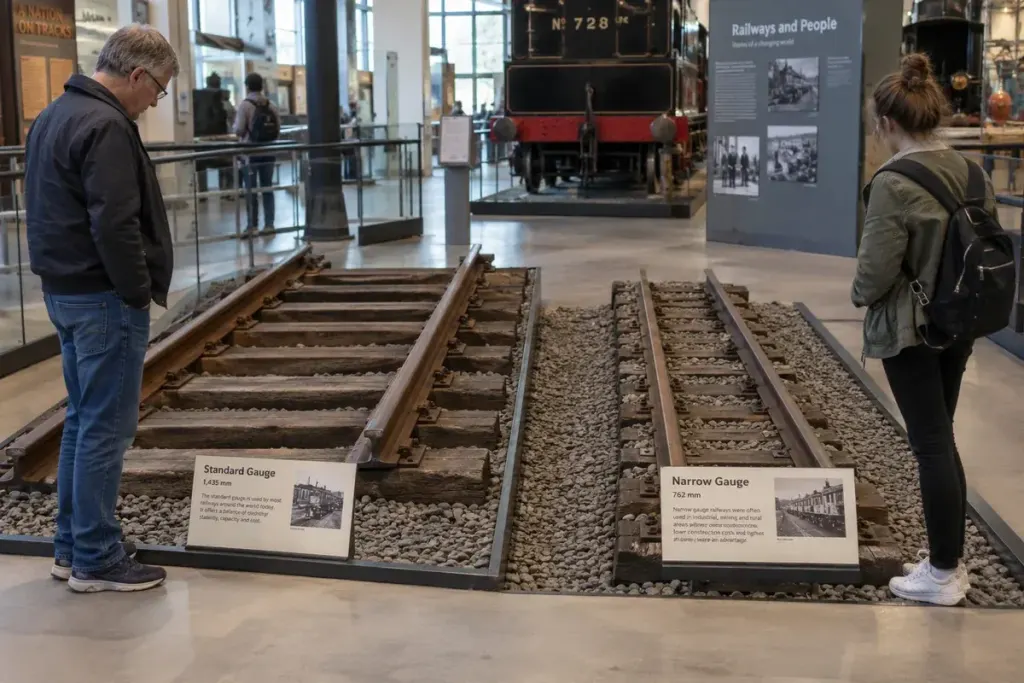
Two railway lines can meet on a map without allowing the same train to continue along both. The missing detail is gauge: the distance between the inside faces of the rails. It is a small measurement with consequences for an entire transport system.
When looking at a historic railway photograph, ask more than whether the locomotive seems small. Look for the relationship between the rails, sleepers, loading facilities and nearby connecting tracks. A picture can suggest a question, but a dated engineering drawing or railway record is stronger evidence for the answer.
The cheaper route could create a costly connection
Narrow-gauge construction could offer advantages where money, terrain and expected traffic constrained a project. The National Park Service documentation of the Denver and Rio Grande provides a historical example of gauge decisions in a mountain railway setting. That example should not be treated as proof that every narrow-gauge railway was built for the same reason.
The connection matters because wheels must match the track arrangement. If two neighbouring systems use incompatible gauges, freight may need transferring between wagons or another specially designed solution. A saving during construction can therefore be accompanied by additional handling later. Imagine a load arriving quickly at a junction and then waiting while people unload and reload it: the railway journey is only one part of the movement.
Read the junction, not just the locomotive
- Find out which companies operated the connecting routes at the date of the photograph.
- Look for platforms, sheds or lifting equipment between tracks.
- Check whether the source describes a transfer facility, conversion project or shared track.
- Keep the photograph date separate from the date when the route first opened.
These questions also prevent a common mistake: assuming that the track visible today preserves the original arrangement. Routes can be rebuilt, relaid or absorbed into another system. Museum track can include equipment moved from somewhere else.
For a useful research note, record the location, date, stated gauge and source together. Add what remains uncertain rather than filling the gap with an attractive explanation. Railway gauge becomes much more interesting when it explains how people connected places, moved goods and dealt with the limitations of decisions made years earlier.