
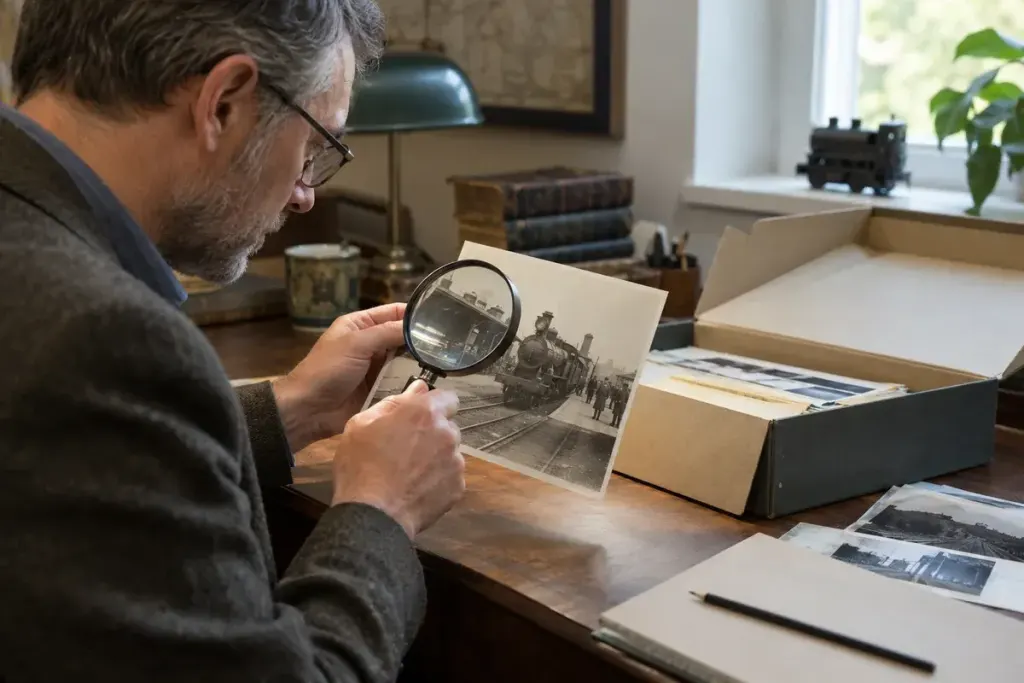
A locomotive appears beside a station platform. The website says 1910, a handwritten caption says 1907 and the image file was uploaded last year. Which date belongs in your notes?
Possibly more than one. A photograph has a history as an image and as a physical object. The exposure, later print, publication and digital reproduction may all have different dates, and a catalogue may give only an estimated range.
Read the catalogue field, not just the search result
The Library of Congress explanation of panoramic photograph records describes how dates, devised titles and reproduction information are recorded. It notes that dates can be estimated and that the image being catalogued is not necessarily the same thing as the historical period depicted.
Open the full record and copy its identifier alongside the wording of the date. Preserve brackets, question marks and ranges in your working notes. Changing “between 1900 and 1910” to “1905” creates precision the source did not provide.
Use visible clues to ask questions
A locomotive number, company emblem, platform canopy or advertisement can help narrow a period. However, a preserved locomotive photographed much later may look like evidence of its original working era. Clothing and surrounding buildings deserve attention as well as the engine.
Build a small evidence table: visible feature, possible implication and source needed to check it. A known station rebuilding date might establish a boundary, but only if you have correctly identified both the station and the feature.
Keep the caption’s history separate
A handwritten note may have been added by someone who was not present when the photograph was taken. A later publication can repeat that note, giving an uncertain date the appearance of independent confirmation.
Where possible, trace whether several websites use the same archive image. Three copies of one caption are not three separate pieces of evidence. Record the earliest accessible source and any stated provenance, while leaving unanswered questions visible.
Write a caption that can survive revision
A careful description might say, “Station platform, archive dated approximately to the early twentieth century; exact year unconfirmed.” You can add a hypothesis about a locomotive’s service period without presenting it as the date of the exposure.
Also check reproduction rights before publishing the image. Historical interest does not automatically remove copyright or access conditions. Good railway research lets readers follow both the line on the map and the evidence behind the photograph.