
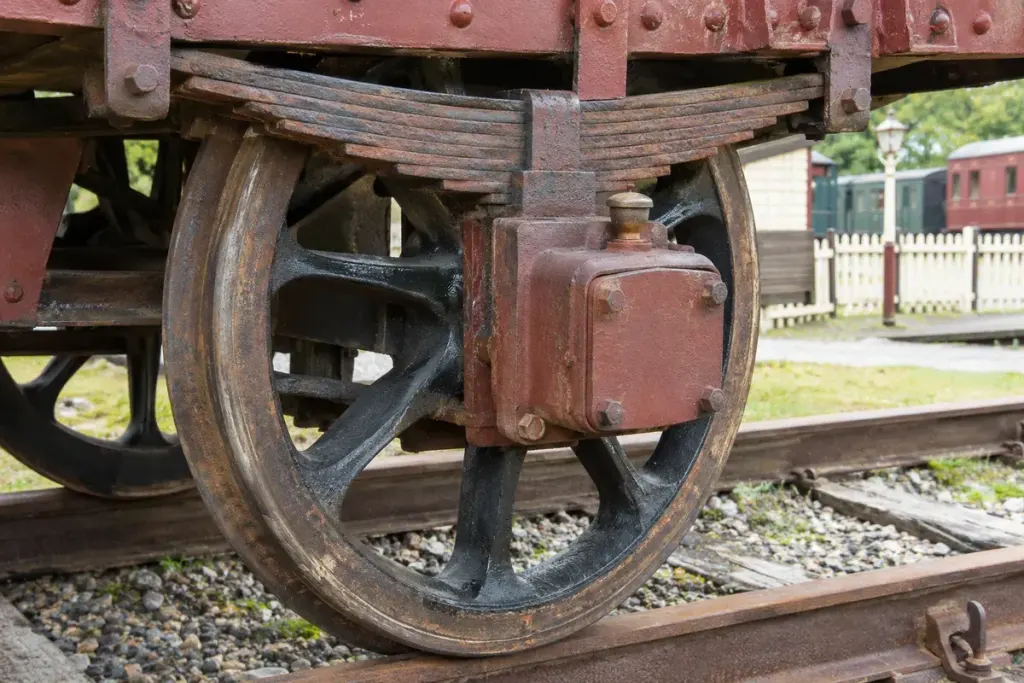
A small lidded housing beside a railway wheel can tell a large story about maintenance. On rolling stock with the relevant plain-bearing arrangement, the journal box enclosed the bearing at the axle end. Its condition depended on attention from people whose work is easy to overlook beside a locomotive’s more dramatic machinery.
A journal hook in the Smithsonian collection makes that work tangible. The museum describes the tool being used to open journal-box lids, check oil and close them again. Its record links the object to inspection and repair work in Salisbury, North Carolina, rather than leaving it as an unidentified piece of metal.
Read the object with its working context
At a museum, look for the relationship between axle, bearing housing and lid. Then read the vehicle’s date and restoration notes. Do not assume every housing visible on a surviving vehicle retains its original bearing arrangement, or that one example represents all railway equipment.
An archive photograph may show a worker crouching beside the wheels. Useful questions include:
- Can the housing or an opened lid actually be identified?
- Does the caption describe inspection, lubrication or another task?
- Is the date attached to the photograph itself or only to the vehicle?
- What evidence connects the tool to this operation?
Keep uncertain details uncertain. A dark patch in a photograph is not enough to identify a lubricant, a fault or a maintenance failure.
For a local-history visit, ask whether the museum has inspection instructions, staff recollections or a related tool collection. Those records can connect engineering to the repeated labour that kept trains moving.
View preserved equipment from the permitted area and leave lids and moving parts alone. The goal is to understand the historical maintenance routine, not to reproduce it on a display vehicle. A small journal box can then become a way to see the railway as a workplace, not only as a collection of machines.