
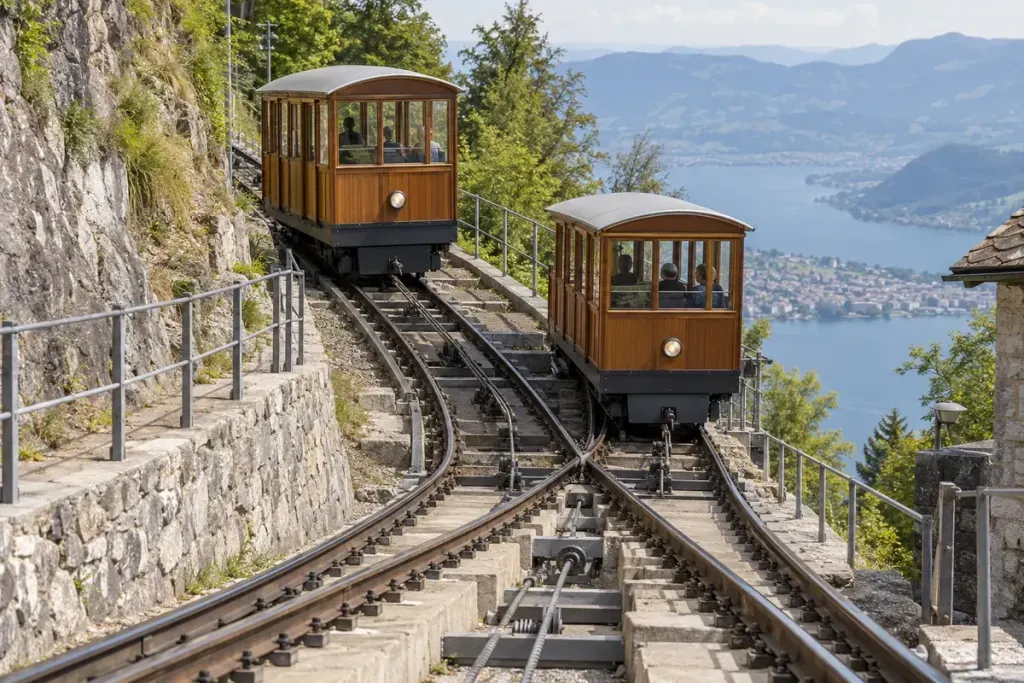
Two railway cars pass on a steep hillside, one climbing while the other descends. Their movements may be linked rather than independently powered. In a typical two-car funicular, a cable connects the cars so the descending load helps balance the ascending one.
A useful operating example is the Lynton & Lynmouth Cliff Railway. Its operator explains how the cars are connected by hauling ropes and how water is used to adjust their balance. This particular railway is water-powered; other funiculars use different drive arrangements. The example illustrates the balancing principle without making water tanks a requirement for every line.
Look for the force that moves the car
A steep gradient alone does not identify the system. A rack railway uses a toothed rail engaged by a gear on the vehicle. A funicular relies on its cable arrangement. The Science Museum Group’s record of a Rigi rack railway makes that distinction when describing a historic image.
In a photograph, examine the space between the running rails, the station equipment and any visible rope. A passing loop can be a clue, but it is not proof on its own. The machinery may be hidden, and a postcard caption may use a broad term rather than an engineering description.
Separate what the image shows from what a record confirms
Write down observable details first: two cars, steep track, stepped passenger compartments, a central passing area. Then consult the railway’s technical history or an archival record for the drive system, dates and alterations. Avoid assuming that a present-day installation is identical to the one in an old photograph.
For a railway-history notebook, the most useful comparison is a mechanism sketch beside a sourced description. Label the sketch as your explanation, not a recovered original plan. If the cable cannot be seen, say that the mechanism is known from the written record rather than claiming it is visible.
This way, a hillside railway becomes more than a picturesque incline. It becomes a question about how load, traction and route design were made to work together.