Look at almost any traditional railroad track and you will see the same basic arrangement.
Two steel rails.
Cross ties underneath them.
And thousands upon thousands of gray rocks.
They are everywhere.
Between the ties.
Under the ties.
Along both sides of the track.
At first, the rocks can look almost incidental—as if the railroad simply needed something cheap to cover the ground.
But remove them and you create a serious engineering problem.
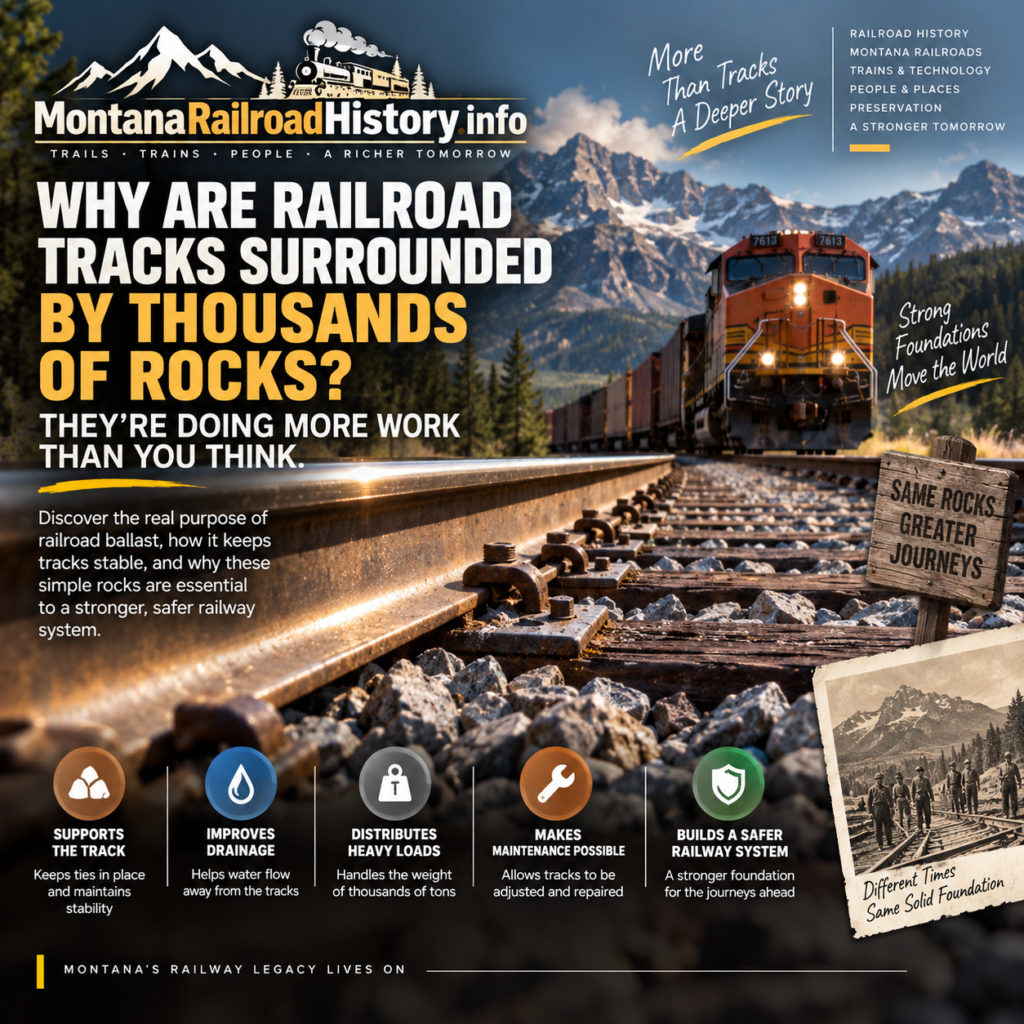
Those rocks are called railroad ballast, and they perform several important jobs simultaneously.
They help distribute enormous loads.
They support the ties.
They help hold the track geometry in position.
They allow water to drain.
They make maintenance possible.
And they help create a stable track structure capable of carrying trains that can weigh thousands of tons.
So if you have ever wondered why railroad tracks have rocks, the answer begins underneath the train.
The Rails Are Only the Visible Part of the Track
When people picture railroad infrastructure, they naturally think about the steel rails.
That makes sense.
The wheels run directly on them.
But rails cannot simply be placed on ordinary soil and expected to remain perfectly aligned.
A conventional railroad track is a system made from several layers and components working together.
At the top are the rails.
Under the rails are the ties, historically called sleepers in many parts of the world.
Beneath and around those ties is ballast.
Below that are prepared foundation layers and the natural or engineered ground supporting the railway.
Every Layer Has a Job
The rail guides the wheels.
The ties maintain rail spacing and transfer loads.
The ballast supports the ties and distributes those loads farther downward.
The foundation ultimately transfers them into the earth.
A Train Is Heavy
Very heavy.
A locomotive alone can weigh well over 100 tons depending on type and configuration.
Add dozens—or even more than a hundred—loaded freight cars and the total train weight becomes enormous.
That Weight Has to Go Somewhere
The wheel contacts the rail.
The rail transfers force into the ties.
The ties transfer force into the ballast.
The ballast distributes it into the layers beneath.
Railroad Track Is Essentially a Load-Distribution System
The rocks are an important part of that system.
Why Not Put Railroad Ties Directly on Dirt?
Imagine laying a wooden board on soft soil.
Stand on it.
The board may move.
The soil compresses.
If the ground becomes wet, it may soften further.
Now imagine repeating that process with enormous axle loads thousands of times.
Ordinary Ground Changes
It gets wet.
Dries.
Freezes in cold climates.
Thaws.
Settles.
Erodes.
Shifts.
Railroad Track Needs Greater Stability
The rails must remain within carefully controlled geometric relationships.
Small changes can affect:
alignment,
level,
cross-level,
and overall track condition.
Dirt Alone Is Not Enough
A properly constructed ballast layer creates a much more suitable support structure.
Why Is Railroad Ballast Made From Crushed Stone?
Look closely at typical ballast.
The pieces usually are not smooth like river pebbles.
They are angular.
Jagged.
Irregular.
That is deliberate.
Angular Stones Interlock
When crushed stone is compacted around the ties, the irregular edges interact and resist movement.
Imagine a Container of Marbles
The round surfaces allow them to roll relatively easily.
Now imagine a container filled with rough, angular rock.
The pieces tend to lock against each other.
Railroads Want That Interlocking Behavior
The track needs support while still remaining maintainable.
Angular ballast provides both.
Why Not Use Round River Rocks?
Smooth rounded stones generally do not interlock as effectively as angular crushed rock.
Under repeated train loads and vibration, excessive movement would be undesirable.
Ballast Should Resist Lateral Movement
The track is subjected to forces in multiple directions.
Not only downward.
Trains accelerate.
Brake.
Travel through curves.
Rails expand and contract with temperature.
Track Must Resist Those Forces
The ballast surrounding the ties contributes to that stability.
Smooth Stones Would Behave Differently
This is why ballast specifications matter.
Railroad companies do not simply purchase “some rocks.”
Ballast Helps Spread the Train’s Weight
A steel wheel places a large force onto a relatively small contact area.
The track structure must distribute that force.
Rails Spread Load Along Their Length
Ties spread it across the track.
Ballast spreads it farther into the foundation.
Think of Snowshoes
A person wearing ordinary boots may sink deeply into soft snow.
Snowshoes distribute the person’s weight across a larger area.
The total weight did not change.
The distribution did.
Ballast Works on a Similar Principle
Not exactly like snowshoes mechanically, of course, but the basic idea helps explain load distribution.
Concentrated Force Becomes Distributed Force
That protects the underlying track structure.
The Rocks Help Keep Railroad Ties in Position
Railroad ties are not simply sitting loosely on top of a pile of stones.
Ballast surrounds them.
It fills the spaces between them.
It extends beyond the ends of the ties.
This Creates Resistance
The ties are supported from underneath and restrained by the ballast around them.
Why Does That Matter?
Because rails need to maintain alignment.
The distance between the rails—the track gauge—must remain controlled.
The entire track also needs to stay positioned correctly through:
straight sections,
curves,
grades,
and transitions.
The Ballast Helps Hold the Track Structure
It is not the only thing responsible for track geometry, but it is a major component of conventional ballasted track.
Why Is There So Much Ballast Along the Sides?
You may notice that the rocks do not stop exactly at the ends of the ties.
They usually extend outward to form what is called the ballast shoulder.
That Extra Material Is Functional
The shoulder helps provide lateral restraint to the track structure.
Curves Make This Particularly Important
A train traveling through a curve produces forces that the track must resist.
The track cannot simply slide sideways every time a train passes.
Ballast Helps Keep Everything Where Engineers Intended It to Be
The exact profile varies depending on railroad standards, track class, conditions, and design.
But the broad principle remains.
One of Ballast’s Biggest Jobs Is Drainage
Water is a major enemy of transportation infrastructure.
Roads suffer from it.
Foundations suffer from it.
Railroads do too.
Imagine Railroad Ties Sitting in Mud
Water accumulates.
The soil softens.
The ties lose consistent support.
The track begins moving under load.
That Is Bad
Ballast allows water to move through the track structure rather than simply pooling around the ties.
Crushed Stone Creates Voids
Water can drain through those spaces toward properly designed drainage systems.
The Goal Is Not Just Dry Rocks
The goal is maintaining a strong foundation underneath the railroad.
Drainage Problems Can Become Track Problems
When water cannot escape effectively, the supporting material beneath the track can weaken.
Repeated train loads may then cause movement and deformation.
Track Geometry Can Deteriorate
Maintenance crews may need to correct the track more frequently.
This Is Why Railroad Drainage Extends Beyond Ballast
Railroads also rely on features such as:
ditches,
culverts,
drains,
embankments,
and properly shaped subgrades.
Ballast Is Part of a Larger Water-Management System
A railroad may look simple from the train window.
The drainage engineering underneath can be surprisingly complex.
What Happens When Ballast Gets Dirty?
Over time, the clean spaces between ballast stones can become contaminated.
Fine material enters the ballast from:
soil,
degraded rock,
environmental debris,
and other sources.
This Is Called Ballast Fouling
As fine material accumulates, the ballast may lose some of the characteristics that made it useful.
Drainage Can Become Worse
The stones may not move and interlock in the same way.
Track support can deteriorate.
Ballast Does Not Last Forever
Railroads must maintain it.
How Do Railroads Clean Ballast?
Railroads can use specialized machinery to remove, screen, clean, redistribute, or replace ballast depending on the condition and maintenance program.
Some Machines Are Enormous
They can work along the railroad while processing the material beneath the track.
Railroad Maintenance Is Highly Mechanized
What once required large crews performing heavy manual labor can now involve specialized machines designed for very specific track tasks.
Ballast Cleaning Is One Example
Tamping is another.
What Is Track Tamping?
If you have ever seen a railroad maintenance machine with equipment extending underneath the track, it may have been a tamper.
Tamping Adjusts Ballast Beneath the Ties
Special tools work the ballast so the ties receive proper support.
The Track Can Also Be Lifted and Aligned During the Process
This allows maintenance crews to correct track geometry.
The Goal Is Consistent Support
A tie that is poorly supported can move more under passing loads.
Repeated Movement Creates Problems
Good ballast maintenance helps reduce that.
How Can Rocks Support a Track but Still Allow Adjustment?
This is one of the clever advantages of ballasted track.
The stones interlock strongly enough to provide stability.
But maintenance equipment can still manipulate them.
That Makes the Track Adjustable
Railroad crews can:
lift,
line,
level,
and tamp
the track.
A Completely Rigid Foundation Would Behave Differently
Ballasted track offers a useful combination of:
strength,
flexibility,
drainage,
and maintainability.
Why Do Railroad Tracks Sometimes Look Uneven Before Maintenance?
Over time, repeated loads and environmental conditions can cause settlement.
One area may settle differently from another.
Track Geometry Slowly Changes
Maintenance crews monitor these conditions.
Modern Railroads Can Use Specialized Inspection Equipment
Track geometry vehicles and other inspection systems can measure track conditions that may not be obvious to someone simply standing beside the railroad.
Maintenance Is Continuous
Railroad track is not built once and ignored for 80 years.
It is inspected, repaired, resurfaced, and renewed.
Do Trains Actually Make the Ballast Move?
Yes, ballast experiences repeated loading and vibration as trains pass.
Individual stones can shift, wear, fracture, or settle over time.
That Is Why Maintenance Exists
The goal is not creating a track that never changes.
That would be unrealistic.
The Goal Is Controlling Change
Inspect.
Measure.
Correct.
Replace.
Repeat.
Infrastructure is a continuous process.
Why Are Railroad Rocks Usually a Certain Size?
Ballast cannot be powdered stone.
It also cannot simply consist of enormous boulders.
Particle Size Matters
The material needs to:
support loads,
interlock,
permit drainage,
and work with maintenance equipment.
Specifications Vary
Different railways and applications can use different gradations and material requirements.
There Is No Universal “Railroad Rock”
But high-quality ballast generally follows engineering specifications rather than being random quarry material.
What Kind of Rock Is Used for Railroad Ballast?
Railroads generally want durable crushed stone capable of resisting breakdown under repeated loads.
Suitable material varies by region and availability.
Hard Rock Is Valuable
The ballast needs to survive:
compression,
abrasion,
weather,
vibration,
and maintenance activity.
Local Geology Matters
Transporting rock is expensive.
Railroads historically benefited from ballast sources located reasonably close to the network.
A Railroad’s Rocks Can Reflect Regional Geology
Look closely at different lines and you may notice variations in color and material.
Did Railroads Always Use Modern Crushed-Stone Ballast?
No.
Railroad construction evolved over time.
Historical railroads sometimes used materials that would not meet modern high-standard ballast expectations.
Depending on location and period, track beds could incorporate:
gravel,
cinders,
slag,
sand,
and locally available material.
Economics Mattered
Railroads covered enormous distances.
Moving heavy material was expensive.
Local Availability Influenced Construction
As traffic became heavier and engineering standards improved, track structures evolved.
Modern Heavy Rail Demands Strong Foundations
Today’s axle loads, speeds, traffic volumes, and maintenance expectations can be very different from those of early railroads.
Cinders Were Once Common Around Railroads
Steam locomotives generated ash and cinders.
Railroads had large quantities of this material available.
It Was Sometimes Used Around Railroad Property
Including in track-related applications depending on railroad, era, and location.
Historic Track Beds Can Tell Stories
The material underneath abandoned railroad grades can provide clues about how the line was constructed and maintained.
Infrastructure Is Archaeology in Plain Sight
Old ties.
Spikes.
Ballast.
Drainage structures.
Telegraph poles.
Bridge foundations.
Each can reveal something about how a railroad operated.
Montana Makes the Foundation Especially Interesting
Railroad infrastructure in Montana has had to operate across very different environments.
Mountain territory.
River valleys.
Open plains.
Areas experiencing severe winter weather.
Geography Changes the Engineering Challenge
A track across relatively level plains faces different conditions from a mountain route involving:
cuts,
fills,
bridges,
curves,
and steep grades.
Water Still Matters Everywhere
Snowmelt.
Heavy rain.
Streams.
Freeze-thaw conditions.
All can influence the railroad foundation.
Ballast Is Only One Piece of Making a Route Durable
But it is one of the pieces you can see almost everywhere.
What Happens During Freeze and Thaw?
Cold climates create another challenge.
Water within soil can freeze.
Ground conditions can change.
Then temperatures rise and the material thaws.
Repeated Freeze-Thaw Cycles Can Affect Infrastructure
Good drainage helps reduce water-related problems.
Again, Water Management Appears
The humble rocks beside the rails are part of protecting a much larger system.
What Is Under the Ballast?
You might imagine ballast continuing all the way down into the earth.
Usually, the track structure is more layered than that.
Beneath Ballast Can Be Sub-Ballast
This layer helps separate the ballast from finer underlying soil and assists with load distribution and drainage depending on design.
Beneath That Is the Subgrade
The prepared earth foundation supporting the railway.
If the Foundation Is Weak, Everything Above It Suffers
You cannot solve every ground problem simply by adding more rocks.
Good Track Begins Below What You Can See
This is true of many forms of infrastructure.
The invisible foundation often matters as much as the visible structure.
Why Doesn’t Ballast Sink Into the Ground?
Over time, material interaction between ballast and subgrade can become a maintenance concern.
That is one reason properly designed layers matter.
Modern Construction Can Use Separation Materials
Depending on conditions, engineered layers or geosynthetic materials may be used to help manage separation, filtration, drainage, or reinforcement.
Railroad Engineering Has Evolved
The basic visual may still be:
rails + ties + rocks.
But the engineering underneath modern track can be sophisticated.
Do All Railroads Use Ballast?
No.
This is where things get interesting.
Some Rail Systems Use Ballastless Track
Instead of conventional ties supported in crushed stone, rails may be mounted on concrete slabs or other rigid track structures.
You Often See This in Certain Modern Systems
Especially where maintenance requirements, tunnels, bridges, urban environments, or high-speed applications make slab track attractive.
Ballastless Does Not Mean Foundationless
The loads still need support.
The engineering solution is simply different.
Why Not Use Concrete Everywhere?
Because every system involves trade-offs.
Traditional ballasted track has advantages.
It can be:
comparatively adaptable,
maintainable,
and suitable for huge networks.
Slab Track Has Advantages Too
But installation can be more expensive and corrections after construction may be less straightforward depending on the system.
Infrastructure Is About Choosing the Right Compromise
Cost.
Maintenance.
Traffic.
Speed.
Environment.
Expected lifespan.
All matter.
Why Do Subway Tracks Sometimes Look Different?
Urban railways can use track structures that differ from traditional open-country railroads.
Inside tunnels, for example, drainage, clearance, vibration, maintenance access, and structural constraints may encourage different designs.
Do Not Assume Every Rail System Is Built Identically
Freight railroad.
High-speed rail.
Metro.
Tram.
Industrial railway.
They can have different requirements.
Why Is Ballast Sometimes Fresh and Bright?
You may travel along a railroad and suddenly see a section where the stones look noticeably cleaner or lighter.
That Can Indicate Recent Maintenance
Fresh ballast may have been added.
The track may have been resurfaced.
Components may have been renewed.
Color Changes With Time
Dust.
Weathering.
Rust.
Oil.
Environmental material.
All can alter appearance.
Fresh Ballast Often Stands Out
Especially beside older track.
Why Are the Rocks Piled Higher in Some Places?
Ballast profiles vary.
You may see differences around:
main lines,
sidings,
yards,
switches,
bridges,
and recently maintained areas.
Do Not Assume More Rock Automatically Means Better Track
Proper ballast depth and profile are engineering decisions.
Randomly Dumping Stone Is Not Track Maintenance
The material must be placed and supported correctly.
What About Railroad Switches?
Switches—or turnouts—allow trains to move from one track to another.
They contain more complicated rail components than ordinary straight track.
The Foundation Still Matters
Moving and intersecting rail components need reliable support and geometry.
A Switch Is Only as Good as the Track Supporting It
This makes maintenance particularly important.
Bridges Can Be Different
Some railroad bridges carry conventional ballasted track.
Others use configurations where the rails and ties interact more directly with the bridge structure.
Track Design Changes With the Structure
Again:
there is no single universal railroad cross-section.
Why Do Railroad Ties Need Ballast?
Ties perform several major functions.
They maintain the position of the rails.
They distribute rail loads.
They provide attachment points for fasteners.
Ballast Supports the Ties
A tie needs consistent bearing underneath it.
Poor Support Creates Movement
Repeated movement can accelerate deterioration in the track structure.
The Relationship Is Cooperative
Rail supports wheel.
Tie supports rail.
Ballast supports tie.
Foundation supports ballast.
What Happens If Ballast Washes Away?
Severe water flow can remove or undermine supporting material.
This can create a dangerous condition.
Washouts Are Serious Railroad Hazards
A track can sometimes appear relatively intact from above even when supporting material beneath it has been damaged.
Inspection After Severe Weather Is Important
Railroads monitor infrastructure for exactly these kinds of problems.
This Is Another Reason Drainage Structures Matter
Culverts and ditches are not boring accessories.
They help keep the railroad physically underneath the train.
Vegetation Can Affect the Track Bed Too
Plants growing excessively within the ballast can interfere with drainage and indicate accumulation of finer material.
Railroads Manage Vegetation for Multiple Reasons
Visibility.
Access.
Fire risk in some environments.
Drainage.
Track condition.
A Clean Track Bed Is Not Merely Cosmetic
It can support maintenance and infrastructure performance.
Why Do Railroad Workers Walk the Track?
Visual inspection remains valuable even in an era of advanced technology.
A trained person can notice:
damaged components,
drainage issues,
debris,
surface conditions,
and other abnormalities.
Technology Adds More Information
It does not make the physical railroad disappear.
Railroads Are Maintained at Ground Level
Someone eventually has to understand what is happening beneath the wheels.
Ballast Makes Track Maintenance Possible
This may be its most underappreciated advantage.
Track geometry can be corrected without completely rebuilding the railway.
Machines Can Manipulate the Ballast
Lift the track.
Move it slightly.
Pack material beneath the ties.
Restore alignment.
Then Trains Continue
That maintainability is enormously valuable across thousands of miles of railroad.
Why Does Freshly Tamped Track Sometimes Look Different?
Maintenance equipment may redistribute ballast.
The shoulders may appear freshly shaped.
Stone color may look brighter.
The Track Has Been Worked
Over time, normal traffic and weather change the appearance again.
Railroad Infrastructure Is Never Truly Static
It is continually aging and continually being maintained.
The Rocks Also Help Control Vegetation—But Don’t Oversimplify It
People sometimes say ballast exists simply to prevent weeds.
That is incomplete.
Vegetation Control Can Be Relevant
But it is not the primary engineering explanation for ballast.
The major functions revolve around:
support,
load distribution,
track restraint,
drainage,
and maintainability.
Avoid the One-Sentence Internet Answer
Railroad engineering is more interesting than:
“rocks stop weeds.”
Does Ballast Reduce Vibration?
The track structure, including ballast, influences how loads and vibrations are transmitted.
Ballasted track can provide a degree of elasticity compared with more rigid structures.
But Vibration Is a System-Level Issue
Vehicle suspension.
Rail condition.
Wheel condition.
Track structure.
Soil.
Bridges.
Speed.
All contribute.
One Component Rarely Explains Everything
Railroad systems work because components interact.
Can You Take Railroad Ballast as a Souvenir?
Do not.
Aside from obvious property issues, active railroad rights-of-way are dangerous places.
Never Walk Onto Active Tracks to Examine the Rocks
Trains can approach faster and more quietly than people expect.
They also cannot stop quickly.
Observe Railroads From Legal, Safe Public Locations
A good railroad-history hobby should not end with an emergency brake application.
Old Railroad Grades Are Different—but Ownership Still Matters
Abandoned-looking does not automatically mean abandoned.
And abandoned does not automatically mean public property.
Check Access Before Exploring
Historic railroad infrastructure is fascinating.
Respect:
property,
preservation,
and safety.
Railroad Ballast Is a Great Example of Invisible Engineering
We notice locomotives because they are enormous.
We notice trains because they move.
We notice bridges because they look impressive.
Ballast Does None of Those Things
It sits there.
Quietly.
For years.
That Makes It Easy to Ignore
Yet every passing wheel depends on the track structure beneath it.
Think About a Freight Train Crossing Montana
Dozens of cars.
Maybe more than a hundred.
Each axle repeatedly loading the rail.
Mile after mile.
Summer heat.
Winter cold.
Rain.
Snow.
Mountain terrain.
Open plains.
The Rails Cannot Handle That Alone
The load has to travel downward through a carefully maintained structure.
Steel.
Fasteners.
Ties.
Ballast.
Foundation.
Earth.
Those Ordinary Rocks Are Part of the Chain
Without them, conventional track would not behave the way railroads need it to.
A Simple Way to Remember What Railroad Ballast Does
Remember five jobs:
Support
It provides a stable bed for the ties.
Distribute
It helps spread train loads into the foundation.
Restrain
It helps resist unwanted track movement.
Drain
It allows water to move away from the track structure.
Maintain
It can be manipulated during track surfacing and alignment work.
Support. Distribute. Restrain. Drain. Maintain.
That is why the rocks are there.
FAQ
What are the rocks under railroad tracks called?
They are generally called ballast or railroad ballast. Ballast forms the crushed-stone layer beneath and around railroad ties in conventional ballasted track.
Why are railroad tracks built on rocks?
Ballast helps support the ties, distribute train loads, restrain track movement, facilitate drainage, and allow track geometry to be maintained.
Why does railroad ballast use crushed stone instead of round rocks?
Angular crushed stone can interlock and resist movement more effectively than smooth rounded material, making it better suited to supporting conventional railroad track.
Does railroad ballast stop weeds?
Ballast and track maintenance can influence vegetation, but weed prevention is not the primary purpose of railroad ballast. Its major functions relate to structural support, drainage, restraint, load distribution, and maintenance.
Why is drainage important for railroad tracks?
Water can weaken the materials supporting the track and contribute to instability or settlement. Proper ballast and drainage infrastructure help move water away from critical parts of the track structure.
What is under railroad ballast?
Depending on the design, ballast may sit above sub-ballast and a prepared subgrade. Modern track construction can also incorporate engineered separation, drainage, or reinforcement materials.
Does every railway use crushed-stone ballast?
No. Some railways use ballastless or slab-track systems, particularly in certain tunnels, urban railways, high-speed applications, and other specialized environments.
What is railroad track tamping?
Tamping is a maintenance process in which specialized equipment manipulates ballast beneath railroad ties while helping correct track level and alignment.
Does railroad ballast need to be replaced?
Ballast can become worn, contaminated, or fouled over time. Railroads may add, clean, redistribute, or replace it as part of track maintenance.
Is it safe to walk on railroad ballast?
Do not enter active railroad rights-of-way to inspect ballast or tracks. Railroad property can be restricted, and active tracks present serious hazards. Observe railway infrastructure only from safe and legal locations.
Conclusion
The next time you see a railroad, ignore the locomotive for a moment.
Look down.
Under the steel rails.
Under the ties.
At the thousands of ordinary-looking rocks surrounding them.
They are not decoration.
They are not simply leftover gravel.
And they are not there only to stop weeds.
Understanding why railroad tracks have rocks reveals one of the fundamental ideas behind conventional railroad engineering.
A train’s enormous weight cannot simply disappear.
It travels through a system.
Wheel to rail.
Rail to tie.
Tie to ballast.
Ballast to foundation.
The angular stones help distribute that load while supporting the track, resisting movement, allowing drainage, and giving maintenance crews a structure they can adjust and restore.
And that may be the most fascinating thing about railroad infrastructure.
The most impressive engineering is not always the part towering above the landscape.
Sometimes it is the part everyone has looked at a thousand times without asking why it is there.
Thousands of rocks, quietly helping keep an entire railroad in place.

