
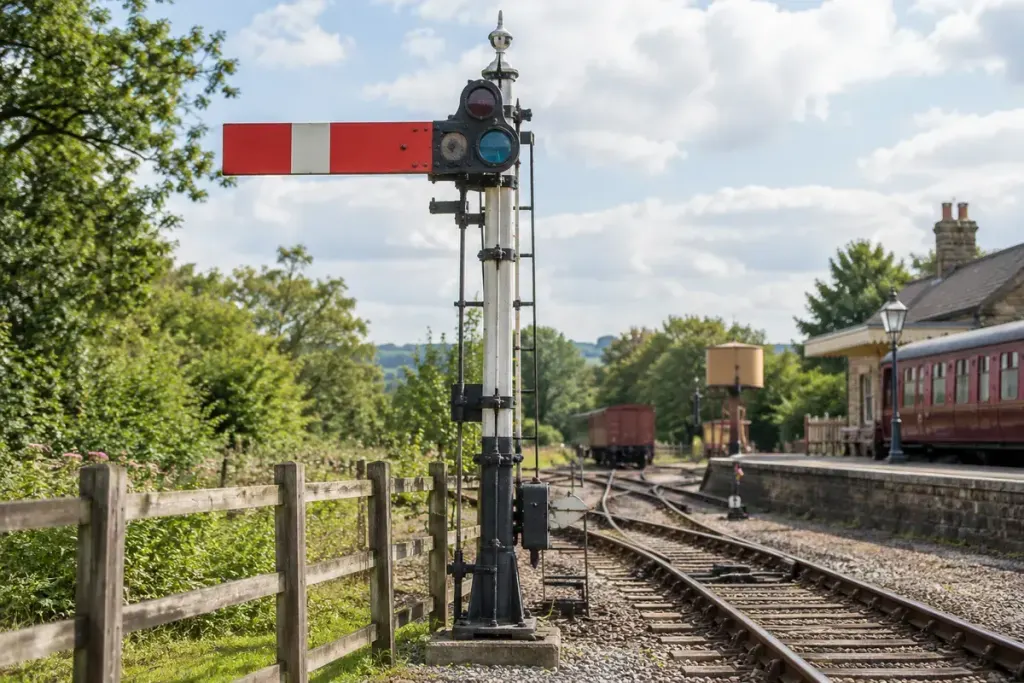
A semaphore arm in a museum invites an immediate question: what did that position mean? The answer needs more context than the colour of the arm. Signalling systems developed within particular railways and operating rules, and a preserved object may no longer stand in its original setting.
Begin with the label’s limits
Record the railway, approximate date, original location and any stated restoration history. Distinguish information supplied by the museum from details you infer from the object. If the label identifies only a manufacturer, do not silently turn that into proof of where the signal was used.
Look for whether the display describes a complete signal, a replacement arm or an assembly reconstructed from several parts. A neat exhibit can explain a mechanism without being an untouched survivor of one working installation.
Find the operating context
Ask the museum whether it can point you to a dated rulebook, diagram or photograph for the railway concerned. Such evidence can help explain the signal’s function and its relationship with other signals. An isolated arm does not reveal the entire instruction a driver would have received on the route.
For a Montana railway research notebook, keep local evidence separate from examples found elsewhere. A British museum display or another North American railroad’s rulebook can suggest questions, but should not be used as an automatic key to every Montana installation.
Photograph the object from permitted public positions and include the label in a separate reference image. Note visible features without operating the mechanism or entering restricted areas. Never use a historical display as guidance for interpreting active railway signals or approaching live tracks.
A strong note might end with an unresolved question: “The exhibit identifies the railway and period, but not the original signal location.” That is a useful research lead. It preserves the boundary between what the object shows, what its documentation establishes and what still needs investigation.