
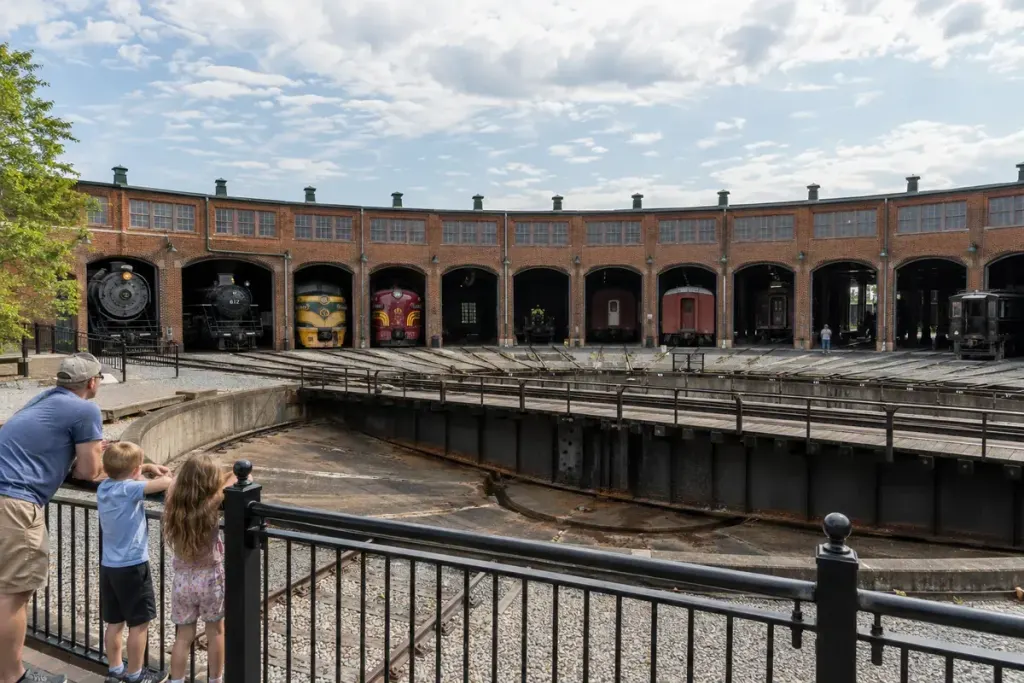
A railway roundhouse is striking even without a locomotive inside. Its curved building and fan of tracks suggest that the shape served a working purpose. Follow those tracks towards the centre and the turntable explains much of the arrangement.
The National Park Service’s description of Steamtown’s turntable explains how locomotives were aligned with maintenance bays, then turned back towards the yard after work. This is a specific preserved example, not a claim that every railway depot used the same layout.
Look at the building as a sequence of jobs
Imagine a locomotive arriving from service. It needs access to the appropriate work area, space for people to inspect it and a route back out. The turntable acts as a moving connection between tracks. The surrounding bays allow several locomotives to occupy different work positions without requiring a separate long approach to each one.
At a museum, look for interpretation explaining inspection pits, ventilation, lifting arrangements and nearby facilities. Do not infer that every visible feature is original. Preserved sites often combine surviving fabric, reconstruction and modern adaptations for visitors or ongoing work.
Steamtown’s park information should be consulted for the site’s current visitor arrangements. Stay on marked routes: a historic workshop can still contain active railway equipment and places where public access is restricted.
Ask what changed when the locomotives changed
A useful historical question is whether larger locomotives required a longer turntable or altered bays. Another is how the depot’s role changed with different traction and maintenance practices. Look for dated plans, photographs and the museum’s documented account before making a conclusion.
For your visit notes, sketch the relationship between turntable, bays and yard rather than attempting an architectural drawing. Add one question about the people who worked there. The roundhouse then becomes more than a dramatic backdrop: it becomes a visible record of how railway work was organised.