
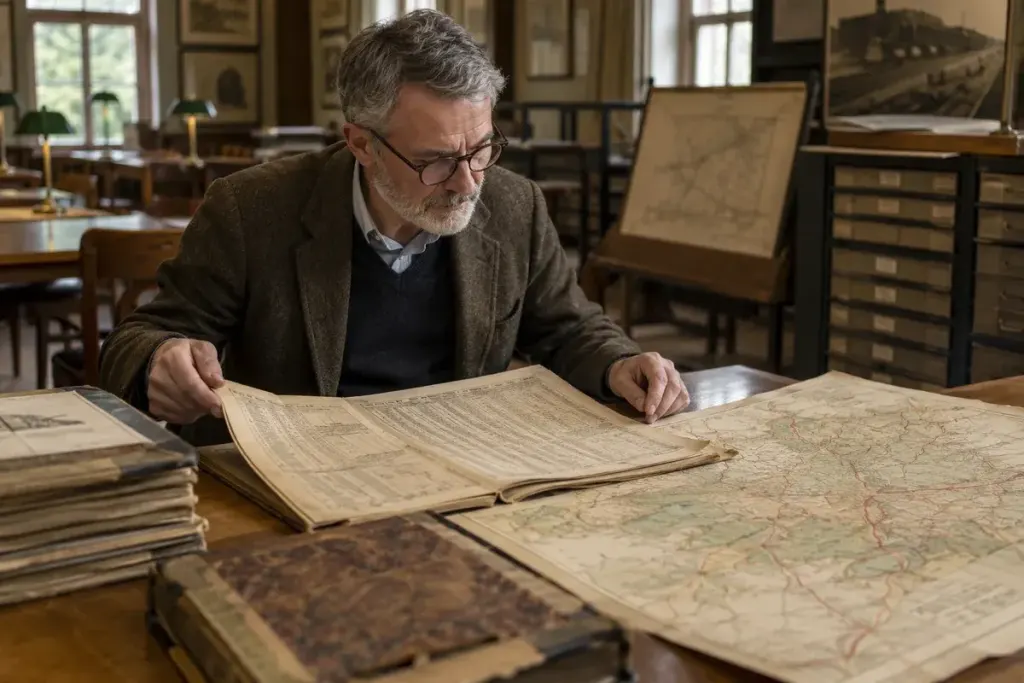
A railway map shows where the line ran. A timetable begins to show what a passenger could actually do with it. The distinction matters when a station appears on a map but the train you are tracing did not stop there.
Historical timetables reward slow reading. Before extracting a journey time or drawing conclusions about a town’s connections, identify the document’s purpose and the conventions printed around the table.
Start with the cover, not the station list
Record the railway, publication date and effective date. These may differ. A seasonal passenger booklet, an employee operating timetable and a later enthusiast’s compilation answer different questions. Keep the archive’s catalogue description with your notes so that another reader can identify the same object.
The Library of Congress guide to railroad maps and timetables provides a useful starting point for locating collections. Finding a document there establishes where it can be consulted; it does not remove the need to inspect its particular date, legend and coverage.
Follow one train all the way down the page
Choose a single train number and trace its column. Check whether time runs downward or upward and whether the table separates directions. Read the explanation of bold type, symbols and footnotes before interpreting a blank cell. It could indicate a non-stop passage, a service limitation or a convention specific to that publication.
In a hypothetical table, a station might have a time in the morning column and a dash in the evening column. That does not prove that the station had only one daily service: another page, route or connecting service may be involved.
Keep a small evidence ledger
Use four fields: exact entry, page or image number, interpretation, and uncertainty. For example, write “connection marked by an asterisk; footnote refers to weekdays” before summarising the journey as a weekday connection. Keeping transcription separate from interpretation prevents an attractive story from quietly replacing the document.
Watch for overnight journeys and time-zone notes before calculating elapsed time. If the scan is illegible, mark the number uncertain instead of choosing the value that makes the journey look plausible.
A scheduled service is not a recorded arrival
A timetable describes an intended operation. It cannot by itself establish punctuality, passenger numbers or whether a particular journey ran during a disruption. Those questions may require contemporary newspapers, company records or personal accounts.
The strongest caption therefore stays modest: name the timetable, date and service that the page documents. A carefully bounded observation about one connection is more useful to railway history than a sweeping claim built from a station name alone.