
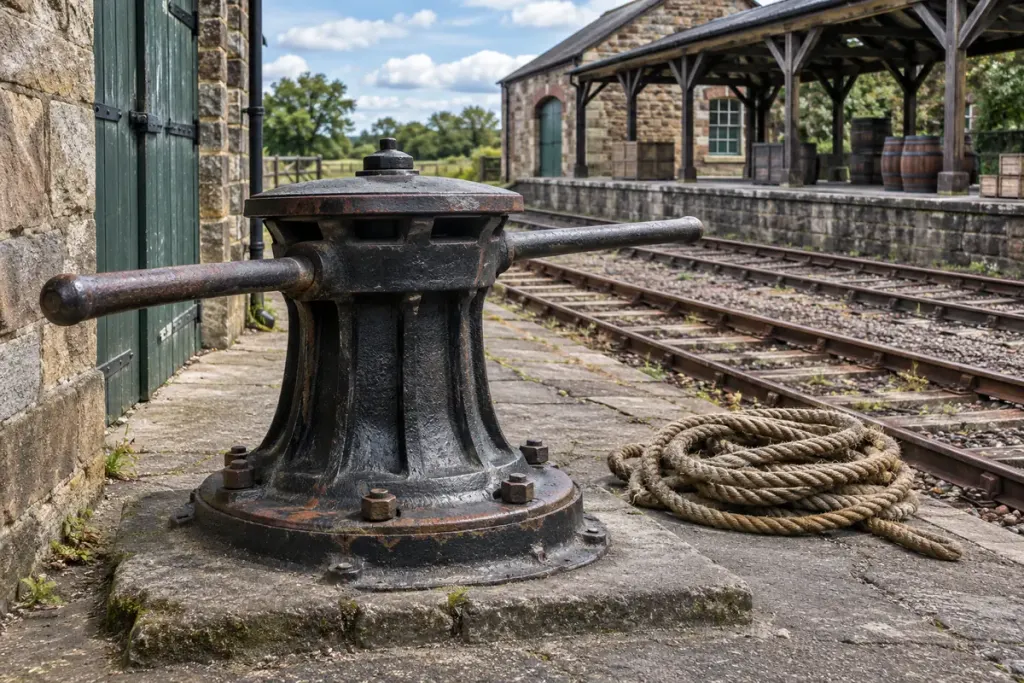
Railway history is full of locomotives, but a wagon did not always need a locomotive beside it for every short movement. In some goods-handling settings, a powered capstan and rope provided another way to move rolling stock.
A capstan is a rotating drum around which a rope can be worked. The Science Museum Group’s hydraulic capstan from Liverpool Road station preserves evidence of that approach. This British example offers a comparison for studying yard technology; it is not evidence that every Montana railway yard used the same equipment.
Look for the system around the object
A surviving drum on its own leaves several questions open. Where did the power come from? Where could the rope run? Which tracks and loading spaces did the arrangement serve? A yard plan or contemporary photograph may answer questions that the object label cannot.
For a historical research note, separate three kinds of evidence: a dated object description, a site plan and an account of work at the site. If one source is missing, record the gap instead of filling it with a scene imagined from another railway.
Safety rules are historical evidence too
The museum also holds a railway notice concerning capstan work. Such notices can reveal what managers expected workers to do and which hazards required attention. A rule’s existence does not establish how consistently people followed it.
One useful museum exercise is to sketch the likely relationship between capstan, rope route and track, then label each connection as documented or uncertain. This makes the interpretation visible without pretending the sketch is an original engineering plan.
Historic machinery is not an invitation to recreate its operation. Moving wagons, tensioned ropes and powered drums create serious hazards; demonstrations belong with trained staff and appropriate safeguards.
The capstan broadens the story of railways from the journey between stations to the work within them. Freight movement depended on handling systems as well as the engines that attract most of the photographs.