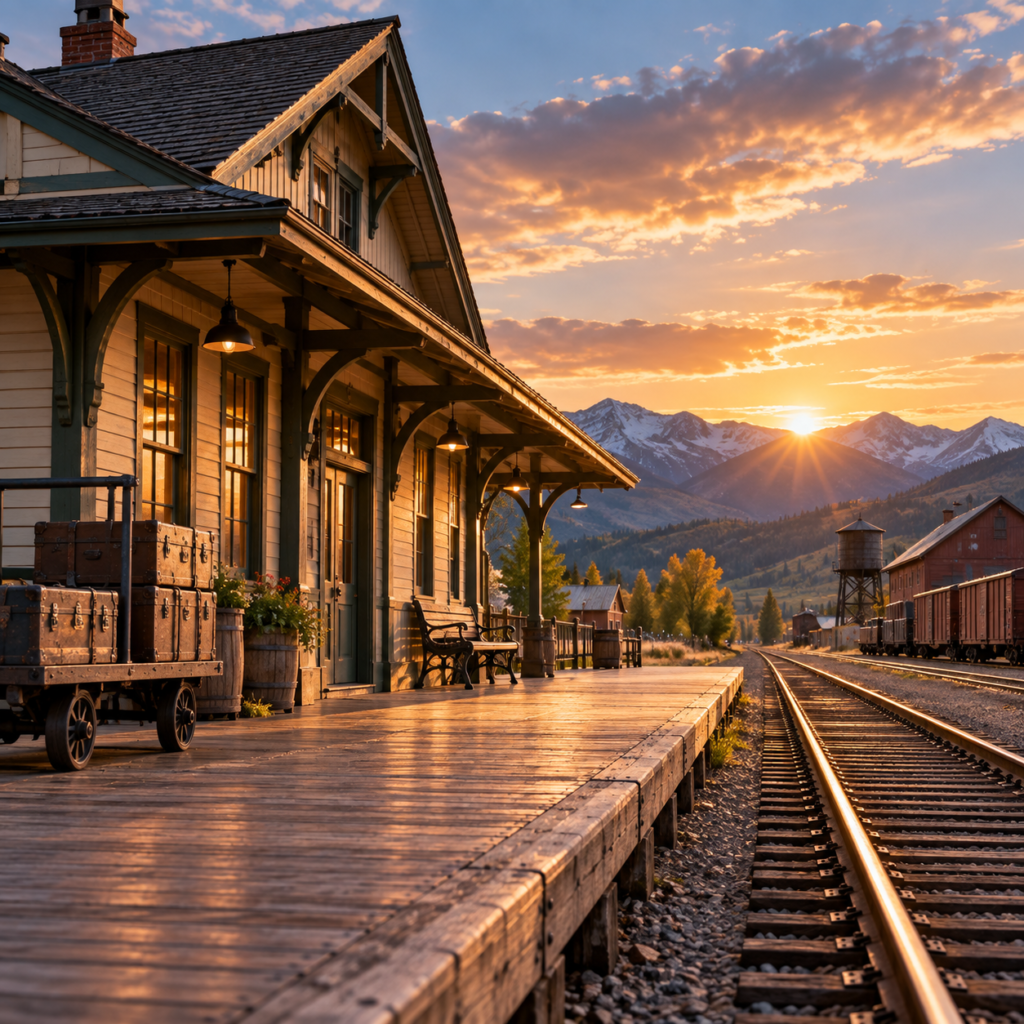
Long after the locomotives disappeared, the building often remained.
Sometimes it is a museum now.
Sometimes a restaurant, community space, office, or carefully preserved landmark.
Sometimes it simply stands beside tracks that are much quieter than they once were.
Look at an old depot in a Montana town and it can be easy to see it as an attractive piece of railroad architecture—a reminder of steam locomotives, passenger cars, conductors, and another era of travel.
But historically, many Montana railroad depots were much more than places where passengers waited for trains.
They were gateways.
People arrived through them. Mail passed through them. Goods moved around them. News traveled through them. Businesses clustered near them. Hotels appeared within walking distance. Streets and commercial districts often developed in relation to the tracks.
To understand why an old depot can still feel unusually important to a town that has not depended on passenger trains for decades, you have to imagine what the building represented when the railroad was one of the fastest connections to the outside world.
Before the Depot, Distance Meant Something Different
Modern travelers can cross Montana by interstate highway, communicate instantly by phone, and order goods from hundreds of miles away without thinking much about the distance involved.
The nineteenth-century experience was very different.
Before railroads spread across Montana, long-distance transportation relied heavily on river routes, wagons, trails, and stage travel.
Moving people and freight could be slow, expensive, seasonal, and difficult.
Then railroad connections began arriving.
The Utah & Northern reached Butte in 1881. The Northern Pacific completed its transcontinental route across Montana in 1883. The Great Northern subsequently crossed northern Montana, and the Milwaukee Road entered the state in the early twentieth century.
Within a few decades, rail lines connected communities across enormous distances.
The depot became the physical place where that network touched everyday life.
Montana Railroad Depots Were Doors to a Much Larger Network
Imagine living in a relatively isolated Montana community during the railroad era.
Then imagine walking into the local depot.
From that building, a passenger could begin a journey toward another city.
A merchant could receive goods shipped from distant markets.
A rancher or farmer could interact with transportation networks that moved agricultural products far beyond the immediate region.
Mail and express shipments could arrive.
Visitors could step off the train.
Workers could come and go.
The depot connected a local community with something much larger.
That made its location extremely important.
The tracks were not merely passing through town.
They were part of the town’s relationship with the wider country.
Some Montana Towns Grew Around the Railroad
Railroads did not simply connect places that already existed.
They also helped determine where development occurred.
Livingston is a particularly clear example.
The Northern Pacific established it as a major division point, repair center, and gateway for travelers heading toward Yellowstone National Park.
That railroad function influenced the city’s growth and physical character.
Elsewhere, rail lines encouraged settlement and commercial activity along their routes.
Great Northern development across northern Montana helped shape communities along what became known as the Hi-Line.
When the railroad chose a location for a station, yard, junction, or maintenance facility, that decision could create powerful economic gravity.
People followed transportation.
Businesses followed people.
The Depot Could Become the First Impression of a Town
Before highways and airports became dominant forms of long-distance travel, many visitors first encountered a community from a train platform.
That made the depot surprisingly important.
It was not hidden infrastructure.
It was a front door.
Passengers stepped from the train and immediately formed an impression of the place around them.
A substantial depot could signal confidence and importance.
Its architecture could communicate permanence.
Its waiting rooms and platforms handled the movement of strangers who might be visiting for business, tourism, family, or migration.
For residents, meanwhile, the same building represented departure.
The depot was both an entrance and an exit.
Not Every Depot Was Grand
Railroad history photographs can make it easy to associate passenger travel with impressive masonry stations and elaborate interiors.
But Montana railroad depots varied enormously.
A major railroad center could justify a substantial building.
A small agricultural community might have something much simpler.
Some facilities combined passenger, freight, and operational functions.
Others existed primarily to serve relatively modest traffic.
That difference tells us something important.
A depot’s scale often reflected the role a particular location played within the railroad system.
Not every stop needed to become a major terminal.
The Platform Was Only One Part of the Story
Today we often think of a station primarily as a place for passengers.
Historically, the railroad’s presence could involve much more.
Freight facilities.
Sidings.
Water infrastructure during the steam era.
Warehouses.
Stockyards.
Section houses.
Maintenance buildings.
Signals.
Telegraph facilities.
Rail yards.
Loading areas.
A surviving depot may therefore be only the most visible fragment of what was once a much larger railroad landscape.
Stand beside one today and an empty area nearby might once have been full of activity.
Why Businesses Gathered Near the Tracks
If travelers were regularly arriving somewhere, businesses wanted to be nearby.
Hotels made sense.
Restaurants made sense.
Saloons, stores, warehouses, and transportation services made sense.
A traveler arriving with luggage did not necessarily want to travel another mile to find lodging.
A merchant receiving freight wanted practical access to transportation.
This helped create recognizable railroad districts.
Even after the railroad’s importance declined, the street pattern and older commercial buildings could preserve traces of that original relationship.
Look at the Street Before You Look at the Building
When visiting a historic depot, it is tempting to focus immediately on architectural details.
But first, turn around.
Look away from the tracks.
Where does the street go?
Is there an old commercial district nearby?
Are there hotels or warehouses?
Does a main street seem to lead toward the station?
Are older buildings concentrated around the railroad corridor?
These relationships can reveal how the depot once fitted into the community.
Railroad history is written not only in rails and locomotives.
It is also written into city blocks.
Depots Were Places of Constant Movement
Picture a busy depot during the height of passenger rail.
Someone is checking the time.
Another person is saying goodbye.
A family is waiting for relatives.
A railway employee is moving baggage.
Mail is being handled.
Freight is being transferred.
A traveler is asking about a connection.
The telegraph brings information from somewhere far away.
Then the train arrives.
For a few minutes, the platform becomes intensely active.
Then the train leaves.
The building becomes quieter.
Until the next one.
The rhythm of train schedules could become part of the rhythm of town life.
Time Became Increasingly Important
Railroads changed people’s relationship with time.
A wagon journey could be influenced heavily by weather, roads, animals, and local conditions.
Railroads operated according to schedules.
Passengers needed to know when trains departed.
Railroad employees needed coordinated operations.
Connections depended on timing.
That made the depot a place where the clock mattered.
The train was not simply coming “sometime today.”
There was a timetable.
And missing the train could mean a significant wait.
The Telegraph Made the Depot an Information Center
Railroads and telegraphy developed in a deeply connected way.
Railroad operations required communication across long distances.
Stations became nodes in communication networks as well as transportation networks.
Before instant personal communication became normal, this gave railroad locations an important informational role.
News that seems ordinary today could once have traveled through systems associated with rail transportation.
The station connected the community not only physically but informationally.
Mail Made Trains Part of Everyday Life
You did not need to be traveling to be affected by the railroad.
Mail and express shipments tied ordinary households and businesses to train movements.
Letters.
Packages.
Business documents.
Newspapers.
Commercial shipments.
A resident might rarely board a passenger train and still depend indirectly on the transportation network surrounding the depot.
That is part of why railroad infrastructure could matter to an entire community rather than only to travelers.
Freight Could Matter More Than Passengers
Passenger trains are usually more romantic in historical memory.
Freight was often more economically significant.
Montana’s railroads served mining, agriculture, timber, livestock, and other industries.
Rail connections made it possible to move heavy goods across distances that would have been extraordinarily difficult to manage efficiently by wagon.
A depot or station therefore existed within a much broader economic system.
Nearby freight structures may have mattered just as much as the passenger waiting room.
Railroads Helped Mining Centers Reach Distant Markets
Mining played a major role in Montana’s railroad development.
The Utah & Northern’s arrival in Butte in 1881 connected the mining district more effectively with the wider national rail network.
Railroads could carry equipment toward mining regions and move mineral output away.
As Montana’s mining economy expanded, rail transportation became deeply connected to industrial development.
The tracks beside a depot might therefore represent much more than passenger travel.
They were part of a supply chain linking local extraction to national markets.
Agricultural Communities Needed Rail Connections Too
As settlement expanded, farmers and ranchers also depended on transportation.
Railroad companies had strong incentives to encourage development along their routes because productive communities created freight and passenger traffic.
The Great Northern became particularly associated with settlement promotion along its northern Montana route.
Rail lines helped connect agricultural areas with markets that would otherwise have been extremely distant.
For many communities, the railroad was therefore not simply transportation infrastructure.
It was part of the economic reason the community could grow.
A Depot Could Become a Place of Hope
There was an emotional side to the station too.
Imagine waiting for someone who had been gone for months.
A family member.
A soldier.
A child returning from school.
A worker coming home.
Then the train appears in the distance.
The platform fills.
Steam, noise, baggage, greetings.
For countless families, the depot became connected with reunion.
That history rarely appears on a railroad map.
But it mattered.
The Same Platform Could Also Mean Goodbye
Every arrival implies a departure.
Young people left town from depots.
Workers moved elsewhere.
Families migrated.
Soldiers departed.
Travelers began journeys that might keep them away for months or years.
A depot could therefore carry contradictory meanings.
Opportunity.
Separation.
Excitement.
Anxiety.
Arrival.
Departure.
This emotional history helps explain why old railroad stations can hold such strong local memories even after their transportation function disappears.
Tourism Also Traveled by Rail
Railroads did more than move people who already had reasons to travel.
They actively promoted destinations.
Montana’s dramatic landscapes provided enormous tourism potential, and railroad companies recognized it.
The Great Northern became closely associated with travel to Glacier National Park, promoting the region to passengers from elsewhere in the country.
Rail transportation helped turn distant western landscapes into destinations accessible to tourists.
The station was the transition point between the long-distance train and the experience travelers had come to find.
Livingston Became a Gateway
Livingston’s railroad history demonstrates how transportation and tourism could intersect.
The Northern Pacific developed Livingston as an important railroad center, and the city also became a gateway for Yellowstone travel.
Passengers could reach the region by rail and continue toward the park.
That meant railroad facilities served both industrial transportation and tourism.
The depot was part of a journey much larger than the city itself.
Architecture Could Express Railroad Identity
Historic railroad companies often developed recognizable architectural styles.
Materials, rooflines, windows, platforms, signs, and interior layouts reflected practical requirements as well as corporate identity.
Larger stations could be designed to impress.
Smaller stations might prioritize efficiency.
When examining an old depot, details can therefore offer clues about its role.
Was the building intended for heavy passenger traffic?
Was freight handled there too?
Does one section appear more formal than another?
Where would passengers have waited?
Where did railroad employees work?
Architecture can preserve answers long after operations have changed.
Look for the Track Side and Town Side
Historic depots often have two different personalities.
One side faces the tracks.
That is the operational side.
The other faces the community.
That is the civic side.
On the track side, you might find a long platform or broad roof overhang designed around train operations.
On the town side, the entrance may feel more like a public building.
Understanding these two orientations helps explain the depot’s original function.
It stood between two systems:
The railroad network and the town.
Why So Many Depots Were Built Along Similar Lines
Railroads operated large networks.
Standardization made sense.
A company building numerous stations could reuse plans or adapt familiar designs to different locations.
That could reduce costs and simplify construction.
As a result, depots hundreds of miles apart might share recognizable characteristics even when their communities were very different.
But local materials, traffic levels, climate, expansions, and renovations could create variations.
This makes depot architecture particularly interesting to compare.
Some Stations Grew With Their Communities
A small stop did not necessarily remain small.
Traffic increased.
The town grew.
More freight arrived.
More passengers traveled.
The railroad might expand the building, replace it, or construct additional facilities.
A depot therefore represents a moment in an evolving relationship.
The building standing today may not be the first station that occupied the site.
Understanding its history sometimes requires looking beyond the surviving structure.
Rail Yards Created Entire Working Landscapes
In major railroad communities, the depot was only one component of a much larger operation.
Rail yards could contain numerous tracks.
Locomotives required servicing.
Freight cars needed sorting.
Trains had to be assembled.
Crews changed.
Equipment required maintenance.
Communities such as Livingston, Laurel, Havre, and Whitefish developed important railroad facilities over time.
The railroad did not merely stop there.
It employed people there.
That distinction had enormous consequences for local development.
Railroad Employment Could Shape Generations
When a railroad became a major employer, its influence entered family life.
One generation worked on the railroad.
Then another.
Jobs could include engineers, conductors, brakemen, station agents, maintenance workers, shop employees, clerks, telegraph operators, and many others.
A town’s railroad identity could therefore be reinforced through generations of employment.
When operations later declined or changed, the impact was not merely architectural.
It affected households.
The Depot Was Part of a Larger Corporate System
Although the station felt local, decisions affecting it might be made far away.
Railroad companies controlled routes across multiple states.
Schedules, investment, service changes, equipment, and closures could reflect network-wide priorities.
A town could depend heavily on infrastructure it did not control.
That created opportunity during periods of expansion.
It also created vulnerability when railroad strategies changed.
Competition Changed Montana’s Railroad Map
Montana eventually hosted multiple major rail systems.
Northern Pacific.
Great Northern.
Milwaukee Road.
And numerous smaller lines and branches.
These companies did not all follow identical routes.
They competed for traffic, resources, communities, and access to important markets.
By 1910, three transcontinental railroad lines crossed Montana.
Their presence helped create multiple transportation corridors whose influence remains visible today.
The Hi-Line Tells a Different Railroad Story
Northern Montana developed around the Great Northern corridor that became known as the Hi-Line.
Communities such as Havre became closely connected to the railroad.
The line crossed enormous stretches of northern Montana, linking towns to a transcontinental network.
Even today, looking at communities along the corridor can reveal how strongly transportation geography influenced settlement patterns.
A town may appear isolated on a modern road map.
Historically, however, it may have sat directly on one of the most important transportation corridors in the region.
The Milwaukee Road Added Another Layer
The Milwaukee Road entered Montana in 1907 as part of its Pacific extension.
Its route across the state introduced another major railroad corridor, particularly through central Montana.
The company became notable for electrifying substantial portions of its western operations.
Communities along the route became connected to a railroad system that was technologically distinctive for its era.
But that story would eventually take a dramatic turn.
What Happens When the Railroad Leaves?
A town built around railroad activity can face difficult questions when service declines.
What happens to the depot?
The yard?
The warehouses?
The businesses that depended on passengers?
The workers?
The tracks themselves?
Some infrastructure remains active.
Some is repurposed.
Some is demolished.
Some slowly deteriorates.
And some corridors disappear so thoroughly that a modern traveler may not realize a railroad once ran there.
The Milwaukee Road’s Departure Changed the Landscape
Financial difficulties eventually led the Milwaukee Road to abandon its Pacific Extension through Montana and the Northwest in 1980.
That removed an enormous amount of railroad infrastructure from active service.
Tracks were lifted in many areas.
Stations lost their original function.
Railroad communities adjusted.
But physical traces remained.
Grades.
Bridges.
Tunnels.
Substations.
Depots.
These remnants allow the abandoned railroad to remain visible even where trains no longer operate.
An Empty Right-of-Way Can Be Historical Evidence
Old railroad history is not always marked by a museum sign.
Sometimes it appears as an unusually straight strip of land.
A raised embankment.
A cut through a hillside.
A bridge pier without a bridge.
A road that follows an oddly gentle grade.
A row of utility poles.
An abandoned tunnel.
Once you learn how railroads shaped terrain, these traces become easier to notice.
The landscape starts telling the story.
Why Depots Often Survive Better Than Other Railroad Structures
Railroad infrastructure is highly functional.
When the function disappears, much of it becomes difficult to reuse.
Tracks can be removed.
Industrial structures may deteriorate.
Small utility buildings may be demolished.
A depot, however, is already a conventional enclosed building.
It has rooms.
Doors.
Windows.
A recognizable architectural identity.
That makes adaptive reuse more practical.
A former station can become a museum, restaurant, office, visitor center, or community building without completely losing its historical character.
Preservation Changes How We Experience Railroad History
A preserved locomotive is impressive.
But a preserved depot offers something different.
You can stand where passengers stood.
Walk through the same doorway.
Look toward the tracks.
Imagine the platform crowded.
Notice how close the building sits to the rail corridor.
History becomes spatial.
Instead of merely reading that trains served a town, you can understand where the experience happened.
That is one reason depot preservation matters.
Restoration Is Not the Same as Freezing Time
Historic buildings change.
A depot may have been remodeled several times while still operating.
Rooms may have changed function.
Technology may have been added.
Later owners may have altered interiors.
A preservation project must therefore decide which period of the building’s history it wants to emphasize.
There may not be one perfectly “original” version.
The building itself has a history.
Old Photographs Can Reveal What Is Missing
If you visit a surviving depot, compare it with historical photographs when available.
You may notice structures that no longer exist.
Additional tracks.
Freight platforms.
Water towers.
Hotels.
Warehouses.
Railroad signs.
Telegraph poles.
The modern scene may look spacious and quiet because much of the original infrastructure disappeared.
Historical photographs restore the density of the working railroad landscape.
Maps Can Reveal Even More
Historic railroad maps help answer questions that buildings cannot.
Where did the line continue?
Where were junctions?
Which railroad owned the track?
Where did branch lines split?
Which communities sat on the main line?
Which were at the end of a branch?
That distinction matters.
A town on a transcontinental main line experienced railroad geography differently from a small community served by a branch.
Do Not Assume an Abandoned Depot Means an Unimportant Railroad
A quiet station today may once have served a meaningful role.
Modern population size can also be misleading.
Railroad geography reflected industries, resources, operational requirements, and transportation technology of another era.
A location that seems remote today might once have been important because locomotives required servicing there or because a branch connected a productive agricultural or mining district.
Historical importance cannot always be measured by today’s traffic.
The Tracks Can Outlive the Passenger Station
In other places, the opposite happened.
Passenger service disappeared, but freight remained.
The depot may have been removed or repurposed while trains continued passing through town.
This is an important reminder:
The end of passenger service is not necessarily the end of the railroad.
Modern freight networks still use many corridors whose origins reach back to nineteenth-century railroad development.
The purpose changed.
The transportation geography endured.
Modern Montana Still Follows Historic Railroad Corridors
Railroad names have changed through mergers, acquisitions, and reorganizations.
The Great Northern and Northern Pacific became part of Burlington Northern in 1970.
Later corporate changes ultimately produced today’s BNSF system.
Many historic routes therefore continue carrying freight even though the locomotives, company names, station operations, and passenger patterns are different.
The railroad landscape is simultaneously historic and active.
That Makes Preservation More Complicated
An abandoned depot can potentially become a dedicated historic site.
An active railroad corridor has different requirements.
Safety comes first.
Tracks are working infrastructure.
Historic interest does not make active rail property a public exploration area.
Anyone studying railroad history in the field should respect property boundaries, posted restrictions, and active operations.
The best view of history is never worth entering a dangerous or restricted area.
How to Read an Old Montana Depot
When you encounter one of the surviving Montana railroad depots, do not only photograph the front.
Study the entire setting.
Look at the distance between the building and tracks.
Notice platform remnants.
Look for freight doors.
Compare the track-facing and town-facing sides.
Observe nearby warehouses.
Find the oldest commercial buildings.
Look for abandoned grades.
Consider where travelers would have entered town.
Then ask:
Why was the station placed here?
That question often leads to a much larger story.
Ask What the Railroad Needed From the Town
We often ask what the railroad gave a community.
Transportation.
Jobs.
Markets.
Visitors.
But the relationship worked both ways.
What did the railroad need from this location?
Freight?
Passengers?
Mining traffic?
Agricultural products?
A division point?
Water?
Maintenance?
A junction?
Access to another route?
Understanding the railroad’s needs can explain why one town became important while another remained a minor stop.
Then Ask What the Town Needed From the Railroad
Now reverse the question.
What did the community gain?
Access to markets?
Employment?
Tourism?
Mail?
Supplies?
Migration?
Industrial development?
The strongest railroad towns often emerged where both sides benefited.
The railroad needed the location.
The community needed the connection.
A Depot Is a Small Building With a Huge Geographic Story
This is perhaps the most interesting thing about historic stations.
Physically, a depot may occupy a tiny area.
Historically, its meaning stretches hundreds or thousands of miles.
The track outside connected to another town.
Then another.
Then another.
Eventually the local platform became part of a continental transportation system.
A person standing in a small Montana community could board a train and enter that network.
That possibility transformed how distance was experienced.
Why These Buildings Still Matter
The practical reason for many depots disappeared decades ago.
Yet communities continue preserving them.
Why?
Because the building is often one of the clearest surviving links between the modern town and the forces that helped create it.
A depot can tell stories about:
Migration.
Industry.
Tourism.
Architecture.
Technology.
Labor.
Agriculture.
Mining.
Transportation.
Family life.
Community growth.
Few buildings connect so many parts of local history in one place.
The Quiet Platform Is Part of the Story Too
There is something striking about standing beside a depot where crowds once waited and hearing almost nothing.
The silence creates contrast.
The tracks may be gone.
The telegraph is gone.
The baggage carts are gone.
The timetable no longer controls the day.
But the building remains.
Its continued presence makes the absence visible.
And sometimes that absence is what makes railroad history easiest to imagine.
Conclusion
Historic Montana railroad depots are more than attractive reminders of old trains.
They are physical evidence of a period when railroads changed the geography of everyday life.
The depot connected a local street to distant markets, travelers, mail, employment, tourism, and national transportation networks. Businesses gathered around it. Communities expanded beside it. Workers built careers around it. Families used the same platform for joyful arrivals and difficult departures.
Some towns became major railroad centers. Others were small stops along enormous transcontinental systems. Some rail corridors remain active today, while others survive only through abandoned grades, bridges, photographs, maps, and station buildings that no longer hear the sound of arriving passenger trains.
That is why an old depot can still feel like the center of a Montana town even after its original purpose has disappeared.
The train may have left decades ago.
But the town around the station still carries the shape of where it once went.