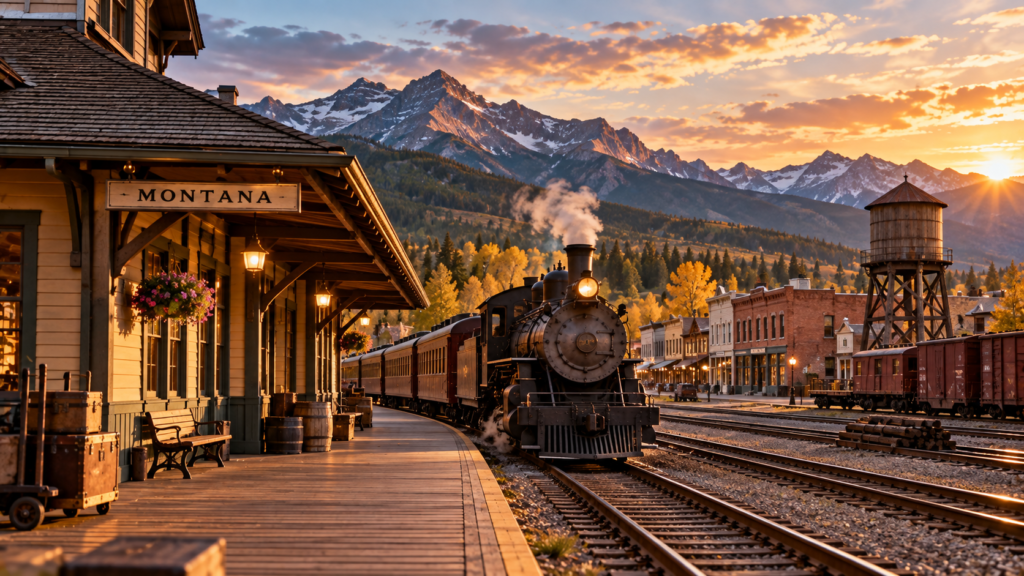
Drive through an older Montana town and something can feel strangely deliberate.
The main street may run toward the railroad.
A grain elevator stands beside the tracks.
An old brick hotel sits a few blocks away.
There is a warehouse district where the buildings seem too large for the businesses occupying them today.
Maybe an old depot survives.
Maybe the depot is gone, but an unusually wide strip of land still cuts through town.
Sometimes the tracks remain active.
Sometimes only the grade is visible.
Sometimes almost nothing obvious survives except the shape of the town itself.
That shape is not accidental.
For decades, railroads were more than transportation companies moving passengers from one place to another.
They moved cattle.
Grain.
Timber.
Ore.
Machinery.
Mail.
Workers.
Immigrants.
Tourists.
Building materials.
Consumer goods.
And wherever those movements became concentrated, communities changed around them.
Some settlements existed before the railroad arrived.
Others expanded because it arrived.
Some were deliberately developed around railroad operations.
And some discovered how vulnerable they were when trains, routes, industries, and transportation patterns changed.
Understanding Montana railroad towns therefore requires looking beyond locomotives.
The more interesting story is what happened beside the tracks.
Before the Railroad, Distance Was a Different Problem
Modern maps can make Montana’s geography deceptively simple.
A road connects one town to another.
A trip takes a few hours.
Goods can arrive by truck.
Messages move instantly.
That was not the transportation world of nineteenth-century Montana.
Movement depended on combinations of river transportation, wagons, stagecoaches, horses, freight roads, and trails.
Travel could be slow.
Weather mattered enormously.
Transporting heavy machinery or large quantities of goods overland was expensive and difficult.
Distance was not simply measured in miles.
It was measured in time, cost, terrain, weather, and access.
Railroads changed that equation.
Not everywhere at once.
Not equally.
And certainly not without conflict.
But once a community became connected to a major rail network, its relationship with distant markets could change dramatically.
The Tracks Connected Montana to Much Larger Economic Systems
A railroad line did something a wagon road could not easily reproduce at the same scale.
It moved large volumes repeatedly.
A mine could receive machinery.
A rancher could ship livestock farther away.
Farm products could reach distant buyers.
Merchants could receive manufactured goods.
Timber could move from forests toward growing industrial markets.
Passengers could travel with greater predictability.
Mail could circulate more efficiently.
This meant a Montana community no longer depended only on what could be produced, consumed, or transported locally.
The railroad connected local economies to regional and national networks.
That connection created opportunity.
It also created dependence.
The Railroad Did Not Simply Find Towns—Sometimes It Helped Make Them
It is easy to imagine railroads as lines connecting places that already existed.
The reality was more complicated.
Railroad companies needed operational points.
Stations.
Water.
Fuel.
Maintenance.
Switching.
Freight handling.
Crew changes.
Administrative facilities.
Where those needs became permanent, settlement could follow.
Businesses appeared because railroad workers and passengers needed services.
Housing appeared because workers needed somewhere to live.
Hotels served travelers.
Restaurants served passengers and crews.
Warehouses served freight.
Stores served residents.
A railroad stop could become an economic nucleus.
That is one reason the history of Montana railroad towns cannot be separated from the history of the companies that built the lines.
A Dot on the Railroad Map Could Become Valuable
Imagine two small settlements.
Both have access to nearby agricultural land.
Both have residents.
Both have merchants.
Then the railroad chooses one for its route.
Suddenly that community has an advantage.
Goods can enter and leave more efficiently.
Travelers pass through.
Businesses gain access to customers beyond the immediate area.
New residents may prefer settling near transportation.
Investors notice.
Land values can change.
The neighboring settlement has not necessarily become worse.
But the economic geography around it has changed.
Transportation infrastructure can create winners without physically destroying the places it bypasses.
Being Bypassed Could Be as Important as Being Connected
The opposite story matters too.
A town might expect the railroad.
Businesses prepare.
Landowners speculate.
Residents imagine growth.
Then surveyors choose another route.
Perhaps the terrain is easier elsewhere.
Perhaps another community offers better conditions.
Perhaps engineering requirements determine the alignment.
The railroad passes several miles away.
That distance can be enough to redirect future development.
Businesses may relocate closer to the tracks.
New construction may cluster around the station.
The original settlement may stagnate while a neighboring railroad community expands.
A few miles on a map could become an enormous economic difference.
Railroad Geography Became Town Geography
Look at historic communities and the railroad often explains features that otherwise seem arbitrary.
Why is the commercial district located there?
Why does one road run at an unusual angle?
Why are warehouses concentrated along one side of town?
Why is there a broad undeveloped corridor?
Why do grain elevators line up in a particular direction?
Why does an old hotel stand near an apparently unimportant intersection?
The answer may be the railroad.
Railroad infrastructure had physical requirements.
Tracks needed relatively manageable grades.
Stations needed access.
Freight required loading space.
Industrial customers wanted sidings.
Rail yards needed land.
Those requirements influenced the physical arrangement of communities.
Main Streets Often Developed in Conversation With the Tracks
In many western towns, commercial streets were not independent of transportation infrastructure.
They interacted with it.
Businesses wanted proximity to arriving passengers and freight.
Hotels benefited from station traffic.
Saloons and restaurants benefited from workers and travelers.
Merchants benefited from shipments.
Warehouses benefited from direct access.
The railroad therefore helped determine where commercial activity concentrated.
Even after the original station disappears, the street pattern can preserve that relationship.
The town becomes a historical document.
The Depot Was More Than a Place to Board a Train
Today, a train station is easy to understand primarily as passenger infrastructure.
Historically, a depot could play a much broader role.
People arrived there.
People departed there.
Mail passed through.
Packages arrived.
News arrived.
Visitors entered town through it.
Salespeople traveled through it.
Families waited there.
Workers gathered there.
For someone arriving in an unfamiliar Montana community, the depot might be the first building they encountered.
That gave it both practical and symbolic importance.
It was a gateway.
The Station Clock Could Reshape Daily Life
Railroads depended on schedules.
Schedules depended on standardized time.
That sounds ordinary today.
But transportation operating across long distances required communities and workers to coordinate around precise timetables.
Trains could not simply arrive “sometime in the afternoon.”
Connections mattered.
Dispatching mattered.
Crews mattered.
Freight mattered.
The railroad helped normalize a world increasingly organized around the clock.
For towns connected to the network, time itself became more standardized.
A Train Arrival Could Be a Daily Event
Imagine living in a small community before instant communication.
The train approaches.
It carries passengers.
Mail.
Packages.
Newspapers.
Goods.
Perhaps someone important.
Perhaps someone returning home.
The station becomes a place where the wider world physically arrives.
That gives train movements a social importance beyond transportation.
Residents might know the schedule even if they were not traveling.
The railroad became part of the rhythm of community life.
Hotels Naturally Gathered Near Stations
A traveler steps off a train in an unfamiliar town.
What do they need?
Food.
A room.
Transportation.
Information.
Perhaps a drink.
Perhaps a place to conduct business.
Hotels near depots were therefore strategically positioned.
Their location reduced friction for travelers.
In some railroad communities, these buildings became prominent landmarks.
Even when their original purpose faded, their location continued to reveal how the town once functioned.
Restaurants Followed the Same Logic
Passengers needed meals.
Railroad employees needed meals.
Travel schedules created predictable flows of people.
Restaurants, lunch counters, dining rooms, and other food businesses could benefit from that traffic.
Larger railroad operations might support substantial commercial activity.
A train did not only carry customers through town.
It could create the conditions for businesses specifically designed around those customers.
Railroad Workers Created Their Own Local Economy
A railroad required far more than engineers and conductors.
Track maintenance crews.
Station agents.
Telegraphers.
Machinists.
Boilermakers.
Car inspectors.
Clerks.
Switchmen.
Yard workers.
Section crews.
Roundhouse employees.
Maintenance workers.
A major railroad facility could employ enough people to support entire neighborhoods.
Those workers bought groceries.
Rented or purchased homes.
Raised families.
Used local services.
Joined community organizations.
The payroll of a railroad could circulate throughout the town.
Division Points Were Especially Important
Railroads divided long routes into operational segments.
Certain communities became places where crews changed, locomotives were serviced, trains were reorganized, equipment was repaired, or administrative work occurred.
These division points could acquire economic importance far beyond what their population might otherwise suggest.
A railroad might build substantial facilities.
Roundhouses.
Shops.
Yards.
Water infrastructure.
Offices.
Worker housing.
The result was not merely a town with a station.
It was a railroad town in the deeper sense.
Its economy and identity were intertwined with railroad operations.
Livingston Became Closely Tied to the Northern Pacific
Livingston provides a powerful example of this relationship.
Its position along the Northern Pacific made it an important railroad center.
The community became associated with railroad operations and with the route toward Yellowstone National Park.
Railroad facilities, workers, passengers, and tourism all contributed to the town’s development.
The railroad was not simply something passing through Livingston.
It became part of the town’s reason for growing.
That distinction matters.
Laurel Grew Around Railroad Function Too
Laurel’s history similarly reflects the importance of railroad operations.
Its location made it useful for switching and transportation activity.
Rail infrastructure became part of the community’s economic foundation.
Places like Laurel demonstrate why a railroad map can sometimes explain settlement patterns better than a modern highway map.
The infrastructure that mattered most when the town developed may not be the infrastructure most visible to a traveler today.
Havre Became a Northern Rail Center
Northern Montana tells another version of the story.
The Great Northern Railway pushed across the state and helped establish an important transportation corridor across northern Montana.
Havre became closely connected to that system.
Rail facilities created employment and supported the community’s role as a transportation center.
The relationship between Havre and the railroad remains visible in the city’s identity.
It is a reminder that the Hi-Line was not simply a geographic region.
It was also a transportation corridor shaped by rail.
Whitefish Developed With the Great Northern
Whitefish is now widely associated with recreation and access to spectacular landscapes.
But its railroad history is fundamental.
The Great Northern established significant operations there, and the community developed alongside those activities.
Railroad employment, maintenance functions, and transportation helped shape the town long before its modern identity fully emerged.
This is one of the fascinating characteristics of railroad communities.
Their economic identity can change while their original infrastructure remains embedded in the landscape.
Harlowton Tells a Different Railroad Story
Harlowton became closely associated with the Milwaukee Road.
The railroad’s arrival transformed the community’s importance.
It became an operational point on a major transcontinental route.
The Milwaukee Road would later become famous for its electrified operations through parts of the West, giving places along the route an association with one of the most technically distinctive chapters of American railroad history.
But Harlowton also illustrates another reality.
When railroad systems contract, towns built around them must adapt.
Three Major Transcontinental Systems Changed Montana
By the early twentieth century, Montana had been crossed by three major transcontinental railroad systems.
The Northern Pacific came first among those major routes.
The Great Northern followed.
Then the Chicago, Milwaukee & St. Paul—later commonly associated with the Milwaukee Road—extended its Pacific route through Montana.
These systems did not follow identical paths.
That mattered.
Different corridors gained different economic connections.
Different towns became operational centers.
Different agricultural, mining, timber, and commercial regions obtained rail access.
The result was not one railroad Montana.
It was a network of competing corridors.
Competition Could Be Good for Communities—and Complicated
Multiple railroads created alternatives.
A community served by more than one carrier could potentially gain better connections or shipping options.
Railroads competed for freight.
They competed for passengers.
They promoted territories along their lines.
They attempted to attract settlers and businesses.
But railroad competition also created overlapping infrastructure and intense corporate rivalry.
What looked like transportation development on the ground was also part of a much larger struggle for markets and territory.
Railroads Did Not Merely Wait for Settlers
Railroad companies had a powerful reason to encourage settlement.
More farms meant more freight.
More towns meant more passengers.
More businesses meant more shipments.
A railroad crossing empty land did not automatically generate enough revenue.
So companies promoted regions along their routes.
They advertised agricultural opportunities.
They encouraged migration.
They marketed western destinations.
Transportation companies therefore participated in shaping the population patterns that would later create demand for transportation.
The customer base could, in part, be cultivated.
Homesteading and Railroads Reinforced Each Other
The early twentieth-century homesteading boom changed Montana dramatically.
Railroads helped settlers reach the region.
They also provided ways to bring equipment and supplies in and agricultural products out.
At the same time, more settlement generated more potential freight and passenger business.
This created a powerful relationship between transportation and agricultural expansion.
The railroad was not merely observing settlement.
It was part of the infrastructure that made settlement economically imaginable for many newcomers.
Grain Elevators Became Vertical Markers of the Railroad Economy
Few structures express the relationship between farming and railroads as clearly as grain elevators.
Their location beside the tracks was practical.
Farmers brought grain to local shipping points.
Elevators stored and transferred it.
Railcars carried it toward larger markets.
As agricultural communities developed, elevators became landmarks.
Tall structures rising above relatively flat landscapes.
Visible from a distance.
Often positioned directly beside the railroad.
Even today, an old elevator can reveal where the economic center of a community once faced.
The Railroad Turned Agricultural Surplus Into Freight
A farm can produce more than the local community consumes.
But surplus has limited economic value if transporting it to buyers costs too much.
Railroads changed that calculation.
Large quantities of agricultural products could move farther.
This helped connect Montana producers to national markets.
It also meant local agriculture became more exposed to distant prices and economic conditions.
Connectivity creates opportunity.
It also connects local livelihoods to forces beyond local control.
Cattle Could Reach Distant Markets More Efficiently
Ranching also benefited from rail transportation.
Moving livestock over long distances had always been possible, but railroads changed scale and access to markets.
Communities connected to rail lines could participate more directly in wider livestock networks.
Stockyards, loading facilities, and related businesses became part of railroad landscapes.
In places such as Miles City, railroad access contributed to the growth of livestock commerce.
The tracks became part of the ranching economy.
Mining Needed Transportation on an Industrial Scale
Montana’s mining history is famous.
Copper.
Silver.
Gold.
Coal.
Other minerals.
But industrial mining requires movement in both directions.
Machinery must arrive.
Fuel may need to arrive.
Workers travel.
Ore and processed material must leave.
Supplies are consumed continuously.
A mining district without efficient transportation faces limits.
Railroads helped remove some of those limits.
That made them critical partners in the industrialization of Montana’s extractive economy.
Butte Needed More Than Mines to Become Butte
Butte’s mineral wealth was extraordinary.
But mineral wealth underground does not automatically create a major industrial city.
Extraction requires equipment.
Smelting requires infrastructure.
Workers require supplies.
Products need markets.
Transportation connects all of those elements.
Railroads therefore became essential to the scale at which Butte’s mining economy developed.
The city’s railroad history cannot be separated from its copper history.
The two systems reinforced each other.
Anaconda’s Industrial Landscape Was Also Rail-Dependent
Mining and smelting created enormous transportation requirements.
Ore.
Fuel.
Machinery.
Industrial materials.
Finished products.
Workers.
The Butte-Anaconda corridor became one of Montana’s most important industrial transportation landscapes.
Rail lines tied mines and processing facilities together.
Industrial railroads and major carriers interacted with an economy operating at a scale that horse-drawn freight could never efficiently support.
This was railroad infrastructure as industrial machinery.
Short Lines Filled Gaps the Transcontinental Routes Could Not
The famous railroads attract attention.
Northern Pacific.
Great Northern.
Milwaukee Road.
But Montana’s railroad system also depended on smaller lines and branches.
A transcontinental railroad could cross the state without reaching every mine, agricultural district, timber operation, or town.
Short lines and branch lines connected local production to larger networks.
They were the capillaries feeding the major arteries.
Without them, the main line could pass relatively close to an industry while remaining economically inaccessible.
A Spur Track Could Change a Business
Imagine operating an industrial facility.
Without direct rail access, goods must first be moved by wagon or truck to a station.
With a siding, railcars can potentially be loaded much closer to production.
That difference affects handling.
Labor.
Time.
Cost.
Scale.
Industrial geography therefore often clustered around rail access.
Factories, warehouses, mills, elevators, mines, and loading facilities were positioned not only according to where land was available but where transportation worked.
Timber Became Another Railroad Commodity
Western Montana’s forests offered enormous resources.
But timber is heavy.
Moving logs and lumber over significant distances requires transportation capacity.
Railroads helped support larger-scale timber operations by linking forest regions, mills, construction markets, mines, and distant customers.
Logging railroads and branch lines could penetrate areas where conventional transportation was difficult.
Once again, the railroad was not merely carrying an existing industry.
Its presence helped determine what scale of industry was practical.
Railroads Required Extraordinary Engineering
Montana is not easy terrain.
Prairie may look straightforward until rivers intervene.
Western Montana presents mountains.
Steep grades.
Deep valleys.
Snow.
Rock.
Water.
A railroad needs relatively controlled grades and curves compared with an ordinary road.
Engineers therefore searched for routes through terrain that seemed determined to resist them.
Passes became strategically important.
Bridges crossed obstacles.
Cuts opened paths through hillsides.
Tunnels bypassed barriers.
Railroad history is therefore also a history of landscape engineering.
Mountain Passes Could Determine Entire Routes
Finding a practical passage through the Rocky Mountains was crucial.
A difference in grade could affect operations for decades.
Steeper routes required more locomotive power.
More fuel.
Different operating practices.
Potentially more maintenance.
That is why passes such as Mullan Pass and Marias Pass became significant in Montana railroad history.
They were not simply scenic locations.
They were solutions to transportation problems.
Marias Pass Gave the Great Northern a Critical Route
The Great Northern’s route across northern Montana depended on finding a practical crossing of the Continental Divide.
Marias Pass provided that opportunity.
Its relatively favorable elevation and geography made it strategically important.
Once the route was established, the railroad could continue west through northwestern Montana toward the Pacific.
The line helped shape communities along what would become one of Montana’s most enduring railroad corridors.
Geography had determined where engineering could succeed.
Engineering then influenced where communities would grow.
Bridges Became Landmarks of Railroad Expansion
Railroad bridges are functional structures.
But historically they also represented something larger.
A bridge meant an obstacle had been overcome.
A river no longer stopped the route.
A valley could be crossed.
A network could continue.
Large trestles and steel bridges became symbols of engineering ambition.
For communities nearby, they could also become recognizable pieces of local identity.
Some survive long after the railroad company that built them has disappeared.
Tunnels Preserve Invisible Labor
A tunnel is easy to appreciate after completion.
The train enters.
The train exits.
The mountain appears conquered.
Construction was another matter.
Workers drilled.
Blasted.
Removed rock.
Installed support.
Worked in difficult and dangerous conditions.
Railroad history can become overly focused on executives and corporate names.
Infrastructure reminds us that thousands of laborers physically created these systems.
Every mile of track required human work.
Railroad Construction Brought Diverse Workers to Montana
Railroad labor drew people from many backgrounds.
Construction crews moved through difficult landscapes.
Immigrant workers contributed to the physical building of western rail systems.
Once lines were operating, railroad employment continued attracting workers to towns and facilities.
These people created families and communities.
They opened businesses.
They participated in local institutions.
The railroad therefore changed Montana’s cultural landscape as well as its transportation landscape.
Not Everyone Experienced Railroad Expansion as Progress
The traditional railroad story can easily become a celebration.
Tracks arrive.
Towns grow.
Industry expands.
Transportation improves.
But this perspective is incomplete.
Railroad expansion crossed Indigenous homelands and interacted with a much larger process of dispossession, treaty violations, federal policy, resource extraction, and settlement.
Tribal nations did not experience the transformation simply as improved transportation.
Railroads helped accelerate profound changes already being imposed across the region.
Any serious account of Montana railroad history needs to include that reality.
The Land Was Not Empty Before the Tracks Arrived
Historical promotional language often described western land as available for development.
But Montana was already home to Indigenous nations with their own territories, economies, travel routes, cultural landscapes, and political relationships.
Railroad expansion did not enter an empty map.
It entered existing worlds.
The construction of transportation infrastructure therefore had consequences that cannot be understood only through freight statistics and town growth.
Economic expansion for newcomers could coincide with severe disruption for Indigenous communities.
Both belong in the history.
Railroads Also Changed Wildlife and Resource Extraction
Transportation infrastructure does not merely move people through a landscape.
It changes what can be extracted from that landscape.
Rail access made it easier to move timber, minerals, livestock, and other resources at much larger scales.
Railroad construction itself required enormous quantities of materials.
Ties.
Fuel.
Bridge timber.
Ballast.
Steel.
Water.
The environmental history of Montana’s railroads is therefore connected to the environmental history of industrial development more broadly.
Fire Was a Constant Railroad Concern
Steam locomotives and early railroad operations introduced significant fire risks.
Sparks could ignite dry vegetation.
Wooden structures could burn.
Railroad shops handled fuel and industrial equipment.
Communities near tracks had to live with these risks.
Railroads also developed their own firefighting and prevention practices.
The romantic image of a steam locomotive moving through open country has another side.
Machines powerful enough to transform transportation also introduced new hazards.
Winter Could Turn a Timetable Into a Battle
Montana winters tested railroad operations relentlessly.
Snow accumulated in cuts.
Wind created drifts.
Extreme cold affected equipment.
Mountain routes faced avalanche danger.
Crews had to keep lines open because entire transportation networks depended on continuity.
Snowplows became essential equipment.
Maintenance crews worked in brutal conditions.
A railroad might be an industrial system, but Montana weather still had the ability to challenge it.
Snow Sheds, Plows, and Crews Were Part of the Railroad Story
The glamorous locomotive pulling a passenger train receives attention.
The snowplow clearing the route does not.
But without maintenance infrastructure, the railroad could not function.
Section crews inspected track.
Workers repaired damage.
Snow crews kept routes open.
Bridge crews maintained structures.
Signal employees supported safe operations.
Railroad history becomes much richer when we look beyond the trains to the systems that allowed trains to move.
Water Once Determined Steam-Era Operations
Steam locomotives consumed enormous amounts of water.
That requirement shaped railroad infrastructure.
Water tanks and towers appeared at strategic points.
Facilities had to supply locomotives along the route.
In arid or remote regions, reliable water could become an engineering challenge.
A structure that today looks like an isolated historic curiosity may once have been essential to keeping trains moving.
Technology leaves architecture behind.
Coal and Fuel Infrastructure Mattered Too
Locomotives also required fuel.
Railroads needed systems for storing and loading it.
Coaling facilities became familiar parts of steam-era railroad landscapes.
Together with water towers, roundhouses, turntables, depots, and yards, they created an industrial environment recognizable across railroad towns.
When diesel locomotives replaced steam, many of these structures lost their purpose.
Technology changed.
The townscape changed with it.
Roundhouses Were Workshops for the Machines That Kept the Economy Moving
Steam locomotives demanded frequent inspection and maintenance.
Roundhouses allowed railroads to service multiple locomotives.
Turntables directed engines toward individual stalls.
For major railroad centers, these facilities could be enormous.
They employed skilled workers.
They consumed land.
They produced noise, smoke, and constant activity.
A roundhouse was not simply a building.
It represented the industrial support system behind railroad transportation.
Railroad Yards Created a Different Kind of Urban Landscape
A yard is not designed primarily for beauty.
It is designed for movement and organization.
Tracks split.
Cars wait.
Trains are assembled.
Equipment is stored.
Locomotives move between assignments.
For communities beside large yards, the railroad became visually and physically dominant.
Tracks could separate neighborhoods.
Crossings could interrupt streets.
Whistles and mechanical sounds became part of daily life.
Living in a railroad town meant living beside industrial infrastructure.
The Railroad Could Unite a Town and Divide It Physically
Tracks connect communities across great distances.
Locally, they can create barriers.
A large rail corridor can divide one side of town from another.
Crossings become critical.
Pedestrian movement changes.
Industrial areas cluster along one side.
Residential areas develop elsewhere.
Even today, people may describe neighborhoods according to which side of the tracks they occupy.
That phrase became metaphorical for a reason.
Rail infrastructure could become a literal boundary within communities.
“The Other Side of the Tracks” Had Social Meaning Too
Industrial land tends to attract certain uses.
Warehouses.
Workshops.
Worker housing.
Freight facilities.
Noise.
Smoke.
Meanwhile, wealthier residential areas may develop farther from heavy operations.
Over time, transportation geography can overlap with social geography.
The railroad did not single-handedly create every class division.
But infrastructure influenced land use.
Land use influenced development.
Development influenced who lived where.
Urban history often accumulates through these layers.
Telegraph Wires Made the Railroad an Information Network
Railroads required communication.
Train movements needed coordination.
Stations needed information.
Dispatchers needed to know where trains were.
Telegraph systems developed alongside railroad routes.
This meant railroad corridors were not merely transportation networks.
They were communication networks.
Information could move along the same corridors as people and freight.
In remote communities, the railroad station could become an important connection to events happening far beyond town.
The Station Agent Could Be an Important Community Figure
Station agents occupied an unusual position.
They worked for the railroad but interacted constantly with the community.
Freight.
Tickets.
Messages.
Schedules.
Shipments.
Questions.
The agent often stood at the intersection between a national corporation and local residents.
In smaller communities, that role could carry substantial responsibility.
The depot was not merely architecture.
It was a workplace connecting local life to a much larger system.
Passenger Trains Changed the Meaning of Travel
Before rail access, a long overland journey could be physically demanding and unpredictable.
Railroads changed expectations.
Travel became scheduled.
Distances became easier to cross.
Families could maintain connections across greater distances.
Business travel expanded.
Tourism developed.
Visitors could reach Montana landscapes that previously required far more difficult journeys.
The railroad helped compress perceived distance.
Places that remained hundreds of miles apart began to feel more connected.
Tourism Became Part of Railroad Strategy
Railroad companies understood that spectacular landscapes could generate passenger traffic.
The American West was not merely something trains crossed.
It could be marketed as a destination.
Railroads promoted scenic travel and access to national parks.
Hotels, lodges, transportation connections, and promotional materials became part of this strategy.
Montana’s landscapes therefore became entangled with railroad marketing.
The railroad sold transportation.
It also sold an image of the West.
Glacier Country Became Closely Associated With the Great Northern
The Great Northern’s northern Montana route placed it in a powerful position to promote travel to the region surrounding Glacier National Park.
Railroad tourism helped bring visitors to the area.
Transportation, lodging, and promotional imagery worked together.
This relationship left a cultural legacy that extends beyond railroad operations themselves.
For many travelers, the journey became part of the destination.
Yellowstone Tourism Also Intersected With Railroad Development
Railroads competed for access to the growing tourism market surrounding Yellowstone.
Routes and connecting services brought visitors toward park gateways.
Communities benefiting from this traffic gained hotels, transportation businesses, and other services.
Tourism therefore became another way railroad geography influenced local economies.
A station could connect not only producers to markets but visitors to landscapes.
Railroads Marketed an Idealized Montana
Promotional materials rarely emphasized blizzards, drought, difficult farming conditions, or economic uncertainty.
They emphasized opportunity.
Land.
Scenery.
Agriculture.
Adventure.
Prosperity.
Railroad advertising helped construct an image of Montana for people who had never been there.
This matters historically because transportation companies were not neutral observers.
They had a financial interest in attracting passengers, settlers, and businesses to their corridors.
The Promotional Map Was Also a Business Document
A railroad map looks geographic.
But it can also be persuasive.
It shows connections.
Destinations.
Resources.
Routes.
Sometimes it makes the railroad’s territory appear central and accessible.
Maps can therefore reveal how companies wanted customers to understand the West.
A line on paper was both infrastructure and marketing.
Historical railroad maps deserve to be read with that dual purpose in mind.
Town Names Could Become Railroad Names
Railroad development influenced place names across the West.
Communities might be named for company officials, engineers, investors, geographic features, or people associated with development.
These names preserve fragments of corporate history.
A modern resident may use the name without thinking about why it exists.
But place names can function like historical fossils.
They preserve relationships long after the original context disappears.
The Railroad Created a Culture of Its Own
Railroad work developed specialized language.
Rules.
Occupations.
Traditions.
Signals.
Seniority systems.
Schedules.
Uniforms.
Stories.
Generations of families might work for the same railroad.
Children grew up around yards and depots.
Railroad identity could become family identity.
This helps explain why railroad history remains emotionally powerful even after many facilities close.
People are preserving more than machines.
They are preserving memories of work and community.
Locomotives Changed, and Towns Changed With Them
Steam locomotives required extensive infrastructure and labor.
Dieselization altered those requirements.
Diesel locomotives could operate differently.
Some servicing facilities became unnecessary.
Certain jobs disappeared.
Operational patterns changed.
For a town whose economy depended heavily on steam-era maintenance, technological progress could have local consequences.
A better locomotive for the railroad might mean fewer jobs for the community.
Innovation creates uneven effects.
Electrification Made the Milwaukee Road Distinctive
The Milwaukee Road became particularly notable for electrifying significant portions of its western route.
Electric locomotives offered advantages in mountain operations and became one of the railroad’s defining technological features.
Montana became home to infrastructure associated with this ambitious system.
Substations and other remnants became part of the historic landscape.
The railroad’s story demonstrates how transportation history can also become technology history.
The Most Modern Railroad Can Still Become History
At one moment, a railroad can represent the future.
Modern engineering.
New locomotives.
Electric operation.
Fast schedules.
Expanding markets.
Then economic conditions change.
Competition changes.
Corporate structures change.
Traffic changes.
Infrastructure ages.
Routes are abandoned.
The same system becomes something historians try to preserve.
Railroad history is full of this transformation.
Today’s infrastructure can become tomorrow’s archaeology surprisingly quickly.
Highways Changed the Competitive Landscape
Railroads did not disappear simply because people stopped liking trains.
Transportation options changed.
Automobiles gave individuals flexibility.
Trucks could move freight directly between locations without requiring a siding.
Highways improved.
Air travel transformed long-distance passenger movement.
Economic geography shifted.
Railroads remained extremely important for freight, but the kinds of services they provided changed.
Communities built around passenger traffic or labor-intensive railroad operations had to adjust.
Passenger Service Declined Across Many Routes
For generations, passenger trains connected Montana communities.
As automobile ownership and air travel expanded, many passenger routes became less competitive.
Services were reduced.
Stations closed.
Some depots lost their original function.
For towns accustomed to regular passenger trains, the change was more than transportation.
A familiar public rhythm disappeared.
The platform became quieter.
The building might remain.
The function did not.
Consolidation Changed Familiar Railroad Names
Railroad companies that once competed eventually merged or disappeared.
The Great Northern and Northern Pacific became part of Burlington Northern in 1970.
Corporate consolidation transformed the map.
Paint schemes changed.
Company names vanished.
Operational priorities shifted.
For railroad communities, this could feel like the disappearance of institutions that had been part of local life for generations.
The tracks might remain while the identity attached to them changed.
The Milwaukee Road’s Decline Left a Particularly Visible Legacy
The Milwaukee Road once represented an ambitious transcontinental system.
Eventually, much of its western network was abandoned.
Communities along the route experienced the consequences.
Tracks were removed in places.
Facilities closed.
Jobs disappeared.
Some structures survived.
Some corridors found new purposes.
The abandoned infrastructure created a distinctive historical landscape.
A railroad can disappear operationally while remaining remarkably visible geographically.
An Abandoned Grade Is Still Infrastructure
Remove rails and ties.
Years pass.
Vegetation returns.
Yet the grade may remain.
A long straight embankment.
A cut through a hill.
A bridge abutment.
A tunnel.
A flattened corridor across otherwise uneven terrain.
Once you learn what to look for, abandoned railroads become surprisingly readable.
The landscape remembers engineering.
Old Depots Often Outlive Their Railroads
A depot may become:
A museum.
Restaurant.
Community center.
Office.
Private building.
Or simply an empty historic structure.
Adaptive reuse can preserve architecture even when transportation use ends.
This creates an interesting reversal.
A building originally designed around movement becomes stationary cultural memory.
The trains leave.
The depot remains to explain why the town developed where it did.
Grain Elevators Can Tell the Same Story Without a Museum
Not every historic railroad artifact has a plaque.
An abandoned elevator beside an old grade may tell just as much.
So can a warehouse door aligned with where a siding once ran.
A broad strip of public land.
A strangely angled street.
Concrete foundations.
A bridge pier standing beside a river.
Railroad archaeology is often hidden in ordinary surroundings.
The town itself becomes the exhibit.
Some Railroad Corridors Found New Uses
Abandoned rail corridors are unusual pieces of land.
They are long.
Continuous.
Often relatively gentle in grade.
That makes them attractive for new purposes.
Trails.
Utility corridors.
Roads.
Recreational routes.
Preservation projects.
A transportation corridor can therefore have multiple lives.
The original railroad shaped the landscape strongly enough that later generations can reuse its geometry.
Active Railroads Still Matter to Montana
Railroad history is not only about abandoned depots and steam locomotives.
Freight rail remains important.
Montana continues to produce bulk commodities that are well suited to rail transportation.
Agricultural products.
Energy-related freight.
Industrial goods.
Intermodal connections.
Modern railroad operations may look different from the steam era, but the basic geographic advantage remains.
Moving large quantities over long distances is still something railroads do extremely well.
The Hi-Line Still Carries the Logic of the Railroad Era
Across northern Montana, communities remain aligned along a corridor shaped by the Great Northern.
Modern highways may parallel portions of the route.
Passenger trains still cross the region.
Freight continues moving.
The towns along the Hi-Line are therefore not merely historic railroad communities.
Many remain connected to active rail transportation.
Past and present occupy the same corridor.
Modern Freight Trains Need Different Infrastructure Than Steam-Era Trains
Today’s locomotives do not stop for water every few dozen miles.
Modern equipment can travel farther.
Train lengths have changed.
Maintenance practices have changed.
Communication has changed.
Dispatching has changed.
This means the geographic needs of railroads changed too.
A facility essential in 1910 may be unnecessary today.
When operations become more efficient, some towns lose functions they once depended upon.
Efficiency at network scale can mean contraction locally.
This Is Why Some Railroad Towns Feel Oversized Today
You may encounter a small town with surprisingly substantial historic buildings.
A large depot.
A broad commercial street.
A hotel that seems too ambitious.
Industrial land larger than current demand would suggest.
These features can be clues that the town once occupied a more important position in a transportation system.
Its architecture reflects an earlier economic geography.
The current population tells only part of the story.
Historic Population Is Not the Only Measure of Importance
A town might never have been enormous.
But if it served as a division point, junction, maintenance center, or shipping location, it could have had significance beyond its population.
Transportation networks create hierarchy based on function.
A small community can be operationally important.
This is why railroad history benefits from looking at maps and facilities rather than simply ranking towns by population.
Railroad Buildings Reveal Hierarchy
Compare a tiny flag stop with a major division depot.
The architecture itself communicates different expectations.
A small shelter suggests limited passenger activity.
A substantial brick station suggests greater traffic and permanence.
Large yards indicate operational importance.
Roundhouses indicate locomotive servicing.
Warehouses suggest freight.
Architecture can therefore help reconstruct the role a community played within the railroad system.
Preservation Is About Context, Not Just Pretty Buildings
An ornate depot is easy to appreciate.
A concrete foundation is harder.
A rusted signal mast may seem insignificant.
An abandoned grade may look like nothing.
But historical value often comes from relationships.
The depot.
Tracks.
Warehouse.
Worker neighborhood.
Industrial site.
Bridge.
Together they explain a system.
Preserving isolated objects without understanding the surrounding landscape can remove much of their meaning.
Photographs Can Reconstruct What Has Disappeared
Historic railroad photographs are especially useful because infrastructure changes rapidly.
A modern site may contain almost nothing.
An old photograph might reveal:
Six tracks.
A depot.
Water tower.
Freight house.
Roundhouse.
Workers.
Telegraph poles.
Businesses.
Suddenly the empty field makes sense.
Photographs allow historians to layer past activity onto present landscapes.
Timetables Reveal Networks That Buildings Cannot
A depot tells us a train stopped somewhere.
A timetable can tell us how that place connected to everything else.
How many trains?
At what times?
Which direction?
What other towns were linked?
How long did the journey take?
Timetables reveal the rhythm of transportation.
They transform a static map into movement.
For railroad history, that difference is crucial.
Maps Reveal Why Towns Exist Where They Do
Historical maps can show:
Main lines.
Branches.
Junctions.
Industrial sidings.
Yards.
Depots.
Town plats.
Compare these with modern maps.
Patterns emerge.
A highway may follow an old transportation corridor.
A neighborhood may occupy a former yard.
A trail may follow an abandoned branch.
A commercial district may still point toward a depot that disappeared decades ago.
Maps make hidden continuity visible.
Newspapers Reveal How Communities Experienced the Railroad
Corporate records explain what the railroad intended.
Local newspapers can show how residents experienced it.
New service announcements.
Accidents.
Schedule changes.
Construction.
Business openings.
Complaints.
Celebrations.
Labor disputes.
Depot improvements.
A railroad can look very different depending on whether the source was written by an executive, worker, passenger, farmer, merchant, or resident.
Good history benefits from those different perspectives.
Oral Histories Preserve What Corporate Records Miss
A company document might record that a facility employed 200 workers.
An oral history can tell us what the night shift felt like.
How cold the yard was.
What workers ate.
How crews communicated.
Which jobs were feared.
Which supervisors were respected.
How families reacted when layoffs came.
Statistics describe scale.
Personal memory describes experience.
Both matter.
Railroad History Is Also Family History
Many Montana families have railroad stories.
A grandfather worked in the shops.
A parent was a conductor.
Someone maintained track.
Someone operated telegraph equipment.
Someone cooked for crews.
Someone ran a hotel near the station.
Someone arrived in Montana by train and stayed.
These stories connect infrastructure to individual lives.
That is why an abandoned depot can carry emotional meaning far beyond architecture.
The Railroad Changed Who Could Imagine Living in Montana
Transportation influences migration.
A place that is extremely difficult to reach attracts different settlement patterns than one connected to national rail service.
Railroads lowered some barriers to movement.
People could relocate.
Visit relatives.
Seek employment.
Move goods.
Receive supplies.
Travel back east.
The psychological distance between Montana and the rest of the country changed.
That helped transform the state’s population.
But Connectivity Also Made Montana More Vulnerable to Distant Markets
The railroad connected producers to opportunity.
It also connected them to competition and price fluctuations.
A farmer might sell into a national market.
That meant national prices mattered.
Mining companies could ship enormous volumes.
That meant global commodity conditions mattered.
Transportation integrates economies.
Integration creates possibilities.
It also means distant events can have local consequences.
The railroad helped make Montana less isolated economically.
That was not always comfortable.
Towns Had to Adapt When Their Railroad Function Changed
A community built around a rail yard faces a difficult question when the yard shrinks.
What comes next?
Some towns diversify.
Tourism grows.
Other industries appear.
Historic architecture gains new uses.
Transportation continues in a different form.
Others struggle.
This is why railroad history does not end when the tracks are completed.
The long-term story is about adaptation.
A Railroad Town Is Not Frozen in the Railroad Era
It would be misleading to describe communities only through their historical railroad identity.
Living towns change.
Residents create new economies.
Old buildings acquire new functions.
New industries appear.
People who have no connection to railroad employment become part of the community.
History explains why a place developed.
It does not determine everything the place must become.
That distinction matters when discussing preservation.
Preservation Works Best When History Remains Usable
A building preserved but permanently empty is difficult to sustain.
Adaptive reuse can give historic railroad structures another economic life.
A depot becomes a museum.
A warehouse becomes commercial space.
A corridor becomes a trail.
A historic district attracts visitors.
Reuse inevitably changes things.
But continued use can also protect structures that might otherwise disappear.
The challenge is maintaining enough context that the history remains understandable.
Sometimes the Most Important Artifact Is the Entire Landscape
Imagine preserving one depot but removing every track, warehouse, yard structure, and industrial building around it.
The depot survives.
But understanding why it stands there becomes harder.
Railroad heritage often works at landscape scale.
Relationships matter.
Distance between buildings.
Alignment with tracks.
Connections to commercial streets.
Proximity to industrial sites.
The historic system may be more valuable than any single object.
Learning to Read a Railroad Town Changes How You Travel
The next time you pass through an older Montana community, do not look only for trains.
Look for geometry.
Where are the tracks?
Where was the depot?
Which buildings face the railroad?
Where are the elevators?
Where are the warehouses?
Is there an unusually wide corridor?
Do streets bend toward or away from the line?
Where might worker housing have been?
Where did industry cluster?
The town begins to tell a story.
Start With the Tracks, Then Look Outward
Railroad history often starts with the locomotive.
Try reversing the perspective.
Stand mentally on the tracks.
Look outward.
What depended on this line?
A mine?
Farm?
Hotel?
Warehouse?
Neighborhood?
Tourism business?
Repair shop?
Restaurant?
Entire town?
This reveals the railroad not as an isolated technology but as the center of relationships.
That is where the history becomes richer.
The Most Important Railroad Artifact May Be Something You Cannot See
Sometimes the depot is gone.
The yard is gone.
The locomotive is gone.
The company is gone.
Yet the town remains.
Its streets still follow the old alignment.
Its commercial district still occupies the same blocks.
Its grain elevators still mark the corridor.
Families still remember railroad employment.
A highway still parallels the old route.
Businesses occupy buildings originally constructed because passengers and freight once arrived nearby.
Infrastructure can disappear physically while remaining embedded in the organization of a place.
Montana’s Railroad Story Is Really a Story About Connections
It is tempting to reduce railroad history to dates.
Those dates matter.
But they are the skeleton.
The larger story is what the tracks connected.
Mines to smelters.
Farms to markets.
Forests to mills.
Ranches to distant buyers.
Workers to jobs.
Immigrants to new communities.
Tourists to landscapes.
Towns to national networks.
And, sometimes, communities to economic forces they could not control.
The railroad changed Montana because connection changes what is possible.
Conclusion
The tracks running through Montana were never merely lines between stations.
They reorganized movement, commerce, settlement, labor, industry, tourism, and the physical design of communities.
That is why the history of Montana railroad towns remains visible even where passenger trains no longer stop or old railroad facilities have disappeared.
Look at the street pattern.
The depot.
The grain elevator.
The warehouse district.
The abandoned grade.
The oversized hotel.
The old industrial corridor.
Each is evidence of a period when proximity to the railroad could influence whether a community expanded, what industries it supported, who moved there, and how closely it was connected to the wider country.
The locomotives may be the most dramatic part of railroad history.
But the towns reveal its consequences.
And in Montana, more than a century after the great railroad-building era, many of those consequences are still written directly into the landscape.
