Montana’s railway history was shaped by enormous distances, demanding terrain, harsh winters, and the constant need to move people and freight efficiently. For decades, steam locomotives were the dominant power on Montana’s railroads. They hauled coal, agricultural products, timber, livestock, machinery, and passengers across a vast landscape.
The arrival of diesel locomotives changed that system profoundly. Diesel power was more than a replacement for steam engines. It transformed maintenance practices, operating schedules, fuel logistics, locomotive design, and the economics of rail transportation.
Understanding these developments provides an important perspective on diesel locomotives history, while also revealing how technological change reshaped Montana’s transportation network.
The Era of Steam Railroading in Montana
During the formative years of Montana’s railroad network, steam locomotives were essential to the expansion of transportation across the state.
Railroads connected growing communities with regional markets and helped move Montana’s natural resources over long distances. However, steam technology came with significant operational demands.
Why Steam Locomotives Were So Important
Steam locomotives generated power by heating water in a boiler and using the resulting steam to drive pistons. The technology was powerful and adaptable, making it suitable for heavy freight trains and difficult grades.
In Montana, locomotives frequently faced steep terrain, long distances between communities, and severe winter conditions.
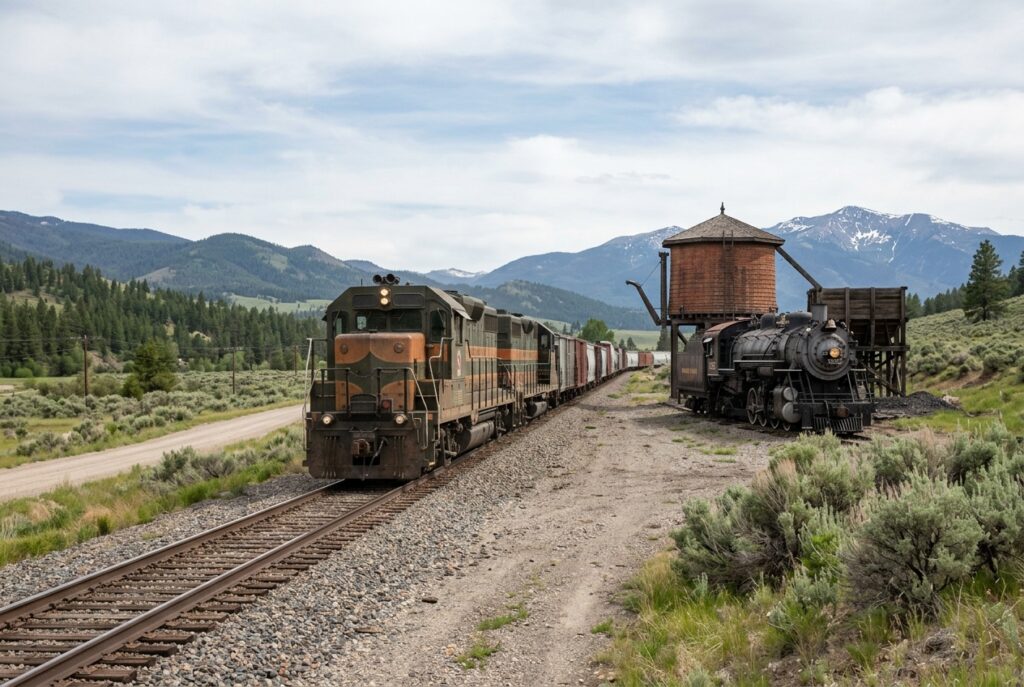
Engine crews also had to manage water and fuel supplies along their routes. Water tanks, coaling facilities, maintenance shops, and servicing points became important parts of the railroad landscape.
This infrastructure reflected the realities of steam-powered transportation.
The Cost of Maintaining Steam Power
Steam locomotives were mechanically demanding machines. Boilers, fireboxes, pistons, valves, rods, and numerous other components required regular inspection and repair.
Crews also had to clean ash, maintain fires, and prepare locomotives before and after major assignments.
For railroads operating across Montana’s extensive territory, these requirements created considerable labor and infrastructure costs.
The steam era was therefore powerful but resource-intensive.
Why Diesel Locomotives Became Attractive
Diesel technology gradually offered railroads a different approach to locomotive operation.
Instead of burning fuel directly to create steam, diesel locomotives used an internal-combustion engine to generate mechanical or electrical power for traction motors.
This design reduced many of the daily tasks associated with steam engines.
The change was particularly significant for railroads looking to improve reliability and reduce operating expenses.
Diesel Efficiency and Longer Operating Cycles
One of the major advantages of diesel locomotives was their ability to operate without the extensive water infrastructure required by steam engines.
A diesel locomotive could also remain in service for longer periods with fewer routine servicing requirements.
For Montana railroads, where distances between major facilities could be substantial, this represented an important operational advantage.
The transition therefore became an important chapter in the broader railroad technology evolution of the American West.
Montana Railway Changes During the Transition
The move from steam to diesel did not happen overnight. It developed gradually as railroad companies evaluated the costs, performance, and reliability of newer locomotives.
As diesel engines became increasingly practical, railroads began integrating them into freight and passenger operations.
These changes affected not only locomotives but also the people and facilities supporting railroad operations.
Fewer Water and Coaling Facilities
Steam locomotives depended heavily on strategically located water towers and fuel facilities.
Dieselization reduced that dependence.
As diesel locomotives became more common, some steam-era facilities became less important or disappeared altogether. Railroad yards began to change as servicing requirements evolved.
The physical landscape of Montana’s railroads consequently reflected the technological transition.
Old water tanks, coaling structures, ash pits, and steam servicing facilities gradually became remnants of an earlier era.
Changes in Railroad Labor
Dieselization also changed railroad employment.
Steam locomotives required specialized crews and extensive maintenance personnel. Firemen, for example, were responsible for maintaining the fire that powered the locomotive.
Diesel locomotives eliminated the need for manual firing.
This did not mean railroads suddenly became labor-free. Instead, the nature of railroad work changed.
Mechanical expertise increasingly focused on diesel engines, electrical systems, fuel systems, and other technologies associated with modern locomotives.
The transition demonstrates that Montana railway changes involved people as much as machines.
Diesel Locomotives and Freight Transportation
Freight transportation was one of the areas where diesel power produced some of its most important effects.
Montana’s economy depended heavily on moving bulk commodities across considerable distances. Railroads needed dependable locomotives capable of handling heavy trains and long routes.
Diesel locomotives provided operational flexibility that was difficult to achieve with traditional steam power.
More Flexible Locomotive Operations
Diesel locomotives could be coupled together and operated as multiple-unit combinations.
This allowed railroads to assemble locomotive power according to the demands of individual trains.
A heavier freight train could receive additional diesel units, while a lighter assignment might require fewer locomotives.
This flexibility made railroad operations more adaptable.
It also helped railroads respond to changing freight volumes without relying entirely on increasingly large steam locomotives.
The Impact on Montana’s Railroad Towns
Railroad technology influenced communities as much as it influenced tracks and locomotives.
Many Montana towns developed around railroad facilities, including depots, yards, maintenance shops, water stations, and fueling locations.
As diesel technology replaced steam, some of these functions declined in importance.
A Changing Railroad Landscape
Communities that once supported large steam servicing operations could experience changes in employment and railroad activity.
Some facilities were modernized for diesel operation, while others were abandoned or demolished.
This created a visible connection between technological progress and historical preservation.
Today, surviving depots, maintenance buildings, bridges, and other structures can help tell the story of how Montana’s railway system evolved.
These sites are valuable pieces of Montana railroad history because they reveal how technological decisions affected physical communities.
Steam Versus Diesel: A Fundamental Technological Shift
The transition from steam to diesel was not simply about replacing one locomotive with another.
It represented a fundamental change in how railroads generated and managed power.
Steam locomotives required a continuous process involving fuel, water, combustion, and boiler pressure. Diesel locomotives concentrated much of the power-generation process inside a compact engine system.
This difference affected nearly every part of railway management.
Reliability and Maintenance
Diesel locomotives generally required fewer routine servicing activities than steam locomotives.
Their operation reduced the need for constant fire management and eliminated many boiler-related tasks.
For railroad companies, this could mean more predictable maintenance schedules and improved locomotive availability.
Reliability was particularly valuable in Montana, where winter weather could make railroad operations challenging.
The Broader Railroad Technology Evolution
Dieselization was part of a larger technological transformation taking place throughout the American railroad industry.
Railroads were gradually moving toward more standardized, efficient, and mechanically sophisticated operations.
Diesel locomotives became increasingly powerful and capable of handling demanding freight assignments.
At the same time, improvements in signaling, track maintenance, communications, braking systems, and freight equipment contributed to a more modern railway network.
Montana participated in this national transformation while retaining the distinctive challenges of its geography.
What Happened to Montana’s Steam Locomotives?
As diesel locomotives became dominant, steam engines were gradually retired.
Some were scrapped for their metal, while others survived in museums, historical collections, and preserved railroad environments.
A small number of steam locomotives eventually found new lives in excursion and heritage operations.
Their survival provides an opportunity to understand the machinery that once powered Montana’s railroads.
For historians, the contrast between preserved steam locomotives and later diesel equipment offers a tangible illustration of diesel locomotives history.
Why the Diesel Transition Still Matters Today
The diesel era fundamentally influenced the modern Montana railway.
Many operational practices established during the transition remain part of contemporary railroading. Modern locomotives continue to benefit from the principles of centralized power, multiple-unit operation, improved fuel efficiency, and reduced servicing requirements.
The transition also changed how railroad companies viewed distance.
A locomotive no longer needed the same network of water and steam-support facilities that had once been essential.
That helped create a more flexible transportation system capable of serving Montana’s enormous geographic area.
Preserving the Story of Montana’s Railway Transformation
The introduction of diesel locomotives should be remembered as more than a technical milestone.
It was a turning point that affected workers, communities, railroad facilities, freight transportation, and the physical appearance of Montana’s railway corridors.
Exploring Montana railway history can therefore reveal a much broader story about industrialization and technological adaptation.
Surviving railroad buildings and historic equipment provide evidence of the transition, while abandoned facilities can show what happened when older technologies became obsolete.
For anyone interested in historic railroad infrastructure, these remnants offer valuable clues about the changing demands of transportation.
The story also demonstrates that technological progress rarely happens in isolation. A new locomotive design can reshape workplaces, towns, maintenance systems, and entire transportation networks.
The Lasting Legacy of Dieselization in Montana
The shift from steam to diesel marked one of the most consequential changes in Montana’s railroad development.
Steam locomotives had helped establish the state’s railway network and connect Montana with distant markets. Diesel locomotives then transformed that network into a more efficient and flexible transportation system.
The transition reduced dependence on water and coal facilities, changed railroad jobs, modernized maintenance practices, and improved the economics of long-distance locomotive operation.
Most importantly, it became a defining stage in the railroad technology evolution that continues to influence rail transportation today.
Montana’s railway landscape still carries traces of both eras. Steam-era structures and surviving locomotives represent the engineering traditions of the past, while diesel-powered freight trains demonstrate how dramatically railroad technology changed.
Together, they tell the story of an industry constantly adapting to geography, economics, and innovation—and explain why the introduction of diesel locomotives remains one of the defining chapters in Montana’s railroad history.


