
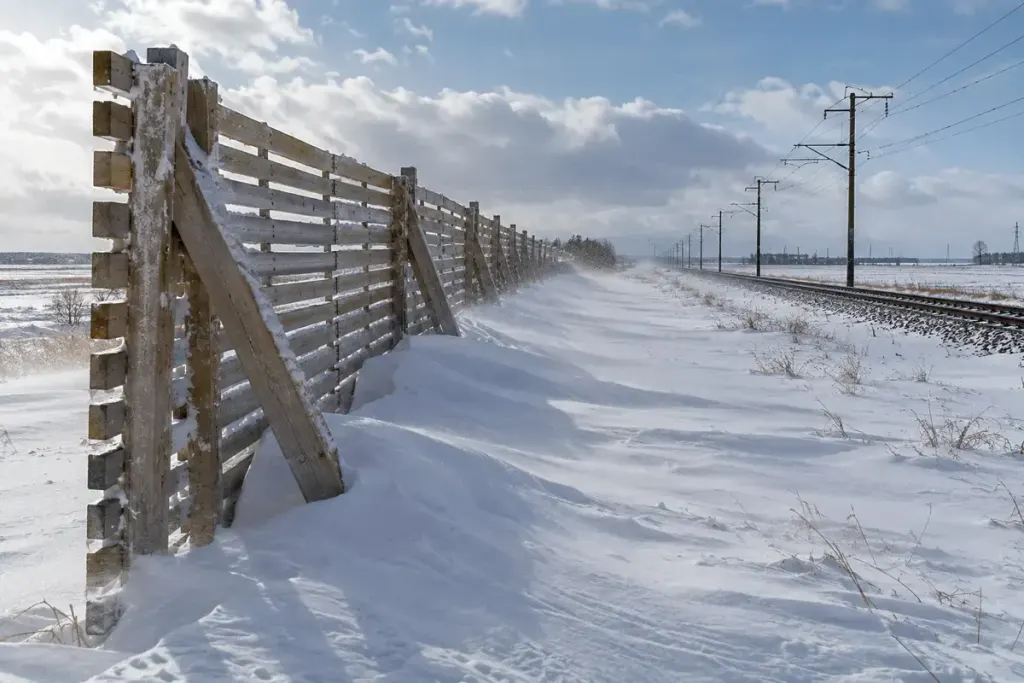
A long fence standing away from a railway may seem oddly placed if you assume its job is to mark the property edge. In exposed country, its purpose may be to influence where windblown snow accumulates.
Union Pacific’s track-maintenance glossary defines a snow fence as a barrier along the right of way intended to prevent blowing snow from drifting onto the track. It belongs to the railway’s winter preparation, alongside the equipment that deals with snow already present.
Read the space around the fence
When studying a photograph, look at the open ground, the track position and the fence’s direction. A fence set back from the railway leaves space for a drift to form away from the running line. Its relationship to the prevailing conditions is part of the explanation, so appearance alone cannot establish whether an old installation was well designed.
Notice whether the image shows a continuous fence, separate sections or a natural shelterbelt. Record those features without assuming that every barrier in a snowy railway scene has the same function.
Three useful archive questions
- Does the caption identify the installation as a snow fence, or is that your interpretation?
- Was the photograph taken before or after a storm?
- Are the date, railway and location specific enough to find maintenance records or another view?
A summer photograph can be especially useful because it reveals the structure that winter drifts partly conceal. Comparing seasons may show why a seemingly remote line of fencing belongs in the railway story.
Keep field observation to lawful public viewpoints. A fence beside a railway is not an invitation to cross railway land, and winter conditions can hide both boundaries and hazards. For historical research, the strongest account combines the visible structure with a dated caption or railway record, rather than treating a plausible explanation as a confirmed identification.