
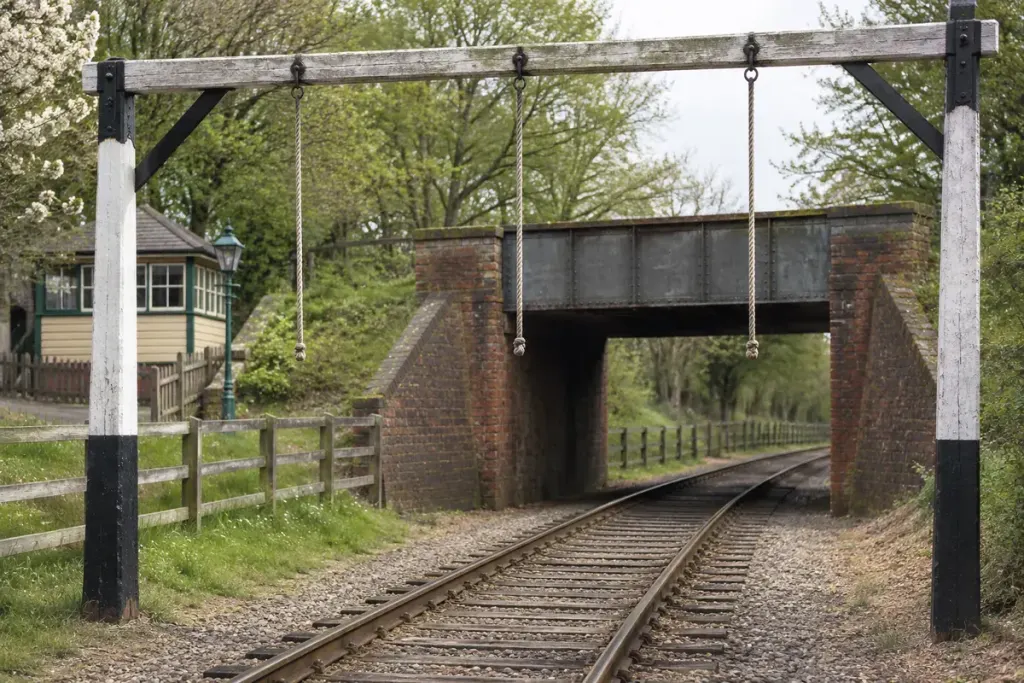
In a railway photograph, the eye usually follows the locomotive and the bridge span beneath it. The masonry or concrete at the ends can be just as informative. An abutment connects the bridge structure with its approach and provides support at the end of the span.
The Federal Highway Administration’s bridge-inventory definitions describe an abutment as an end substructure transferring loads to the foundation and supporting the approach embankment. Although that document concerns highway inventory, the distinction between an end abutment and an intermediate pier is useful when learning to read railway structures.
Look where the span meets the approach
Start with a photograph or an authorised public viewpoint. Identify the span, its end supports and any supports between the ends. Do not assume every wall beside the railway is an abutment: retaining walls and wing walls can have related but different positions and functions.
For a historical comparison, place two dated photographs side by side. Does the visible span change while the end masonry appears similar? Has the opening widened? Are there unused support surfaces or a nearby remnant aligned with an earlier route? These are questions for further research, not proof of a rebuilding date.
A replacement span can make a bridge look newer than parts of its supporting structure. Conversely, repairs or facing work can alter the appearance of an old abutment. Construction records, engineering drawings and contemporary reports are better evidence than a guess based only on stone colour.
Make a record that separates sight from inference
Write “masonry end support visible on the eastern side” before writing “original nineteenth-century abutment.” The first is an observation; the second needs evidence. Add the image date, viewpoint and any uncertainty about orientation.
Never enter railway property or climb a structure to improve the view. Historical interpretation also cannot establish whether a bridge is safe for use. From an archive photograph, the useful achievement is a better question: which parts belong to the same construction phase, and which records might explain the differences?