
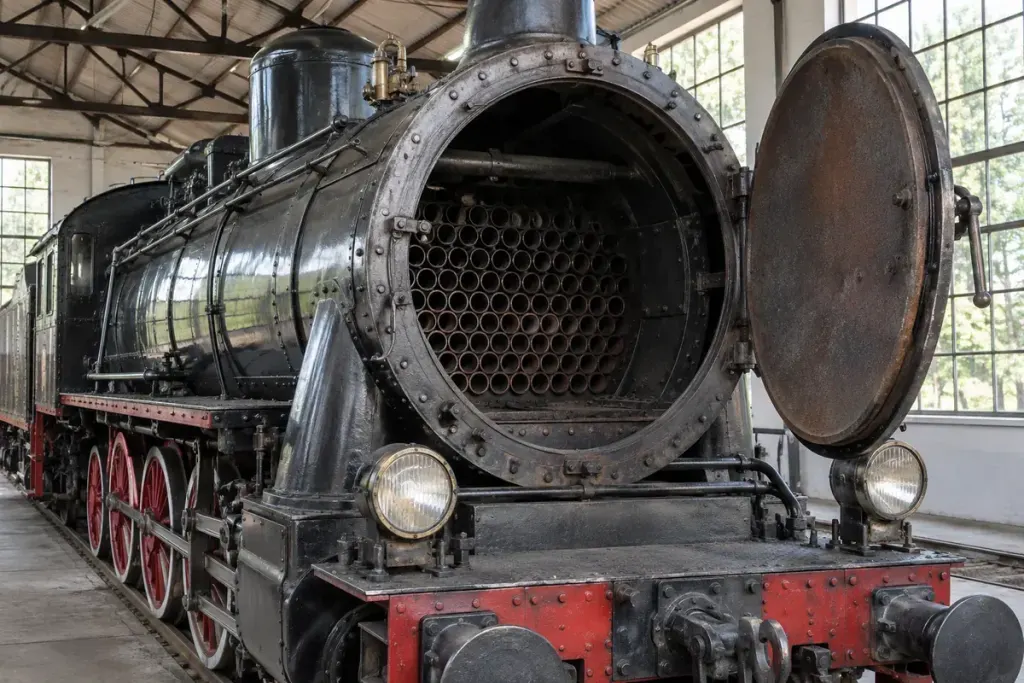
The round door at the front of many steam locomotives opens onto a chamber with a very different job from the water-filled boiler behind it. This is the smokebox: a place where combustion gases arriving through the boiler tubes are directed toward the chimney.
Reading a cutaway becomes easier if you trace two paths separately. Hot gases travel from the firebox through tubes surrounded by boiler water. The water receives heat while remaining outside those gas passages. At the forward end, the tubes open into the smokebox.
The National Railway Museum’s steam-locomotive support material explains how exhaust steam from the cylinders passes through the blast pipe below the funnel. Its action helps draw the firebox gases through the tubes. The front chamber therefore participates in the draught that keeps the fire working.
Three things to find in a display
- The tube ends: locate where combustion gases enter the front chamber.
- The blast pipe: follow its relationship to the chimney rather than assuming every visible pipe carries fresh steam to a cylinder.
- The access door: notice how the chamber can be reached for inspection and maintenance when the locomotive is safely out of service.
Details vary between locomotive designs. Spark-control arrangements, exhaust systems and the shape of the chamber are reasons to read the label for the actual engine, rather than treating one diagram as a universal drawing.
A useful comparison is the Science Museum Group’s quarter-scale smokebox and Kylchap blast-pipe model. A model can make the relationship between parts easier to see than an assembled locomotive with its door closed.
For a museum notebook, record the locomotive number and photograph the smokebox door from the permitted viewing area. Compare its hinges and fastening arrangement with a second engine. Ask whether the museum has a maintenance drawing for that specific class: a closed door tells you little about the exhaust equipment hidden behind it.