Before the railroad, distance shaped almost everything in Montana.
Moving people, mining equipment, livestock, timber, and agricultural products across the territory could be slow and expensive. Then steel rails began pushing through the landscape, connecting isolated communities to national markets.
The change was much larger than transportation.
Montana railroad towns grew around depots, division points, repair facilities, mining connections, and places where trains needed water, fuel, crews, or freight. Some became permanent cities. Others prospered briefly before changes in railroad operations left them behind.
To understand many Montana communities, it helps to begin with the tracks.
Before the Rails, Geography Controlled the Economy
Montana’s mountains and enormous distances made transportation difficult.
Before extensive railroad development, rivers, wagon roads, and trails carried much of the movement through the territory. These methods worked, but they placed practical limits on how quickly goods and people could travel.
Railroads changed that equation.
The Utah & Northern reached Butte in 1881, connecting the booming mining district with the wider rail system. Just two years later, the Northern Pacific completed its transcontinental route across Montana. Montana Historical Society
Suddenly, a remote mining or agricultural region could have a much stronger connection to distant markets.
A Railroad Needed More Than Tracks
A railway was an entire operating system.
Steam-era trains needed depots, sidings, water, maintenance facilities, freight yards, crew bases, and places where locomotives and cars could be serviced.
Where railroads established important operating points, workers followed.
Those workers needed houses.
Families needed stores, schools, services, and businesses.
A railroad facility could therefore become the economic foundation around which a community developed.
That is one reason historic railroad geography remains visible in Montana today. Communities including Livingston, Laurel, Harlowton, Havre, and Whitefish were supported by significant railroad switching or repair facilities. Montana Historical Society
Livingston Shows How a Railroad Could Shape a Town
Livingston offers a particularly clear example.
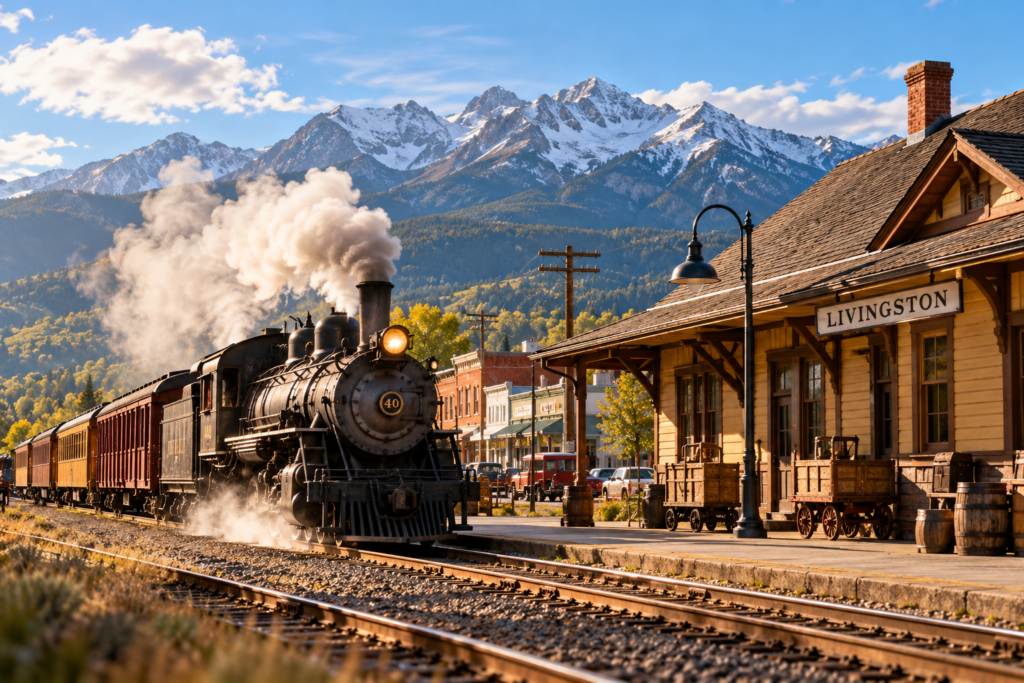
The Northern Pacific established Livingston as an important division point and maintenance center in the early 1880s. It also became associated with travel toward Yellowstone National Park. Wikipedia
That meant trains were not simply passing through.
Railroad operations created continuing activity.
Employees worked there. Passengers arrived there. Supplies moved through the town. Hotels, shops, restaurants, and other services could develop around that traffic.
The depot was not merely somewhere to board a train.
It helped define the town’s relationship with the outside world.
Railroads Could Create Communities Almost Intentionally
Some railroad settlements did not grow gradually around an existing town.
Railroad companies could actively promote settlement along their routes.
The Great Northern Railway became especially influential across northern Montana. Its route formed the corridor commonly associated with Montana’s Hi-Line, and the railroad promoted settlement along the territory it served. Communities such as Havre and Glasgow benefited from this expansion. Montana Beyond
For settlers, proximity to rail transportation mattered enormously.
A farm located near a railway had better access to markets than one isolated from affordable transportation.
The railway therefore influenced not only where people traveled but where some people decided to live and build businesses.
Mining Made Rail Connections Extremely Valuable
Montana’s railroad development cannot be separated from mining.
Butte was one of the most important examples.
Railroads could bring machinery and supplies into mining districts while carrying ore and other products outward.
This made industrial communities especially attractive destinations for railroad builders.
Smaller lines and branches also developed to connect productive areas with larger networks.
The result was a landscape in which tracks often reveal the economic priorities of an earlier Montana: mining districts, agricultural areas, timber regions, and commercial centers became connected through an expanding rail system.
Competition Produced Different Routes Across Montana
Montana was not shaped by a single railroad.
Several major systems crossed the state.
The Northern Pacific completed its transcontinental route through Montana in 1883. The Great Northern later crossed northern Montana on its route toward the Pacific Northwest, reaching Seattle in 1893. The Milwaukee Road entered Montana in 1907 and completed its Pacific extension in 1909. Montana Historical Society
Each system made different routing decisions.
Those decisions mattered.
A town located on a main line could receive regular traffic and investment, while another community only a modest distance away might remain comparatively isolated.
Railroad maps therefore became something like economic maps.
Where the tracks went, opportunities often followed.
The Railroad Also Changed Existing Communities
Not every railroad town started from nothing.
Some communities existed before the rails arrived but were transformed afterward.
Businesses moved closer to depots.
Warehouses appeared near sidings.
Hotels positioned themselves for passengers.
Industrial operations sought convenient rail access.
Even the physical layout of a town could reflect its relationship with the railroad.
This is why old depots and abandoned grades are valuable historical evidence. They can help explain why commercial districts developed where they did and why certain communities became regional centers.
The Transformation Came With Serious Costs
Railroad expansion was not simply a story of technology and economic growth.
Tracks crossed landscapes that were already inhabited and used by Indigenous peoples.
Railroad expansion contributed to profound changes in land control, settlement, wildlife, and access to traditional resources. Montana Historical Society educational material notes that tribes lost millions of acres between 1870 and 1890, with railroad expansion playing an important role in that transformation. Montana State Government
That history matters when discussing Montana railroad towns.
The same infrastructure that created new economic opportunities for settlers and businesses was also part of a much larger transformation that imposed severe consequences on Native communities.
A Town’s Dependence on the Railroad Could Become a Weakness
The same railway that helped a community grow could eventually make that community vulnerable.
Railroad technology changed.
Steam locomotives disappeared.
Routes were consolidated.
Passenger services changed.
Maintenance facilities closed or moved.
Branch lines were abandoned.
If a town depended heavily on railroad employment, losing a division point or major line could remove one of its primary economic reasons for existing.
Some communities adapted.
Others declined.
And some former settlements became little more than names on historic maps.
Abandoned Tracks Still Tell the Story
An abandoned railroad grade may initially look like an empty strip of land.
Historically, it can reveal much more.
Follow the old route and you may find former depot sites, bridge foundations, industrial remains, altered street patterns, or communities whose histories make far more sense once the railway is placed back on the map.
Even Montana’s lesser-known railroads left traces.
The Montana Railroad, nicknamed the “Jawbone,” was built between Lombard and Lewistown around the turn of the twentieth century before being absorbed into the Milwaukee system. Much of the Milwaukee Road trackage associated with the route was later abandoned. Wikipedia
Routes disappeared, but the geography they created did not completely vanish.
Montana’s Railroad Towns Were Part of a Larger Network
It is tempting to look at an old depot as a purely local landmark.
But historically, that depot represented connection.
A train arriving in a small Montana community could connect local ranchers, miners, merchants, workers, and passengers to a transportation system extending hundreds or thousands of miles beyond town.
That was the transformative power of the railroad.
It reduced the practical isolation created by Montana’s enormous distances and connected local economies with national ones.
The tracks were physical infrastructure.
But the real change was connectivity.
Conclusion
The history of Montana railroad towns explains why so many communities developed where they did.
Railroads brought workers, freight, passengers, investment, industry, and access to distant markets. Depots and railroad facilities became anchors around which businesses and neighborhoods could grow.
But the story was never simply one of progress. Railroad expansion also reshaped Indigenous lands and communities, while towns that became dependent on rail activity could suffer when routes and operations changed.
Today, old depots, abandoned grades, bridges, rail yards, and surviving tracks remain evidence of that transformation.
Look closely at an old Montana railroad map and you are not merely looking at transportation history.
You are looking at part of the blueprint that helped shape modern Montana.