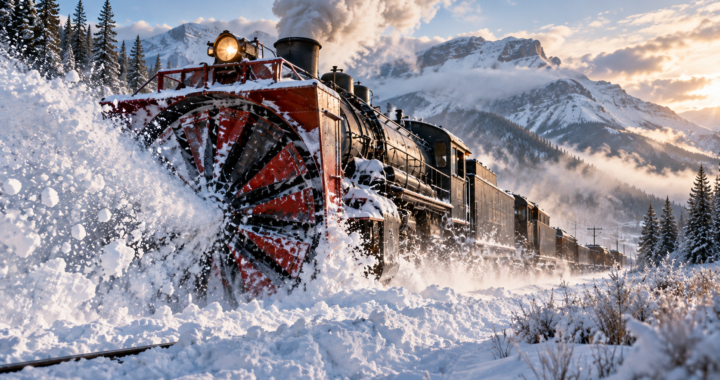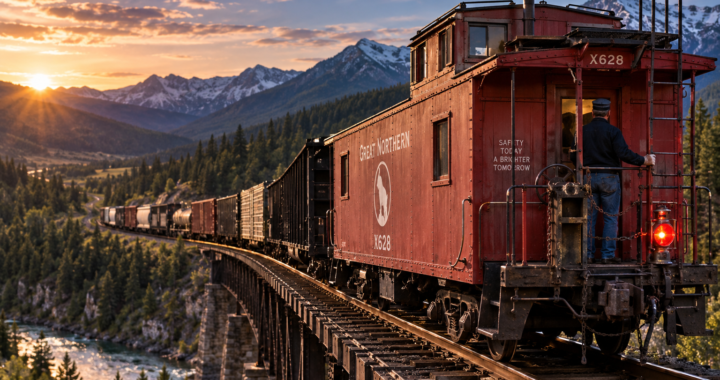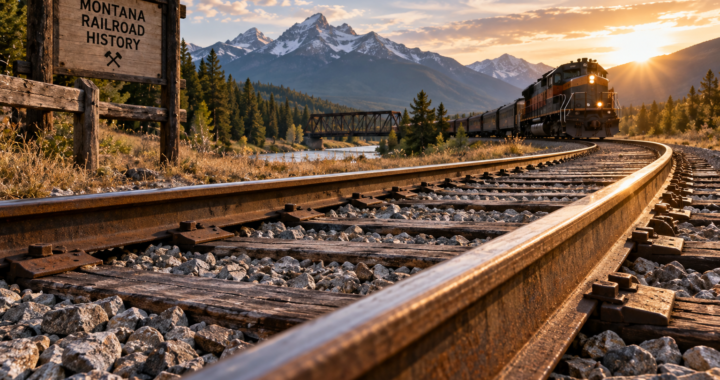
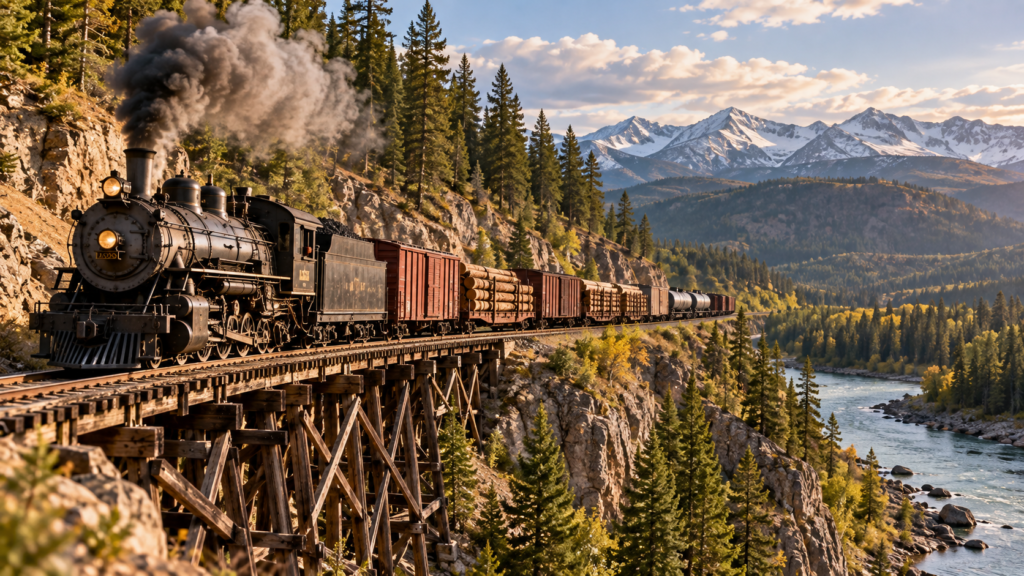
A freight train moving across Montana in the late nineteenth or early twentieth century was more than a collection of railroad cars.
It was part of an economic system that was changing the state.
Ore could leave a mining district in quantities that would have been extraordinarily difficult to move by wagon. Ranchers gained better access to distant livestock markets. Farmers could ship agricultural products beyond their immediate communities. Machinery, manufactured goods, construction materials, and supplies could travel in the opposite direction.
The railroad did not simply make transportation faster.
It changed what could realistically be produced, sold, purchased, and built.
Understanding Montana railroad freight therefore means looking beyond locomotives and tracks. The cargo inside the cars helps explain why railroads became so important to mining districts, ranches, farms, lumber operations, towns, and businesses throughout the state.
To understand Montana’s railroad history, it is worth asking a simple question:
What were all those trains actually carrying?
Before the Railroad, Distance Was an Economic Problem
Montana possessed valuable resources long before extensive railroad networks crossed the territory.
The difficulty was transportation.
A mine could contain valuable ore, but the material still needed to reach processing facilities or markets.
A ranch could raise cattle, but livestock needed access to buyers.
Merchants needed manufactured goods.
Mines needed equipment.
Communities needed building materials and everyday supplies.
Moving heavy freight over long distances by wagon was slow and expensive.
River transportation provided another important connection, particularly through the Missouri River and Fort Benton, but it could not provide the extensive year-round inland network that railroads eventually created.
As railroads expanded during the 1880s, they increasingly displaced older transportation systems and connected Montana communities to national markets.
Railroads Changed the Meaning of Distance
Before reliable rail transportation, a distant market might as well have been inaccessible for certain commodities.
The product could be valuable.
But if transportation cost too much relative to the value of the cargo, shipping it made little economic sense.
Railroads changed that calculation.
A freight car could move large quantities of material over long distances much more efficiently than wagon transportation.
Suddenly, Montana’s location far from major population centers became less restrictive.
Chicago, Minneapolis, St. Paul, Seattle, and other markets became part of a broader commercial network connected by steel rails.
Mining Was One of the Strongest Reasons Railroads Came to Montana
Montana’s mining industry created enormous demand for transportation.
Mining required more than moving valuable material out of the state.
Mines also consumed equipment.
Machinery.
Timber.
Fuel.
Tools.
Construction materials.
Replacement parts.
Food and supplies for workers and communities.
Railroads therefore served mining districts in both directions.
Heavy industrial materials moved in.
Ore and other products moved out.
Butte Demonstrates the Connection Clearly
Montana’s first railroad connection was closely associated with mining.
In 1881, the Utah and Northern reached Butte, linking the mining district with the Union Pacific system farther south. Montana Historical Society educational material specifically identifies copper exports and imported mining equipment as major economic reasons for connecting Butte by rail.
That tells us something important about early Montana railroad freight.
The railroad was not simply following population.
It was following economic opportunity.
Butte offered exactly that.
Ore Was Heavy
This obvious fact mattered enormously.
Mining produces material that must physically move.
Large quantities of rock and ore cannot conveniently be transported hundreds of miles by horse-drawn wagon at industrial scale.
Railroads were exceptionally well suited to heavy bulk cargo.
Once tracks reached important mining regions, extraction could operate within a much larger transportation system.
The mine was no longer only connected to the nearest road.
It was connected to a railroad network.
Railroads Also Helped Mines Become More Industrial
Transportation worked in both directions.
Railroads could bring machinery and equipment into Montana, helping industrialize mining and other sectors. The Montana Historical Society describes this two-way role directly: trains carried Montana resources outward while bringing farming equipment, consumer goods, and machinery needed for mine development into the state.
This is easy to overlook.
We often imagine freight trains carrying Montana’s resources away.
But inbound freight was equally important to economic development.
Coal Became Important Railroad Freight—and Railroad Fuel
Coal had a particularly interesting relationship with railroads.
Railroads could transport coal.
But steam railroads also consumed coal.
This created a transportation system that could stimulate demand for one of the commodities it carried.
Coal deposits located near useful railroad connections therefore had potential economic advantages.
Rail access could turn a difficult-to-transport resource into a commercially useful one.
Branch Lines Could Exist Because of a Particular Commodity
Not every railroad in Montana existed primarily to connect major cities.
Some smaller lines and branches were closely connected to particular industries or resource districts.
Coal.
Timber.
Ore.
Agriculture.
A mine or industrial operation located away from a main line could create demand for a branch or short-line connection.
The Montana Historical Society notes that smaller railroads and spurs connected specific communities and commodities to the larger system.
Freight Helps Explain Why Some Tracks Went Where They Did
Look at an old railroad map and a route may initially seem strange.
Why did a line bend toward one valley?
Why did a branch extend toward a small community?
Why was a railroad built into an area that never developed a large population?
The answer may be freight.
Railroads needed traffic.
A mine, mill, timber operation, agricultural district, or coal field could provide the traffic necessary to justify a line.
Cattle Were Freight Too
When we think of freight, we often imagine crates or raw materials.
But livestock traveled by rail as well.
Montana’s cattle industry depended increasingly on access to distant markets.
Before modern refrigerated trucking and interstate highways, railroads provided an important way to move large numbers of animals over long distances.
Livestock cars became moving pieces of the ranching economy.
Montana Cattle Could Reach Major Markets
Rancher Conrad Kohrs provides an early example of how rail transportation could expand the market available to Montana livestock producers.
The National Park Service notes that Kohrs began rail shipments to Chicago’s Union Stock Yard in 1874, even before Montana had developed the extensive rail network that would later cross the state.
That demonstrates the economic attraction of railroad access.
A rancher’s potential customer base no longer needed to be local.
Shipping Livestock Was More Complicated Than Loading a Boxcar
Cattle were living cargo.
They required different handling from lumber, ore, or machinery.
Animals needed to be loaded.
Moved safely.
Watered and cared for during transportation.
Unloaded at appropriate facilities.
Railroad infrastructure associated with livestock could therefore include stockyards, loading pens, ramps, and related facilities.
A town located along a railroad in ranching country might become an important livestock shipping point even if it was not a major passenger destination.
Stockyards Became Part of the Railroad Landscape
Imagine arriving in a Montana railroad town during a major livestock shipment.
The station was only one piece of the environment.
Nearby might be:
Sidings.
Freight platforms.
Warehouses.
Stock pens.
Water facilities.
Railroad offices.
Maintenance structures.
Loading areas.
Railroad communities were often industrial landscapes, not simply picturesque depots.
Ranching Became Connected to National Prices
Rail transportation also changed how ranchers thought about markets.
A local shortage or surplus was no longer the only factor determining opportunity.
Prices in distant markets mattered.
Transportation rates mattered.
Rail schedules mattered.
Demand elsewhere mattered.
The railroad connected Montana ranching more directly to a national commercial system.
That connection created opportunity, but it also created dependence on conditions far beyond the ranch.
Grain Became Another Important Type of Freight
As agricultural settlement expanded, railroads became essential to moving farm products.
Grain is a classic railroad commodity.
It is produced seasonally.
It can be stored.
It is relatively dense.
And agricultural regions can generate enormous quantities of it.
Without efficient transportation, farmers are limited by the size of nearby markets.
Rail access dramatically changes that equation.
A Farmer Could Produce for People Hundreds of Miles Away
Imagine a wheat farmer before extensive rail transportation.
Producing more grain than the local area could consume was not necessarily useful if transportation costs made distant sales impractical.
With a railroad connection, surplus production could reach larger markets.
This encouraged a different scale of agriculture.
The railroad was therefore not merely transporting the harvest.
It influenced what farmers could economically justify planting.
Grain Elevators Changed the Appearance of Railroad Towns
As grain production expanded, elevators became characteristic structures along railroad lines across agricultural regions of the West.
Their placement was logical.
Farmers brought grain to a collection point.
The elevator stored and handled it.
Railcars carried it onward.
The relationship between agriculture and railroad transportation became physically visible in the town.
A tall grain elevator beside a track was effectively a transfer point between farm and national market.
Freight Facilities Could Matter More Than Passenger Facilities
Historic photographs often focus on passenger depots because they are architecturally interesting.
But economically, the freight side of a railroad property could be equally important.
A town might have:
A freight house.
Loading platform.
Warehouse.
Stock pens.
Coal facilities.
Industrial sidings.
Team tracks where wagons could transfer cargo to railcars.
These spaces reveal what the railroad actually did for the local economy.
Timber Moved by Rail
Montana’s forests supported another major industry.
Logging supplied timber for buildings, mines, railroad construction, and other uses.
Railroads themselves required enormous quantities of wood during their expansion.
Ties had to support the rails.
Bridges and trestles needed structural material.
Stations, warehouses, water tanks, and other facilities required construction lumber.
Mines also consumed timber to support underground workings. Montana Historical Society material notes the heavy demand for wood from railroads, mines, and construction.
The Railroad Could Both Consume and Transport Timber
This created another interesting economic relationship.
Railroad expansion increased demand for timber.
Then railroad transportation helped move timber products.
Logging areas that were difficult to reach by wagon could become more economically useful when connected to rail.
Specialized logging railroads sometimes extended transportation deeper into timber-producing regions.
The rail system was both customer and carrier.
Lumber Helped Build Growing Towns
As Montana communities expanded, they needed construction material.
Homes.
Stores.
Barns.
Industrial buildings.
Railroad structures.
Warehouses.
Lumber could move from sawmills toward developing towns.
Again, freight was not simply leaving Montana.
Materials circulated within the state as well.
Railroads connected producers and consumers on multiple scales.
Manufactured Goods Came Into Montana
Railroad freight was not only about raw materials.
Imagine a general store in a growing Montana town.
Its shelves might contain products manufactured far away.
Tools.
Clothing.
Household goods.
Hardware.
Food products.
Furniture.
Farm equipment.
Industrial supplies.
Many of these goods could arrive more efficiently because of the railroad.
The Railroad Changed What Stores Could Sell
Transportation influences retail.
If goods are expensive and unreliable to transport, merchants must be cautious about what they stock.
Railroads increased access to larger distribution networks.
A merchant could order goods produced far outside Montana and receive them through established transportation systems.
That expanded consumer choice.
It also tied local businesses more closely to national manufacturers and wholesalers.
Mail Traveled Through the Railroad Network
Freight and passenger trains also helped move information.
Mail was a crucial railroad cargo.
Before electronic communication became dominant, physical letters, newspapers, business documents, catalogs, and packages connected communities.
Railroads dramatically accelerated those connections.
A train arriving in town did not merely deliver objects.
It delivered information.
Catalog Shopping Became More Practical
The growth of national mail-order businesses depended heavily on transportation networks.
A household far from a major city could browse a catalog and order products manufactured elsewhere.
Those products still had to physically reach the customer.
Railroads made that commercial relationship practical across enormous distances.
This gradually changed expectations about what rural and small-town consumers could purchase.
Newspapers Also Became More Timely
Information had economic and social value.
Newspapers from distant cities could arrive faster.
Local papers could obtain information and materials more efficiently.
Businesspeople could communicate with suppliers and customers.
Families could exchange letters.
Rail transportation reduced the isolation created by Montana’s enormous distances.
Construction Materials Arrived by Freight Train
Growing towns needed more than lumber.
They needed:
Brick.
Metal.
Glass.
Hardware.
Pipe.
Tools.
Machinery.
Fixtures.
Coal.
Cement and other building materials as construction methods evolved.
Railroads allowed heavy materials to travel farther at lower cost than many earlier transportation methods.
This influenced what could realistically be built.
The Railroad Helped Build the Town That Supported the Railroad
There was a circular relationship.
A railroad arrived.
Businesses appeared.
Buildings were constructed.
People moved into the area.
Those people needed goods.
Businesses needed supplies.
The growing town then generated additional freight and passenger traffic for the railroad.
Transportation encouraged settlement.
Settlement created transportation demand.
Machinery Was Especially Important
Industrial development depends on machines.
A mine may require pumps, hoists, drills, compressors, and processing equipment.
A farm may need increasingly sophisticated agricultural machinery.
A sawmill requires equipment.
Workshops need tools.
Moving large machines by wagon over long distances could be difficult.
Railroads provided a practical way to bring industrial equipment into developing regions.
Freight Could Transform a Small Community Quickly
Consider a settlement before rail access.
Its economy is primarily local.
Then a railroad arrives.
Suddenly the community can export a valuable product.
A warehouse appears.
A loading facility is built.
Merchants expand.
Workers arrive.
Hotels and restaurants open.
More homes are constructed.
A railroad connection could accelerate development dramatically.
Some Towns Existed Because of Freight
Not every railroad town began as an established community.
Railroads created new settlements for operational reasons and stimulated growth in others.
The Montana Historical Society describes how railroads invigorated existing towns, created new ones, and provided employment both directly and within communities along the tracks.
Freight was often central to whether those places prospered.
If a town became an important shipping point, economic activity followed.
Other Towns Lost When the Railroad Went Somewhere Else
Transportation networks create winners and losers.
A community located on the main route could gain access to markets.
A nearby town bypassed by the railroad might struggle to compete.
Merchants could relocate.
New businesses might choose the railroad town.
Population could shift.
The placement of tracks therefore influenced Montana’s geography long after construction ended.
Freight Rates Could Determine Whether an Industry Was Competitive
Having a railroad nearby did not automatically solve every transportation problem.
The cost of shipping mattered.
For low-value bulk commodities, even relatively small differences in freight rates could affect profitability.
Businesses and communities therefore paid close attention to railroad pricing.
A mine, farm, or mill might depend heavily on transportation rates it did not control.
Railroads Held Significant Economic Power
When one railroad dominated transportation in a region, customers had limited alternatives.
That created tension.
Farmers, merchants, miners, and political leaders sometimes criticized railroad rates and business practices.
Railroads were celebrated for connecting communities while also being criticized for the power that connection gave them.
Both perspectives are important to railroad history.
The Boxcar Was One of the Most Versatile Freight Cars
Railroads developed different cars for different cargo.
The boxcar became one of the most recognizable because it could protect a wide range of goods from weather.
Crates.
Manufactured products.
Bagged agricultural goods.
Furniture.
Supplies.
Anything requiring an enclosed car could potentially travel inside.
The simple boxcar was one of the workhorses of the freight system.
Flatcars Carried Loads That Did Not Fit Easily Inside
Some cargo was too large, heavy, or awkward for an enclosed car.
Machinery.
Construction equipment.
Large timber.
Vehicles in later periods.
Industrial components.
Flatcars provided a basic platform for oversized freight.
They demonstrate how railroad equipment evolved around the physical characteristics of cargo.
Gondolas Were Useful for Bulk Material
Open-top freight cars could carry materials that did not require weather protection.
Ore.
Coal.
Scrap.
Stone.
Other heavy bulk commodities.
Loading and unloading methods varied depending on the industry and period.
For mining and industrial regions, these cars were particularly important.
Stock Cars Were Designed Around Animals
Livestock required ventilation.
A completely enclosed boxcar would be unsuitable for long-distance cattle transportation.
Stock cars therefore used open slatted sides that allowed airflow while keeping animals contained.
Their design reminds us that railroad technology was shaped by the needs of specific cargo.
Refrigerated Cars Changed Food Transportation
Perishable food created another challenge.
Meat.
Dairy products.
Fruit.
Vegetables.
These goods could spoil during long trips.
Refrigerator cars—often called reefers—helped expand the distance over which perishable products could travel.
Before modern mechanical refrigeration became common, insulated cars and ice were used to maintain lower temperatures.
This technology contributed to increasingly national food markets.
Tank Cars Carried Liquids
Petroleum products and other liquids required another specialized design.
Tank cars allowed bulk liquids to move without being packaged in thousands of individual containers.
As industrial economies developed, these cars became increasingly familiar components of freight trains.
Again, the diversity of railroad cars reflects the diversity of the economy they served.
A Freight Train Was an Economic Cross-Section
Imagine standing beside a Montana rail line more than a century ago.
One train might contain several types of cars.
Some cargo originated in Montana.
Some was destined for Montana.
Some might simply be passing through the state on a transcontinental route.
The train represented multiple industries simultaneously.
Mining.
Agriculture.
Ranching.
Manufacturing.
Retail.
Construction.
Transportation itself.
Montana Was Both Producer and Consumer
It is easy to tell Western railroad history as a story of resources moving east.
That is incomplete.
Montana exported resources.
But Montana communities also consumed enormous quantities of goods produced elsewhere.
Railroads supported both sides.
They carried Montana products to distant buyers and brought distant manufacturing into Montana homes, farms, mines, and businesses.
That two-way flow was essential.
Freight Trains Helped Standardize Commerce
Railroads encouraged businesses to operate according to schedules and standardized systems.
Shipments needed documentation.
Cars had to be routed.
Goods needed classification.
Rates had to be calculated.
Connections had to be coordinated.
The transportation system became increasingly organized.
This influenced how businesses interacted with markets far beyond their local communities.
Railroad Time Changed Daily Life
Railroads also helped standardize time.
Train schedules demanded coordination across long distances.
Before standardized time zones, communities often relied on local solar time.
That became increasingly impractical when railroads connected towns across large regions.
Transportation did not merely move goods through space.
It changed how communities organized time.
Freight Yards Were Busy Workplaces
Moving freight required labor.
Cars needed to be assembled into trains.
Switches had to be operated.
Locomotives needed maintenance.
Cargo had to be loaded and unloaded.
Paperwork needed processing.
Tracks required inspection and repair.
Railroad employment extended far beyond locomotive engineers and conductors.
Many Jobs Existed Because Freight Moved
Consider the workers involved in a shipment.
Ranch hands drove cattle toward loading pens.
Warehouse workers handled merchandise.
Station agents managed records.
Telegraphers communicated information.
Switch crews moved cars.
Maintenance workers kept tracks usable.
Locomotive crews hauled the train.
Freight agents coordinated business.
The economic impact of Montana railroad freight therefore extended well beyond the cargo itself.
Freight Houses Were Interfaces Between Rail and Town
A freight house was where the railroad transportation system met local commerce.
Goods arriving by train could be unloaded and held for customers.
Outgoing shipments could be assembled for loading.
Wagons—and later trucks—connected the freight house with businesses that were not directly beside the track.
These buildings were practical, busy spaces.
They were among the places where national transportation became local.
Sidings Connected Individual Businesses to the Railroad
Large industrial customers did not always want to move freight through a public freight house.
A mine, grain elevator, lumber yard, warehouse, or manufacturing facility might have its own siding.
Railcars could be delivered directly to the business.
This reduced handling and made rail transportation even more useful for large-volume customers.
A siding on a historic map can therefore reveal a great deal about a town’s former economy.
Railroad Maps Can Be Read as Economic Maps
Look beyond the main line.
Where are the branches?
Where are the yards?
Where are the industrial sidings?
Which towns have large clusters of tracks?
Which routes reach mining districts?
Where do agricultural branches extend?
Railroad infrastructure often traces the economic geography of a region.
The tracks show where transportation demand once existed.
Old Freight Buildings Preserve Economic History
A surviving depot tells us where passengers boarded.
A surviving freight house tells another story.
A grain elevator beside abandoned tracks.
A warehouse aligned with a former siding.
A loading platform behind an old commercial building.
A stockyard location visible on a historic map.
These remains can help reconstruct how a community interacted with the railroad.
The Absence of Tracks Can Be Misleading Today
Modern visitors may see a quiet field or abandoned grade and have difficulty imagining heavy industrial activity.
Tracks have been removed.
Warehouses demolished.
Stock pens disappeared.
Mines closed.
Vegetation returned.
But historical maps and photographs can reveal landscapes that once looked completely different.
Railroad history often requires learning to see what is no longer there.
Seasonal Freight Created Busy Periods
Agricultural freight was not necessarily evenly distributed throughout the year.
Harvest created concentrated shipping demand.
Livestock movements could also follow seasonal patterns.
Railroads needed enough equipment and operational capacity to handle these fluctuations.
For communities, certain times of year could bring intense railroad activity.
The rhythm of freight followed the rhythm of the industries it served.
Weather Could Complicate Freight Operations
Montana’s climate presented serious operational challenges.
Snow.
Extreme cold.
Wind.
Flooding.
Mountain conditions.
A delayed freight train could affect more than the railroad company.
Businesses waiting for supplies could be disrupted.
Livestock shipments could become more difficult.
Perishable goods faced additional risk.
Industrial operations depending on incoming materials might have to adjust.
Railroad reliability had real economic consequences.
Mountain Geography Made Heavy Freight Difficult
Montana railroads crossed demanding terrain.
Grades affected how much a locomotive could pull.
Mountain passes could require additional power.
Curves and elevation changes influenced operations.
Railroad companies built infrastructure around these challenges.
Bozeman, for example, developed railroad facilities associated with helper locomotives used to assist eastbound trains over Bozeman Pass.
Heavy freight and mountain geography were directly connected.
Helper Engines Were About Physics
A locomotive can pull only so much weight up a particular grade.
Add enough loaded freight cars and the train may require additional power.
Helper locomotives could be attached to assist trains over difficult sections.
This created operational centers at strategic locations.
A mountain railroad was therefore shaped not just by destinations but by gradients.
The landscape influenced where railroad workers and facilities were needed.
Freight Helped Determine Locomotive Design
As trains became heavier, railroads demanded more powerful locomotives.
Freight service emphasized pulling capacity.
Passenger service often placed greater emphasis on speed.
These different needs influenced locomotive development.
Large steam locomotives associated with Western railroading were ultimately responses to practical transportation demands.
The impressive machine existed because something heavy needed to move.
Railroads Became Industrial Systems
By the early twentieth century, a major railroad was far more than a track and train.
It included:
Yards.
Roundhouses.
Water facilities.
Coal facilities.
Maintenance shops.
Telegraph networks.
Bridges.
Signals.
Stations.
Freight houses.
Warehouses.
Employee housing in some locations.
Thousands of workers supported the movement of trains and cargo.
The visible locomotive was only the moving part of a much larger machine.
Transcontinental Freight Added Another Layer
Montana’s railroads were not exclusively Montana transportation systems.
Major lines crossed the state as part of transcontinental networks.
Northern Pacific completed its transcontinental route through Montana in 1883. Great Northern later crossed northern Montana, and the Milwaukee Road added another transcontinental route in the early twentieth century.
That meant some trains carried cargo whose origin and destination were both outside Montana.
The state became part of a national transportation corridor.
Montana’s Geography Became Strategically Important
Montana occupies a large portion of the northern interior West.
Railroads seeking routes between the Midwest and Pacific Northwest had to negotiate its plains, river valleys, and mountains.
This placed Montana communities along transportation corridors connecting distant regions.
Local economies could benefit from being part of a much larger flow of traffic.
The Railroad Changed Settlement
Transportation infrastructure influences where people live.
Railroads promoted settlement and economic activity along their routes.
New towns appeared.
Existing communities expanded.
Farmers gained transportation access.
Businesses clustered near depots and freight facilities.
The Montana Historical Society describes railroads as helping populate the region with new people, towns, farms, and economic activity while branch lines connected communities.
Freight was a major reason those connections mattered.
But Railroad Expansion Also Had Major Human Costs
The economic story should not be separated from the consequences of railroad expansion.
Railroad construction and the settlement it encouraged intensified pressure on Indigenous lands.
Federal policy reduced tribal landholdings while newcomers, ranchers, miners, farmers, businesses, and railroads sought access to land and resources.
Montana Historical Society educational material emphasizes that today’s reservations are much smaller than tribes’ traditional homelands and places railroad expansion within that broader history.
That context is essential to understanding the transformation created by the railroads.
Economic Growth Was Not Experienced Equally
For some people, railroads created jobs and commercial opportunities.
For others, expansion brought dispossession, disruption, or greater outside control over land and resources.
Historical interpretation becomes more accurate when both realities are visible.
The railroad was transformative.
But transformation does not mean every community benefited in the same way.
Freight Also Increased Extraction
Better transportation made it economically possible to remove resources at larger scales.
More ore could reach markets.
More timber could move.
More agricultural products could be shipped.
Industrial equipment could arrive to increase production.
Railroads therefore did not simply serve existing industries.
They could accelerate them.
Transportation Can Change the Scale of an Economy
This is one of the most important lessons of railroad history.
Before a transportation revolution, production may be constrained by local demand.
Afterward, producers can serve regional or national markets.
That changes incentives.
A mine can expand.
A ranch can grow.
A farm can produce more.
A timber operation can reach more customers.
Transportation does not merely carry economic growth.
It can help create the conditions for it.
Trucks Eventually Changed the Freight System
Railroads did not retain complete dominance forever.
Improved highways and motor trucks introduced a more flexible competitor.
A truck could travel directly from a warehouse to a customer without requiring a siding or transfer from rail.
By the mid-twentieth century, trucking was increasingly important.
Montana’s historic preservation planning documents note that improved highways and the growth of trucking after World War II contributed to declining dependence on railroads.
Railroads Remained Strong for Heavy Bulk Freight
Trucks offered flexibility.
Railroads retained an important advantage for moving large quantities of heavy cargo efficiently over long distances.
Bulk commodities continued to suit rail transportation particularly well.
This helps explain why freight rail survived even as many passenger trains and local branch services disappeared.
The role changed.
The railroad did not simply vanish.
Consolidation Changed the Railroad Map
The twentieth century brought mergers, abandonment, and consolidation.
Some routes disappeared.
Some companies became part of larger systems.
The Great Northern and Northern Pacific were among the lines incorporated into Burlington Northern in 1970, while other historic routes eventually ceased operations or changed ownership.
For communities built around earlier railroad patterns, those changes could be significant.
When Freight Disappeared, Towns Could Feel It
A railroad job was not only one job.
Railroad employees bought food.
Rented or owned homes.
Used local services.
Raised families.
Participated in communities.
Freight customers supported warehouses and related businesses.
When railroad operations were reduced or moved elsewhere, the economic effects could spread beyond the tracks.
The history of railroad decline is therefore also part of community history.
Abandoned Rail Lines Still Reveal What Montana Once Shipped
Today, an abandoned grade may look quiet.
But ask why it existed.
Perhaps it reached a mining district.
A coal field.
A timber operation.
An agricultural region.
A group of small towns.
The former route may provide clues about an economy that no longer exists in the same form.
Railroad archaeology begins with that question.
Look at the Landscape Beside the Tracks
When studying a historic railroad site, do not focus only on rails or depots.
Look for:
Foundations.
Loading platforms.
Warehouses.
Elevator structures.
Industrial buildings.
Old road alignments.
Stockyard remnants.
Coal facilities.
Abandoned sidings.
Changes in ground elevation.
These features may explain what freight once moved through the location.
Historic Photographs Become More Interesting When You Look at the Cars
A photograph may be labeled simply as a railroad station.
Look closer.
What freight cars are visible?
Boxcars?
Stock cars?
Flatcars?
Gondolas?
Tank cars?
What businesses stand beside the track?
Are there loading platforms?
Warehouses?
Grain elevators?
The freight cars can reveal the economic function of the place.
Freight Records Can Tell Stories Too
Railroad history is not limited to photographs.
Researchers may find useful information in:
Timetables.
Freight tariffs.
Company reports.
Shipping records.
Maps.
Sanborn fire insurance maps.
Newspapers.
Business advertisements.
Railroad employee records.
Government documents.
Local histories.
Each source provides a different view of how freight moved.
The Montana Historical Society maintains extensive digital and archival resources, including newspapers, maps, photographs, books, diaries, and other records useful for this type of research.
Newspapers Can Reveal Everyday Freight Activity
A local newspaper might mention:
A shipment of cattle.
A new grain elevator.
A delayed train.
A railroad rate dispute.
Machinery arriving for a mine.
A new siding.
A warehouse fire.
A record harvest shipment.
Individually these may seem like small stories.
Together they can reconstruct how deeply the railroad was embedded in daily economic life.
The Most Interesting Railroad Question May Be “Why?”
Why was the track built here?
Why did the town grow on this side of the river?
Why is there an abandoned grade toward the mountains?
Why was the freight house unusually large?
Why did the railroad build multiple sidings?
Why did a community decline after a route was abandoned?
The answer often begins with cargo.
Follow the freight and much of the railroad landscape starts making sense.
Freight Is the Missing Half of Popular Railroad History
Passenger trains naturally attract attention.
Elegant depots.
Dining cars.
Sleeper cars.
Famous named trains.
Travel stories.
They represent the romantic side of railroad history.
Freight is less glamorous.
But economically, it may tell an even bigger story.
Ore did not care about elegant upholstery.
Wheat did not need a dining car.
Cattle did not admire the station architecture.
Yet moving those commodities helped determine where railroads were built and whether they made money.
A Railroad Exists Because Something Needs to Move
That is perhaps the simplest way to understand the system.
People need to move.
Goods need to move.
Resources need to move.
Mail needs to move.
Machinery needs to move.
A railroad converts those transportation needs into a network.
The more freight a region produces or consumes, the more valuable that connection can become.
Conclusion
The history of Montana railroad freight is ultimately the history of how Montana became connected to a much larger economy.
Early trains carried far more than passengers.
They moved ore from mining districts, livestock from ranching country, agricultural products from farms, timber and lumber from forests and mills, and eventually a wide variety of industrial commodities.
In the opposite direction came machinery, manufactured goods, construction materials, household products, equipment, and supplies that allowed communities and industries to expand.
The effect went far beyond transportation.
Railroads influenced where towns developed.
They helped determine which mines could expand.
They connected ranchers and farmers to distant markets.
They encouraged new settlement and industrial development while also intensifying pressure on Indigenous lands and resources.
They created jobs, warehouses, stockyards, grain elevators, sidings, freight houses, maintenance facilities, and entire communities tied to the movement of trains.
Eventually, highways and trucks changed the transportation landscape.
Many branch lines disappeared.
Railroad companies merged.
Some once-busy freight facilities became abandoned buildings or empty ground.
But the historical landscape still contains their traces.
An old siding.
A warehouse facing a vanished track.
A grain elevator beside an abandoned grade.
A mining branch disappearing toward the mountains.
Each is evidence of a time when the economic life of a Montana community could be measured partly by the freight cars arriving and departing every day.
To understand why Montana’s railroads went where they did, look beyond the locomotive.
Look at what was inside the train.