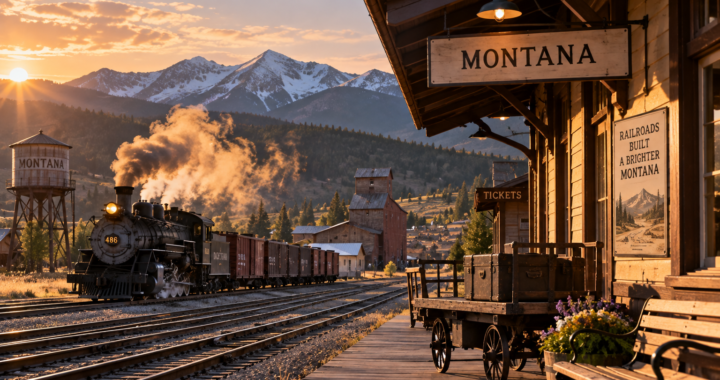

Long before highways carried most travelers across Montana, arriving in a town could mean stepping down from a passenger car onto a railroad platform.
The depot might be one of the first buildings a visitor saw.
Nearby stood hotels, warehouses, grain elevators, restaurants, stores, freight platforms, and businesses hoping to benefit from the constant movement of people and goods.
For residents, the station was more than somewhere to catch a train.
It was a connection to distant markets, relatives, newspapers, mail, employment, equipment, and communities hundreds of miles away.
That helps explain why Montana railroad depots occupied such important places in the development of many communities.
Railroads did not merely pass through Montana. They helped create towns, strengthen existing settlements, determine where businesses clustered, and influence how communities physically developed.
To understand many historic Montana towns, it helps to begin at the tracks.
Montana Railroad Depots Were Gateways to a Much Larger World
It is difficult to appreciate the significance of a railroad depot without considering transportation before widespread rail service.
Travel across Montana could be slow, difficult, and dependent on weather, roads, horses, stagecoaches, or river transportation.
Railroads changed the scale of movement.
Montana’s railroad era expanded significantly during the late nineteenth century. The Northern Pacific began operating across Montana in the 1880s, the Great Northern expanded through the state in the following decade, and the Milwaukee Road later completed its route across Montana in the early twentieth century.
With those lines came stations.
A depot connected a local community to a transportation network extending far beyond the town itself.
Passengers arrived and departed there.
Mail passed through.
Freight was received.
Agricultural products could be shipped outward.
Equipment and manufactured goods could arrive from distant markets.
News and visitors moved through the same point.
For a relatively isolated community, the depot represented connection.
Some Montana Towns Existed Because the Railroad Needed Them
Not every Montana community simply happened to have a railroad nearby.
In some cases, the railroad played a direct role in creating or expanding the settlement.
Railroad companies required operational points across long routes.
Locomotives needed servicing.
Crews needed facilities.
Freight needed to be organized.
Equipment required maintenance.
Water, fuel, repair facilities, switching operations, and administrative functions all needed locations.
The Montana Historical Society identifies communities including Forsyth, Livingston, Harlowton, Glasgow, Havre, and Lima as places that developed as railroad maintenance or operating centers.
The railroad was therefore not simply another local business.
In communities like these, railroad activity could become one of the reasons the town existed in the form it did.
The Depot Became a Natural Center of Activity
Imagine a new railroad stop surrounded by relatively little development.
Passengers begin arriving.
Freight begins moving through.
Workers need housing.
Travelers need meals.
Farmers need places to ship products.
Merchants want access to incoming goods.
Hotels want to be close to passengers.
Warehouses need access to freight.
Businesses naturally begin positioning themselves near this activity.
Over time, streets appear.
Commercial buildings follow.
Residential areas expand.
The station becomes an anchor.
This helps explain why old railroad corridors remain visible in the geography of many Montana communities even when passenger trains no longer stop there.
The depot may have disappeared.
The economic gravity it created can remain embedded in the town.
A Railroad Could Shape the Street Grid
When looking at an old Montana town from above, the railroad can sometimes explain why the streets look the way they do.
Rail lines rarely cared about creating perfectly symmetrical town grids.
Engineers were concerned with practical transportation considerations such as terrain, grades, curves, river valleys, and efficient routes.
The community then developed around that infrastructure.
Some streets ran parallel to the tracks.
Others approached the depot.
Commercial areas emerged nearby.
Industrial land clustered around freight access.
Residential neighborhoods developed farther away.
This relationship between transportation and urban form was not unique to Montana, but it became especially important across a large state where rail connections dramatically affected settlement and commerce.
Main Street and the Railroad Were Often Closely Connected
Today, people often imagine Main Street as the obvious center of a small town.
Historically, however, the relationship between Main Street and the railroad could be extremely close.
Montana’s historic preservation materials note that small-town Main Streets were often located along or perpendicular to railroad lines, with features such as grain elevators standing near rail stations.
That arrangement made practical sense.
Businesses wanted access to customers arriving by train.
Hotels benefited from being close to the depot.
Freight-related businesses needed access to rail infrastructure.
Travelers stepping off a train needed food, lodging, transportation, and supplies.
The railroad could therefore influence not only where the town developed but also where its commercial center formed.
The Station Was Both Passenger Terminal and Community Landmark
A railroad depot had an unusual role.
It was functional infrastructure, but it could also become one of the most recognizable public buildings in town.
Residents repeatedly encountered it.
Someone might visit to meet a relative.
Another person might leave for employment elsewhere.
A family could arrive to begin a new life.
Business owners waited for shipments.
Railroad employees reported for work.
Travelers passed through without staying.
The depot became a place associated with both ordinary routines and major life transitions.
That gave the building cultural importance beyond its physical size.
Passenger Trains Changed the Meaning of Distance
Before fast transportation networks, distance affected almost every aspect of life.
A place could be geographically close yet difficult to reach.
Railroads changed that relationship.
Once communities were connected by scheduled train service, movement became more predictable.
A traveler could plan around timetables.
Mail could move more efficiently.
Businesses could communicate with distant suppliers.
People could visit communities that previously required far more difficult journeys.
For Montana residents, the railroad helped connect a vast landscape.
The depot was where that larger network became locally accessible.
Freight May Have Been Even More Important Than Passengers
Historic photographs often make passenger trains the most visually memorable part of railroad history.
But freight was fundamental to the economic importance of railroads.
Montana produced commodities that needed transportation.
Agriculture, timber, livestock, and mining all depended heavily on the ability to move material efficiently.
At the same time, Montana communities needed goods from elsewhere.
Building materials.
Machinery.
Household products.
Food.
Tools.
Fuel.
Commercial inventory.
Railroads connected producers and consumers across enormous distances.
A depot and its surrounding freight facilities therefore represented access to markets, not merely transportation for travelers.
Grain Elevators Reveal the Railroad’s Agricultural Role
One of the clearest visual reminders of this relationship can still be seen across parts of Montana.
Grain elevators often stand beside railroad corridors.
Their location was practical.
Farmers brought grain to local collection points.
The grain could then be loaded onto railcars and transported to larger markets.
This created a recognizable pattern across agricultural communities:
Railroad tracks.
Depot.
Elevator.
Commercial district.
Nearby farms supplying the system.
Even where trains no longer stop regularly, an old elevator beside abandoned or lightly used tracks can reveal how the local economy once functioned.
The landscape itself becomes a historical document.
Railroads Did More Than Serve Settlers—They Helped Attract Them
Railroad companies needed customers.
A rail line crossing sparsely populated land would be more profitable if communities and farms developed along it.
That gave railroad companies a strong incentive to encourage settlement.
The Milwaukee Road, Northern Pacific, and Great Northern promoted Montana to prospective settlers.
Advertising campaigns presented opportunities for agriculture, business, and new lives in the West.
Railroad companies therefore participated in shaping migration as well as transportation.
They did not simply wait for towns to appear.
They had economic reasons to encourage them.
The Homestead Era Strengthened This Relationship
During the early twentieth century, homesteading brought large numbers of settlers into parts of Montana.
Railroad marketing played an important role in promoting agricultural opportunities.
Prospective settlers could encounter promotional material describing available land and the possibilities of farming in the region.
The railroad benefited when settlement increased.
New farmers needed transportation.
They ordered equipment and supplies.
They shipped crops.
Families traveled.
New communities generated freight and passenger traffic.
The relationship could become self-reinforcing:
Railroad access encouraged settlement.
Settlement created more railroad business.
Some Towns Were Platted by Railroad Interests
Railroad influence could become extremely direct.
Companies or affiliated land businesses sometimes acquired property and laid out towns along new routes.
That meant the arrival of the railroad could determine where streets, lots, and commercial districts would be located before a mature community even existed.
This was transportation planning and real-estate development happening together.
A station needed surrounding activity.
Land near the railroad gained value.
Businesses needed lots.
Workers needed homes.
Railroad-related development could therefore leave a permanent physical footprint.
Long after the original company disappeared, the basic layout might survive.
A Depot Could Determine Which Side of Town Became Commercial
Location mattered.
Imagine a railroad crossing near an existing settlement.
Where should businesses move?
A merchant wants to be near arriving customers.
A hotel wants to be visible from the station.
A warehouse wants convenient freight access.
Restaurants want travelers.
Transportation services want passengers.
The economic pull toward the depot could gradually shift the center of activity.
In some places, the railroad strengthened an existing commercial area.
In others, it created competition between an older settlement center and a newer district closer to the tracks.
Transportation infrastructure could literally change where the town’s center of gravity was located.
Hotels Often Followed the Tracks
Travelers arriving by rail needed somewhere to stay.
This created obvious opportunities for hotels and boarding houses.
Location mattered enormously.
A hotel close to the depot could advertise convenience without needing modern transportation connections.
A passenger arriving late did not want to travel far through an unfamiliar town.
Railroad workers also needed temporary accommodation.
Business travelers passed through.
Tourists arrived.
The depot generated a steady stream of potential customers.
That is why historic hotel buildings are often important pieces of railroad-town architecture.
Restaurants and Saloons Benefited From Passenger Traffic
The same logic applied to food and entertainment.
Travelers needed meals.
Railroad workers needed places to eat between shifts.
Passengers waiting for connections had time to spend.
Businesses clustered where people naturally gathered.
A station could create predictable waves of activity tied to train schedules.
The arrival of a train might temporarily transform the atmosphere around the depot.
People gathered.
Hotel staff prepared.
Carriages waited.
Freight was handled.
Mail changed hands.
Restaurants received customers.
Then the train departed and the platform became quiet again.
The town’s daily rhythm could partly follow the timetable.
The Telegraph Made Stations Information Centers
Railroads were closely associated with another transformative technology: telegraph communication.
Stations frequently served as communication points as well as transportation facilities.
Railroad operations themselves depended on rapidly transmitting information.
Train movements had to be coordinated.
Operational messages traveled between stations.
For communities, this infrastructure helped reduce informational isolation.
The station therefore connected a town in two ways:
Physically through the railroad.
Informationally through communication networks associated with it.
The depot was part of a much larger technological system.
Railroad Jobs Created Stable Communities
Railroads required large workforces.
Engineers.
Firemen.
Conductors.
Brakemen.
Telegraphers.
Station agents.
Section crews.
Maintenance workers.
Shop employees.
Yard workers.
Clerks.
Many of these jobs were not temporary construction positions.
They were ongoing occupations.
A major railroad facility could support families for generations.
Workers bought homes.
Children attended local schools.
Families shopped in local businesses.
Employees joined churches, clubs, and civic organizations.
Railroad payroll circulated through the local economy.
The impact of a depot or rail yard therefore extended far beyond railroad property.
Larger Railroad Centers Needed Extensive Infrastructure
A small station might consist of a modest depot and limited freight facilities.
A major railroad town was different.
Large operating centers could include:
Roundhouses.
Repair shops.
Water facilities.
Fueling infrastructure.
Switching yards.
Freight houses.
Crew facilities.
Administrative buildings.
Storage tracks.
Employee housing.
A large railroad complex could occupy a significant portion of a community.
Towns such as Livingston, Havre, Harlowton, Laurel, and Whitefish became strongly associated with railroad operations in different periods.
Their history cannot be separated easily from the infrastructure that supported rail transportation.
Livingston Shows How a Railroad Could Define a Town
Livingston is one of Montana’s most recognizable railroad communities.
Its location became important to Northern Pacific operations and access toward Yellowstone.
Railroad employment and infrastructure helped shape the community’s development.
The town’s historic architecture still reflects this connection.
Livingston demonstrates an important principle:
Railroad history is not confined to locomotives.
It includes buildings.
Street patterns.
Hotels.
Commercial districts.
Worker neighborhoods.
Industrial spaces.
The railroad becomes part of the urban landscape.
Havre Developed Around Great Northern Operations
Northern Montana tells a similar story through a different railroad.
The Great Northern became one of the major transportation systems crossing the state.
Havre developed as an important operating center along the line.
Railroad activity brought employment and connected the community to the broader northern route across Montana.
The significance of such places extended beyond passenger service.
Maintenance and switching operations could provide long-term economic stability.
This helps explain why some railroad towns continued growing even as the character of rail transportation changed.
Harlowton Became Closely Associated With the Milwaukee Road
The Milwaukee Road added another major chapter to Montana railroad history.
Its transcontinental expansion reached across the state in the early twentieth century.
Harlowton became closely associated with the railroad and later with its electrified operations.
For decades, railroad activity shaped local employment and identity.
When a town depends heavily on one transportation company, however, that relationship creates vulnerability.
Changes in railroad operations can affect far more than trains.
They can affect businesses, population, employment, and property.
That became increasingly important as America’s transportation system changed during the twentieth century.
Not Every Railroad Town Had the Same Future
A railroad could create opportunity.
It could also create dependence.
If the company moved facilities, changed routes, reduced service, or abandoned a line, a community could lose an important part of its economy.
Some towns adapted successfully.
Others declined.
The Montana Historical Society’s history of Kalispell provides an especially interesting example.
Kalispell was founded in 1891 as a Great Northern railroad town.
But the railroad relocated its main route north in 1904.
For many railroad-dependent communities, losing the main line could have been devastating.
Kalispell survived and continued developing as a regional commercial and administrative center.
Its experience demonstrates that the railroad could create a town without permanently determining its future.
A Route Change Could Reshape an Entire Community
Railroads made decisions according to transportation economics.
A community might care deeply about maintaining service, but railroad companies considered operating costs, grades, distances, traffic, infrastructure, and network strategy.
If a route changed, businesses near the old station could lose traffic.
Hotels might receive fewer travelers.
Freight operations might disappear.
Railroad employees could relocate.
Property values might shift.
The same infrastructure that had helped a community grow could become less important surprisingly quickly.
That is one reason abandoned railroad landscapes can feel so dramatic.
They represent systems that once controlled enormous amounts of movement and economic activity.
Passenger Decline Changed the Role of the Depot
For decades, the railroad station was one of the primary gateways into many American communities.
Then transportation habits changed.
Automobiles became more common.
Highways improved.
Commercial aviation expanded.
Freight patterns changed.
Passenger rail service declined across much of the country.
The station gradually lost some of its everyday importance.
A building that had once welcomed multiple trains and crowds of travelers might eventually see little activity.
Some depots were demolished.
Others were abandoned.
Some found completely new purposes.
The Railroad Did Not Disappear From Montana
The decline of historic passenger depots should not be confused with the disappearance of rail transportation.
Freight rail remains important.
Rail corridors still move large quantities of goods through Montana.
Passenger rail also continues across the state’s northern corridor.
What changed was the relationship between many communities and their stations.
Modern freight operations often do not require the same kind of public-facing depot that historic passenger service did.
The transportation system can remain active even while the traditional station building loses its original function.
Why So Many Historic Depots Were Lost
Old depots can look charming today.
That does not mean communities always viewed them that way when rail service declined.
An unused station required maintenance.
Roofs deteriorated.
Heating cost money.
Vandalism could become a problem.
Railroad companies no longer needed certain buildings.
Land might be valuable for another purpose.
Demolition could appear cheaper than preservation.
Across the country, many historic railroad structures disappeared for these reasons.
Montana was not immune.
Once a depot was gone, however, recreating that physical connection to railroad history became impossible.
Why Surviving Montana Railroad Depots Matter
A surviving depot can reveal an extraordinary amount about a community.
Look at its location.
What stands nearby?
Where is Main Street?
Where are the oldest hotels?
Can you find a former freight area?
Are grain elevators nearby?
Where are the tracks?
How are surrounding streets oriented?
Even without entering the building, you can begin reconstructing how the town once functioned.
That makes Montana railroad depots valuable historical evidence.
They help explain relationships between transportation, architecture, commerce, and settlement.
Architecture Can Reveal the Importance of a Station
Not every depot looked alike.
Some were modest buildings serving small communities.
Others were substantial structures intended to represent the importance of the railroad and the city.
Architecture could communicate permanence.
A prominent station told travelers that they had arrived somewhere significant.
Larger depots might include passenger waiting rooms, ticket offices, baggage facilities, railroad offices, and other specialized spaces.
Smaller stations combined multiple functions into compact buildings.
Studying the structure can reveal the scale of activity it was designed to support.
Freight Areas Look Different From Passenger Areas
When exploring historic railroad landscapes, it helps to distinguish passenger infrastructure from freight infrastructure.
Passenger facilities prioritize people.
Platforms.
Waiting rooms.
Ticket offices.
Baggage areas.
Freight facilities prioritize goods.
Loading docks.
Warehouses.
Sidings.
Industrial buildings.
Stockyards.
Elevators.
A town might contain both.
Understanding those different functions makes the surrounding landscape easier to interpret.
The railroad was simultaneously a passenger network and an industrial transportation system.
Old Photographs Become Much More Useful When Compared With the Present
Historic railroad photographs are not merely pictures of trains.
They often contain enormous amounts of environmental information.
Look beyond the locomotive.
Notice:
Buildings behind the tracks.
Utility poles.
Street alignment.
Platforms.
Signs.
Warehouses.
People.
Vehicles.
Landscape features.
Industrial structures.
Then compare the photograph with the same location today.
Perhaps the depot survives but the freight house is gone.
Maybe the tracks remain but a hotel disappeared.
A parking lot might occupy the former rail yard.
A trail could follow an abandoned grade.
Historical comparison can transform an ordinary modern location into a much richer story.
Sanborn Maps and Historic Maps Can Reveal Hidden Railroad Landscapes
Maps are especially valuable for railroad research.
A modern visitor may see an empty field beside active tracks.
A historic map might reveal that the site once contained:
A roundhouse.
Turntable.
Freight house.
Stock pens.
Water tank.
Section house.
Warehouse.
Multiple sidings.
Railroad infrastructure could be extensive even when little survives above ground.
Maps help reconstruct what has disappeared.
They can also explain unusual property boundaries and street patterns that otherwise seem arbitrary.
Railroad Grades Can Survive After the Rails Are Gone
Steel rails can be removed.
Ties can disappear.
Bridges can be dismantled.
Yet the route itself may remain visible.
An abandoned railroad grade often requires substantial earthwork.
Cuts were made through hills.
Embankments crossed low ground.
Grades followed carefully selected routes through valleys.
These alterations can survive for decades.
From the ground or aerial imagery, a former railroad corridor may appear as a remarkably consistent line through the landscape.
Learning to recognize these features opens another way of reading Montana railroad history.
A Grain Elevator Without Active Tracks Still Tells a Story
Imagine driving through a small Montana community and seeing a tall wooden grain elevator beside an apparently unused rail corridor.
The building may seem isolated.
Historically, it was probably positioned very deliberately.
Its location connected local agriculture to regional and national transportation networks.
Farmers brought grain there because trains could carry it elsewhere.
The elevator therefore marks a point where local production met long-distance commerce.
Even when the transportation system changes, the building can preserve that relationship visually.
Old Hotels Can Point Toward a Missing Depot
Sometimes the railroad building itself is gone.
Other structures can still reveal where activity once centered.
A historic hotel near the tracks is a clue.
So is an unusually wide street approaching the railroad corridor.
Warehouses provide another clue.
Commercial buildings facing an apparently empty area may once have faced a busy station environment.
Historical landscapes are rarely erased completely.
Pieces remain.
The challenge is learning how to connect them.
Railroad History Is Also the History of Ordinary Workers
Locomotives naturally dominate railroad imagery.
They are large, mechanical, and visually dramatic.
But a railroad could not operate because of locomotives alone.
Thousands of individual decisions and tasks kept the system functioning.
Track needed inspection.
Telegraph messages needed transmission.
Switches needed operation.
Tickets needed selling.
Freight needed handling.
Engines needed repair.
Snow needed clearing.
Passengers needed assistance.
Stations needed management.
The history of Montana railroad depots is therefore also the history of station agents, telegraphers, section crews, engineers, conductors, maintenance workers, and their families.
The Railroad Created Daily Rhythms
Imagine living near a busy station before automobiles dominated transportation.
You might recognize trains by their schedule.
A whistle could announce an arrival.
Mail appeared after a particular train.
Travelers entered local businesses.
Workers changed shifts.
Freight activity increased.
The depot created rhythms that residents understood.
Time itself became closely associated with railroad schedules.
Reliable timetables were essential to coordinating trains across long distances.
The railroad brought a new kind of regularity to communities that depended on it.
The Station Was a Place of Arrivals and Departures
Railroad history often becomes most human at the platform.
People left Montana from these stations.
Others arrived.
Some were beginning jobs.
Some were visiting family.
Some were moving permanently.
Soldiers departed.
Students traveled.
Tourists arrived.
Workers relocated.
Families waited for loved ones.
Every depot accumulated thousands of individual stories that rarely appear in corporate railroad records.
That is one reason station buildings can carry such strong historical meaning even after their original transportation role ends.
They were places where personal history intersected with national infrastructure.
Tourism Added Another Dimension
Railroads were not only interested in workers, farmers, and freight customers.
They also promoted travel.
Montana’s landscapes offered powerful marketing opportunities.
Railroads advertised scenic destinations and encouraged visitors to experience the West by train.
Railroad companies developed tourism infrastructure and promoted destinations near their routes.
The Great Northern became particularly associated with travel to the Glacier region.
The Northern Pacific promoted access toward Yellowstone.
For many visitors, the station was therefore the beginning of a Montana experience rather than merely a transportation stop.
Depots Help Us Understand Why Towns Developed Where They Did
Modern transportation can obscure older geographic logic.
A highway bypass may now carry most traffic.
Shopping may have moved toward the edge of town.
The historic downtown may seem strangely positioned.
Then you find the old railroad corridor.
Suddenly the geography makes sense.
The town center was not necessarily built around today’s highway.
It was built around yesterday’s transportation system.
Understanding that distinction is essential when interpreting historic Montana communities.
The Tracks Can Explain Buildings That Otherwise Seem Out of Place
Why is there an enormous warehouse behind a quiet residential street?
Why does an old hotel face an empty lot?
Why is a grain elevator standing far from today’s commercial center?
Why does one street abruptly curve?
Why is there a long narrow strip of undeveloped land?
Railroad history may provide the answer.
Infrastructure leaves spatial fingerprints.
Even after the trains change or disappear, the town continues living around decisions made generations earlier.
Preservation Is About More Than Saving a Pretty Building
When a historic depot is preserved, the value is not simply architectural.
The building can help explain:
How the town developed.
How people traveled.
How businesses received goods.
Where workers were employed.
How agriculture reached markets.
How newcomers arrived.
How communication worked.
How the community related to the rest of the country.
Preserving railroad heritage therefore means preserving context.
A depot without its story is simply an old building.
Understanding its role reconnects it to the larger community.
Adaptive Reuse Can Give Depots Another Life
A former railroad station does not necessarily need to remain frozen in time.
Historic structures can sometimes find new purposes.
Museums.
Community spaces.
Visitor centers.
Offices.
Restaurants.
Other public uses.
Adaptive reuse can keep a building maintained while preserving important architectural features.
The exact solution depends on the structure, ownership, condition, and community.
But continued use often gives a historic building a stronger chance of surviving than abandonment.
Look Beyond Famous Railroad Towns
Montana railroad history is not limited to the largest operating centers.
Smaller communities can reveal equally interesting stories.
A modest depot foundation.
An abandoned grade.
A surviving grain elevator.
A former section house.
An old bridge abutment.
A street named Railroad Avenue.
Each can provide evidence.
The scale may be smaller, but the historical relationship is similar.
Transportation created opportunities, influenced settlement, and connected local communities to much larger economic systems.
Reading a Montana Railroad Town Starts With One Question
When visiting an old Montana town, ask:
Where were the tracks?
Then:
Where was the depot?
Where is Main Street in relation to it?
Where were the hotels?
Where did freight move?
Are elevators still standing?
Which streets follow the railroad?
Are there unusually large empty spaces near the corridor?
Where might the rail yard have been?
These questions can completely change how you see the town.
Instead of looking at isolated old buildings, you begin seeing a transportation system.
The Depot Was Only One Piece of a Larger Network
It is tempting to treat a surviving station as the entire railroad story.
But every depot belonged to something larger.
Tracks connected it to neighboring stations.
Telegraph systems connected operations.
Rail yards supported trains.
Maintenance facilities supported equipment.
Workers maintained infrastructure between communities.
Freight connected farms and mines to distant markets.
Passenger service connected families and businesses.
The station was the visible local doorway into this enormous network.
That is what made it so important.
Conclusion
Historic Montana railroad depots were never simply places where trains stopped.
They were gateways between local communities and a much larger transportation system.
Around them grew hotels, warehouses, grain elevators, businesses, streets, industrial facilities, and neighborhoods.
Railroads helped create some Montana towns and transformed others. They provided employment, encouraged settlement, carried agricultural and industrial products, transported passengers, and influenced where commercial districts developed.
Then transportation changed.
Passenger service declined in many places.
Railroad operations consolidated.
Some routes disappeared.
Depots were abandoned or demolished.
Yet the physical influence of the railroad often survived.
Look carefully at an old Montana town and you may still find it in the street grid, an aging hotel, an abandoned grade, a grain elevator beside the tracks, or a depot that has outlived the trains it was built to serve.
That is why Montana railroad depots remain so valuable to understanding the state’s history.
They show us something a locomotive photograph alone cannot:
how the railroad became part of the town itself.