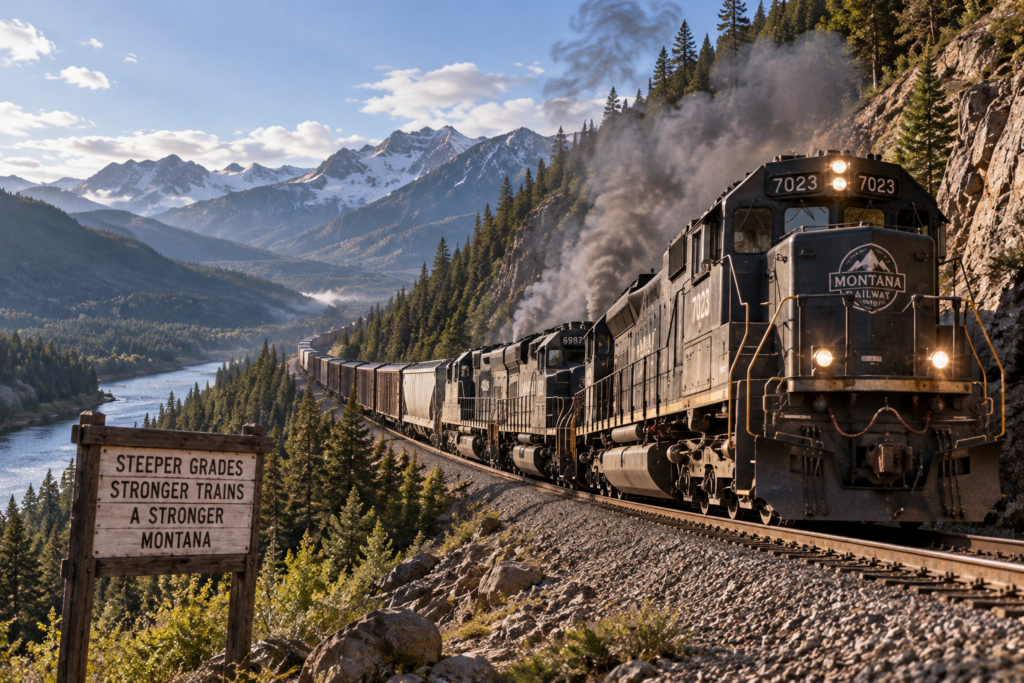
A long freight train approaches a mountain grade. The locomotive at the front is already working hard, yet before the climb begins, another locomotive is coupled to the train.
Sometimes it joins the front. On other routes, the extra engine is placed at the rear and pushes while the lead locomotive pulls.
Once the train reaches the top, that additional locomotive may be removed and sent back downhill to assist another train.
For generations of railroaders, this was a normal part of mountain operations. Helper locomotives on steep grades allowed railroads to move trains across terrain where a single locomotive could not provide enough usable pulling power to handle the load efficiently and safely.
A Railroad Grade Does Not Need to Look Steep to Matter
Road drivers may barely notice a gradual incline, but railroads operate under very different conditions.
Steel wheels rolling on steel rails produce relatively low rolling resistance, which makes rail transportation efficient on level track. The tradeoff is limited adhesion between the locomotive’s driving wheels and the rail.
As the track rises, gravity increasingly works against the train.
Even a grade that appears gentle can significantly increase the force required to move hundreds or thousands of tons uphill.
That is why railroad builders historically tried to avoid steep grades whenever geography and construction budgets allowed.
Mountains Created an Expensive Engineering Problem
Building a railroad through mountainous country required compromise.
Engineers could reduce the grade by following valleys, building longer approaches, cutting through hills, constructing bridges, or boring tunnels. But each solution increased construction difficulty and cost.
Sometimes a steeper section was unavoidable or economically preferable.
The railroad could build the route, but operations then had to adapt to the terrain.
A train that could travel comfortably across flatter territory might reach the mountain district and suddenly require considerably more locomotive power.
Why Not Simply Make Every Train Shorter?
Railroads could reduce the number of cars in each train.
Operationally, however, that had disadvantages.
If freight traffic was already assembled into long trains, dividing one train into several sections meant additional crews, locomotives, scheduling, and movements over the same route.
Instead, railroads could concentrate additional power where it was actually required.
A helper locomotive could assist a heavy train through the difficult section and then return to help the next one.
The locomotive therefore served a specific geographic problem rather than accompanying every train for its entire journey.
Helper Districts Developed Around Difficult Grades
On routes where assistance was regularly required, railroads established what became known as helper districts.
Extra locomotives and crews could be stationed near the bottom of a demanding grade.
When a heavy train arrived, a helper would be attached. The locomotives worked together through the difficult section, and after reaching the designated point, the helper could be detached.
It would then return to its base or become available for another assignment.
This turned mountain climbing into a repeatable operating system rather than an improvised solution.
A Helper Could Pull From the Front
One straightforward arrangement was placing additional locomotive power at the head of the train.
The helper and road locomotive could then pull together.
This concentrated the locomotives in one location and simplified some aspects of coordination, but it also meant the couplers near the front of the train had to transmit substantial pulling force through the cars behind them.
Train handling was not simply a question of adding horsepower.
Where the locomotives were positioned could affect how forces traveled through the train.
Other Helpers Pushed From the Rear
The image of a locomotive pushing against the back of a freight train became closely associated with mountain railroading.
Rear helpers added power while distributing some of the force differently through the train.
Instead of requiring all additional tractive effort to be transmitted from the front through every coupler, the rear locomotive contributed by pushing.
This could be useful on demanding grades, although successful operation required coordination between crews.
With locomotives working at opposite ends of a long train, careless changes in power could create undesirable forces between cars.
Some Trains Had Locomotives in the Middle
Additional locomotives were not limited to the front or rear.
Railroads also used locomotives positioned within the train in some circumstances.
This distributed power and could help manage the forces acting on a very long or heavy consist.
Modern distributed power technology has made locomotives placed throughout freight trains much more familiar, but the underlying operational problem is much older: long trains must be moved while keeping forces within manageable limits.
The technology changed dramatically.
The physics did not.
Horsepower Was Not the Only Thing That Mattered
It is tempting to describe a helper locomotive simply as “more horsepower.”
Railroad operations are more complicated.
A locomotive must turn its power into usable force at the rail without excessive wheel slip. Speed, locomotive design, adhesion, train weight, curvature, and grade all influence what can actually be accomplished.
For heavy low-speed climbing, tractive effort becomes especially important.
A powerful locomotive is useful only when that power can be effectively transferred to the rails.
Curves Could Make a Difficult Grade Even Harder
Mountain railroads rarely consisted of perfectly straight climbs.
Routes often curved around terrain as engineers searched for manageable paths through mountains and valleys.
Curvature adds resistance.
A train climbing a grade while simultaneously negotiating repeated curves therefore faces a more difficult task than the percentage of the grade alone might suggest.
This is one reason railroad operating rules and tonnage calculations could vary by route.
The physical characteristics of a specific district mattered.
Weather Could Change the Equation
Rail conditions were not constant.
Rain, snow, ice, leaves, and other contamination could reduce adhesion.
A locomotive that handled a particular train under favorable conditions might struggle when the rail became slippery.
Railroads developed several ways to improve adhesion, including applying sand to the rail near locomotive wheels.
But additional power could still be necessary when conditions made a difficult grade even more demanding.
Mountain operations had to account for both geography and changing weather.
Steam-Era Helper Service Was Labor Intensive
During the steam era, helper operations required more than an extra machine.
They required another locomotive crew.
The helper itself needed fuel, water, inspection, maintenance, and servicing. If it returned downhill after every assignment, that movement also had to fit into traffic on the line.
A busy helper district could therefore become a substantial railroad operation of its own.
Facilities and communities sometimes developed around locations where locomotives and crews were regularly needed.
The geography of the railroad helped shape the geography of railroad employment.
Steam Locomotives Made Mountain Railroading Dramatic
Mountain grades produced some of the most memorable scenes of the steam era.
Multiple locomotives could work a heavy train through a mountain district, producing smoke, exhaust, mechanical noise, and enormous visible effort.
But the spectacle had a practical purpose.
Railroads needed locomotives capable of producing high tractive effort at relatively low speeds.
This demand contributed to the use of large locomotive designs intended for heavy freight and mountain service.
Railroad technology was often shaped by the terrain it needed to conquer.
Communication Between Crews Was Essential
Imagine operating the locomotive at the rear of a long train when the engineer controlling the front locomotive may be hundreds or even thousands of feet away.
Both crews needed to understand what the train was doing.
Changes in speed and power had to be coordinated carefully.
Before modern radio communication became commonplace, railroaders relied on operating procedures and other communication methods available to them.
The challenge was not merely making every locomotive pull or push as hard as possible.
The entire train had to behave as one connected system.
Reaching the Summit Did Not End the Train-Handling Problem
The difficult climb eventually ended.
Gravity, however, did not disappear.
Once a train crossed a summit and began descending, the operational challenge changed from pulling a massive train uphill to controlling its movement downhill.
That required careful braking and train handling.
Historically, mountain railroading therefore demanded skill in both directions.
The same terrain that required extra power during the climb could create serious braking demands during the descent.
Dieselization Changed Helper Operations
Diesel-electric locomotives transformed railroad operations during the twentieth century.
Multiple diesel units could be connected and controlled together from one operating position, making it easier to combine locomotive power.
Railroads could assign several units to a train without requiring a separate crew in every locomotive.
That reduced some of the operational complexity associated with steam-era multiple-locomotive service.
Yet steep grades did not disappear when steam locomotives did.
Heavy trains still needed enough power and adhesion to cross them.
Distributed Power Changed Where Locomotives Could Work
Modern freight trains may operate with locomotives at the front and additional units farther back in the train or at the rear.
Electronic control systems allow these distributed power units to be controlled remotely.
This provides more than additional horsepower.
Distributing locomotives can help railroads manage forces through long trains rather than concentrating all pulling effort at the front.
In that sense, modern technology addresses some of the same fundamental problems that helper operations confronted generations earlier.
Traditional Helper Service Has Not Been Needed Everywhere Forever
Changes in locomotive capability, train planning, signaling, infrastructure, and distributed power have altered how railroads handle difficult territory.
Some places once famous for dedicated helper operations no longer function the same way.
Other routes still require special consideration because of grades and train weight.
This is an important distinction when looking at railroad history.
A practice may disappear not because the physical problem vanished, but because technology found a different way to solve it.
Old Railroad Routes Still Reveal the Problem
Historic railroad grades can make more sense when you understand helper operations.
A former engine facility near the base of a mountain may not have been located there by accident.
A railroad town may have supported crews whose work was closely connected to the grade.
Operational landmarks that seem insignificant on a modern map may once have been essential to moving freight.
Railroad history is often preserved not only in locomotives and stations, but in the relationship between infrastructure and terrain.
Montana Made Grade Management Especially Important
Montana’s railroad history is inseparable from geography.
Long distances, mountain ranges, valleys, winter weather, and important routes crossing the northern Rocky Mountain region created substantial engineering and operating challenges.
Railroads had to think carefully about grades when deciding where tracks would run and how trains would be operated across difficult territory.
For someone studying historic railroads in Montana, understanding grades helps explain why certain routes, facilities, locomotive assignments, and operating practices developed where they did.
The landscape was not simply scenery around the railroad.
It was one of the forces shaping the railroad itself.
Conclusion
Helper locomotives on steep grades existed because a train that could operate normally across relatively level track could require significantly more tractive effort once it reached difficult terrain.
Instead of permanently reducing every train or carrying unnecessary locomotive power across an entire route, railroads could place additional engines where the problem was greatest. Helpers might pull from the front, push from the rear, or work from another position in the train.
Steam gave way to diesel-electric power, and modern distributed power changed the way locomotives can be controlled. Yet the underlying challenge remains recognizable.
A railroad may look like two simple steel rails stretching across the landscape.
But when those rails begin climbing a mountain, a small change in elevation can transform the entire way a train must be operated.
